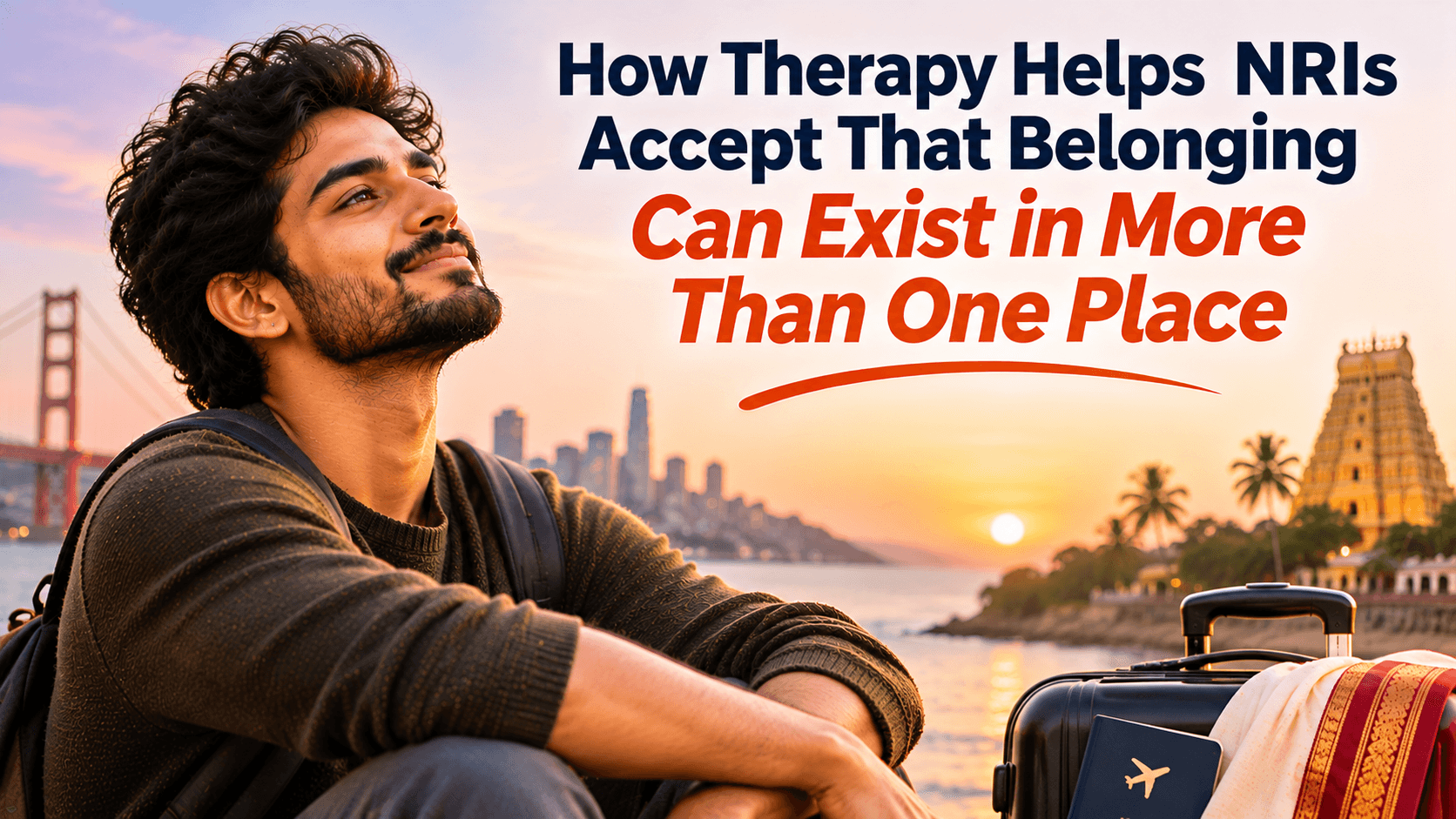
How Therapy Helps NRIs Accept That Belonging Can Exist in More Than One Place
How Therapy Helps NRIs Accept That Belonging Can Exist in More Than One Place
Focus: Migration identity, home, cultural belonging, acceptance
Living abroad can create a complicated relationship with the idea of home. You may build a meaningful life in another country, develop friendships, create routines, grow professionally, and begin feeling settled. Yet a part of you may still feel deeply connected to India, your family, your language, your food, and the version of yourself that existed before you left.
For many NRIs, this creates an emotional question that does not have a simple answer: “Where do I really belong?”
At India Therapist, many NRIs come to therapy because they feel caught between two places. They may feel guilty when life abroad starts feeling like home, but also strangely disconnected when they return to India. Therapy can help you understand that belonging does not always require choosing one place over another. You can build emotional roots in more than one culture, more than one community, and more than one version of home.
Why Migration Can Change Your Sense of Home
Before moving abroad, home may have felt obvious. It was the place where your family lived, where you grew up, where people spoke your language, and where many cultural traditions felt automatic.
Migration changes that certainty.
Over time, the country you moved to may become connected to your work, independence, relationships, routines, and adult identity. You may begin feeling comfortable there in ways you never expected.
A therapist in India can help you understand that this shift does not mean you have forgotten where you came from. It may simply mean your definition of home has expanded.
You May Feel Guilty When Life Abroad Starts Feeling Normal
Many NRIs experience guilt when the foreign country stops feeling foreign.
You may notice that you miss your own apartment when you travel to India. You may prefer your routine abroad. You may feel relieved to return after a long visit home.
These feelings can be confusing.
You may think, “How can I miss this place more than India?” or “Does this mean I am becoming disconnected from my family?”
An Indian therapist online can help you understand that comfort is not betrayal. Becoming attached to the life you built abroad does not erase your connection to India.
Returning to India May Not Feel Exactly Like Coming Home
One of the most surprising experiences for NRIs is returning to India and realizing that home feels different.
The streets may be familiar. The food may taste the same. Your family may still be there. Yet you may notice that your habits, expectations, schedule, or way of thinking have changed.
You may feel deeply connected and slightly out of place at the same time.
This can create grief because you expected returning home to feel effortless.
Therapy helps you understand that both you and the place you left have changed. Home may still matter deeply without feeling exactly the way it once did.
You Can Feel Homesick in Both Directions
Migration can create a strange form of double homesickness.
When you are abroad, you may miss family, festivals, language, food, familiar places, and the feeling of being culturally understood.
When you visit India, you may miss your privacy, routine, friendships, work environment, independence, or home abroad.
This can leave you feeling as if you are never completely satisfied in either place.
Therapy in India can help you stop treating this as evidence that something is wrong with you. It may simply reflect the reality that your emotional life now exists across more than one place.
Cultural Belonging Can Become More Complex
Living abroad often changes the way you relate to your culture.
Some traditions may become more important because they help you stay connected to identity. You may celebrate festivals more intentionally, cook familiar foods, seek Indian communities, or speak your language more often at home.
At the same time, you may adopt values, habits, or perspectives from the country where you live.
This can sometimes create tension when you return to India. Family members may say you have changed, while people abroad may still see you primarily through your Indian identity.
Therapy helps you create space for a more complex identity. You do not have to fit perfectly into one cultural category.
Family May Not Fully Understand the Person You Became Abroad
Your family may remember the version of you who left India. But living abroad can change you.
You may become more independent, direct, private, or comfortable making decisions without family involvement. You may develop different expectations around relationships, work, parenting, finances, or personal boundaries.
When you return home, family dynamics may pull you toward an older version of yourself.
Therapy can help you understand the discomfort that comes from moving between these identities. You can remain connected to your family without pretending that migration did not change you.
Belonging Is Not the Same as Fitting In Perfectly
Many people assume that belonging means feeling completely comfortable and understood.
But belonging can be more flexible than that.
You may belong to your family even when you disagree with them. You may belong to India even if you no longer understand every social expectation. You may belong in another country even if you sometimes feel culturally different from the people around you.
Therapy helps you separate belonging from perfect sameness.
You do not have to be identical to everyone around you in order to feel connected.
You May Feel Pressure to Choose One Identity
People may ask, “Where is home now?” or “Are you planning to stay abroad permanently?”
These questions can create pressure to give a clear answer when your emotional reality is much more complicated.
You may genuinely feel connected to both places.
Therapy helps you become more comfortable with an answer that is not absolute.
Your life does not have to fit into a simple choice between “India” and “abroad.” You can have multiple communities, identities, and emotional homes.
Migration Can Create Grief Without Regret
You can be grateful for your life abroad and still grieve what migration cost you.
You may miss watching your parents age, everyday time with siblings, childhood friendships, or the feeling of being surrounded by people who understand your cultural references without explanation.
That grief does not mean moving abroad was a mistake.
At the same time, you can love India and still appreciate opportunities, relationships, or freedom you found elsewhere.
Therapy helps you hold both gratitude and grief without forcing one emotion to cancel the other.
Creating New Traditions Can Strengthen Belonging
Belonging often becomes easier when you stop waiting for one place to feel exactly like the other.
You may create your own traditions abroad. You might celebrate festivals with friends, cook family recipes, teach children your language, call parents during important occasions, or combine Indian traditions with aspects of your current culture.
These traditions can create continuity between different parts of your identity.
At India Therapist, culturally sensitive therapists in India and Indian therapists online can support NRIs who are navigating migration identity, cultural belonging, family expectations, homesickness, and the emotional complexity of living between countries.
How Therapy Helps With Migration Identity
Therapy gives you space to explore questions that may feel difficult to discuss with family or friends.
You can talk about missing India without being told to move back. You can talk about loving your life abroad without being made to feel guilty. You can explore how migration changed your values, relationships, and identity.
Therapy can help you:
process migration grief
reduce guilt about feeling at home abroad
understand cultural identity changes
navigate family expectations
cope with reverse culture shock
manage homesickness
create meaningful traditions
develop a more flexible sense of belonging
The goal is not to choose one identity. It is to become comfortable with the complexity of who you have become.
Your Relationship With India Can Change Without Disappearing
You may no longer experience India exactly as you did before migration.
Certain routines may feel unfamiliar. Some values may no longer fit you. Visits may feel emotionally intense rather than completely relaxing.
But your connection to India can still remain meaningful.
Belonging can evolve.
You may relate more strongly to language, family, food, music, traditions, childhood memories, or specific places rather than feeling connected to every part of life in India.
That does not make your belonging less real.
Your Life Abroad Does Not Have to Replace Your Life in India
Building roots abroad does not require cutting roots elsewhere.
You can create friendships, routines, a career, a home, and a family abroad while still maintaining emotional connection with India.
The two parts of your life do not need to compete constantly.
Therapy helps you move away from the question, “Which place matters more?” and toward the question, “How can I stay connected to the parts of both places that matter to me?”
Home Can Become a Feeling Rather Than a Single Location
As migration becomes part of your identity, home may stop being one geographical point.
Home may be the language you speak with your parents. It may be your apartment abroad. It may be a childhood street in India, a friend group in another country, a family recipe, or the person you feel safest with.
Your sense of home can become layered.
This does not mean you are rootless.
It may mean you have developed roots in more than one place.
Acceptance Means Allowing Yourself to Belong Fully
Sometimes NRIs live emotionally between countries because they are afraid that fully belonging somewhere new means betraying where they came from.
But belonging does not have to work like a limited resource.
You can love the place you came from and the place you built your life. You can carry multiple cultures without needing to prove which one is more authentic.
Therapy helps you move from “I have to decide where I truly belong” to “My identity has grown across places, and I am allowed to belong to more than one home.”
Ready to talk to someone who understands?
Connect with an Indian therapist who speaks your language and understands your cultural context.