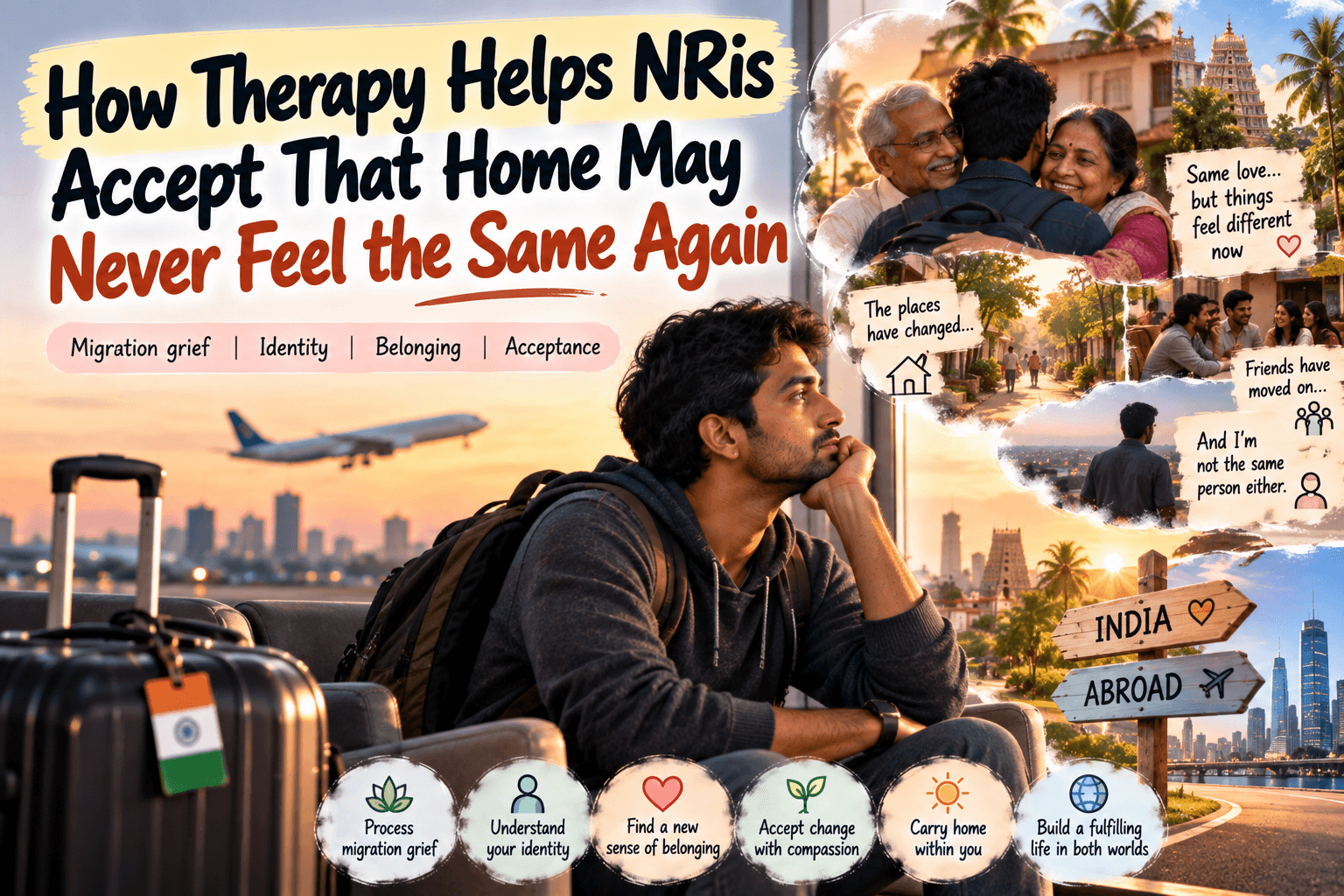
How Therapy Helps NRIs Accept That Home May Never Feel the Same Again
How Therapy Helps NRIs Accept That Home May Never Feel the Same Again
Focus: Migration grief, identity, belonging, acceptance
For many NRIs, “home” is not just a place. It is family, language, food, memories, routines, festivals, familiar streets, and the version of yourself that existed before you moved abroad. But after years of living in another country, returning home can sometimes feel unexpectedly different.
You may look forward to visiting India for months, only to arrive and feel strangely disconnected. The house may be the same, but your relationship with it has changed. Your parents may have new routines, friends may have moved on, neighborhoods may look different, and even you may no longer feel like the same person who once lived there.
At India Therapist, many NRIs seek therapy because they feel guilty admitting that home no longer feels completely like home. Therapy can help you understand migration grief, identity changes, and the emotional complexity of belonging to more than one place while feeling completely rooted in neither.
Why Home Can Feel Different After Living Abroad
When you move abroad, your life changes slowly. You develop new routines, friendships, habits, expectations, and ways of thinking. At first, you may still imagine India as a fixed place waiting for you exactly as you left it.
But home changes while you are away too. Parents get older, siblings build their own lives, friendships evolve, neighborhoods develop, and family routines shift. When you return, you are meeting a changed version of home with a changed version of yourself.
A therapist in India can help you recognize that this sense of unfamiliarity is not a sign that you have forgotten where you came from. It is often a natural part of migration and personal growth.
The Grief of Losing the Home You Remember
Migration grief is not always about missing India while living abroad. Sometimes it appears when you return and realize that the home you carried in your memory no longer exists in exactly the same way.
You may miss the version of your parents who were younger, the friendships that once felt effortless, or the daily routines that made you feel deeply connected. You may even miss the version of yourself who once belonged without thinking about it.
This can create a quiet kind of grief. You are not grieving a place that disappeared completely. You are grieving a feeling that has changed.
An Indian therapist online can help you name this experience instead of dismissing it as being ungrateful or overly emotional.
Why You May Feel Like a Visitor in Your Own Home
One of the most painful experiences for NRIs is feeling like a guest in the house they still call home. Your room may have changed. Parents may have developed routines that do not include you. You may need to ask where things are or adjust to the way the household now functions.
Relatives may treat your visit like a special event instead of everyday family life. Friends may need appointments to meet instead of simply showing up. Even familiar places may feel slightly foreign after years away.
These experiences can trigger the thought, “Do I still belong here?”
Therapy helps you understand that belonging can change without disappearing. Your role within the family may be different, but different does not mean less meaningful.
Living Abroad Can Change Your Identity
Migration often affects identity in ways you do not notice at first. You may adopt new ways of communicating, working, parenting, socializing, or thinking about independence. When you return to India, people may notice these changes before you do.
Someone may say, “You have changed,” or “You have become too foreign.” Even casual comments can make you question where you belong.
At the same time, when you return abroad, you may still feel deeply Indian and emotionally connected to home. This can create an identity that exists between cultures rather than entirely inside one.
NRI counselling mental health support can help you understand that identity does not have to be either-or. You can belong to India and still be shaped by the country where you now live.
Why Guilt Can Make Acceptance Harder
Some NRIs feel guilty when home begins to feel unfamiliar. You may think, “How can I feel disconnected from my own family?” or “Why does my life abroad sometimes feel more comfortable?”
That guilt can make you force yourself to recreate old feelings. You may expect every India visit to feel deeply emotional or every family gathering to immediately make you feel at home again.
But belonging cannot always be forced.
Therapy helps you accept that emotional connection can change without meaning that love has disappeared. You can love your family deeply while recognizing that your everyday life now exists somewhere else.
Friendships May Not Feel the Same Either
Another part of migration grief involves friendships. People you once spoke to every day may now have spouses, children, careers, and responsibilities that have changed their lives. When you meet again, there may still be warmth, but the closeness may feel different.
This can be difficult because old friendships often represent the life you had before migration. When those relationships change, it can feel like another piece of home has disappeared.
Therapy helps you grieve these changes without assuming the friendship was meaningless. Some relationships belong deeply to particular stages of life. Their form may change even when the history still matters.
How Therapy Helps You Redefine Home
Therapy can help you move away from the idea that home must be one place that feels exactly as it once did. Instead, you can begin asking what home means to you now.
Home may become:
the people with whom you feel emotionally safe
familiar foods, languages, and traditions
routines you carry with you
friendships spread across countries
the place where your current life is built
the family you return to even when the dynamic has changed
This broader definition can reduce the pressure to choose between India and life abroad.
Acceptance Does Not Mean Letting Go of Your Roots
Accepting that home feels different does not mean becoming disconnected from your culture. In fact, acceptance often creates a healthier way of staying connected.
Instead of constantly trying to recreate the past, you can build new traditions. You may celebrate festivals differently abroad, speak your language at home, cook family recipes, stay connected with relatives, or create routines that bring pieces of India into your everyday life.
Therapy in India can help you preserve what matters while also allowing your identity to evolve.
How Therapy Supports Migration Grief
Migration grief can involve homesickness, nostalgia, identity confusion, guilt, loneliness, and a sense of not fully belonging anywhere. Therapy gives you space to process these emotions without treating them as signs that you made the wrong decision by moving abroad.
Therapy can help you:
understand migration grief
process the loss of your old sense of home
reduce guilt about changing
explore cultural identity
adjust to changing family relationships
create belonging in more than one place
accept friendships and routines that have evolved
build a sense of home that reflects who you are now
At India Therapist, culturally sensitive therapists in India and Indian therapists online can support NRIs who feel caught between cultures, family expectations, nostalgia, and the reality of building a life abroad.
You Do Not Have to Choose One Place to Belong
Many NRIs spend years searching for the answer to one question: “Where is home now?” But perhaps home does not need to be a single answer.
India may always carry your history, family, language, and memories. Another country may hold your everyday routines, career, friendships, partner, children, or future. Both can matter.
Belonging does not always mean feeling completely rooted in one place. Sometimes it means learning how to carry multiple places inside your identity.
Therapy can help you stop seeing this as confusion and begin seeing it as a more complex form of belonging.
Home Can Change Without Disappearing
The home you remember may never feel exactly the same again. That realization can be sad. But it can also create space for something new.
You can build new relationships with your parents as adults. You can create different traditions with siblings and friends. You can allow India to become a place you return to differently rather than expecting it to remain frozen in time.
Most importantly, you can build a sense of home inside yourself.
Therapy helps you move from “I no longer know where I belong” to “My idea of home has changed, and I am allowed to belong in more than one place.”
Ready to talk to someone who understands?
Connect with an Indian therapist who speaks your language and understands your cultural context.