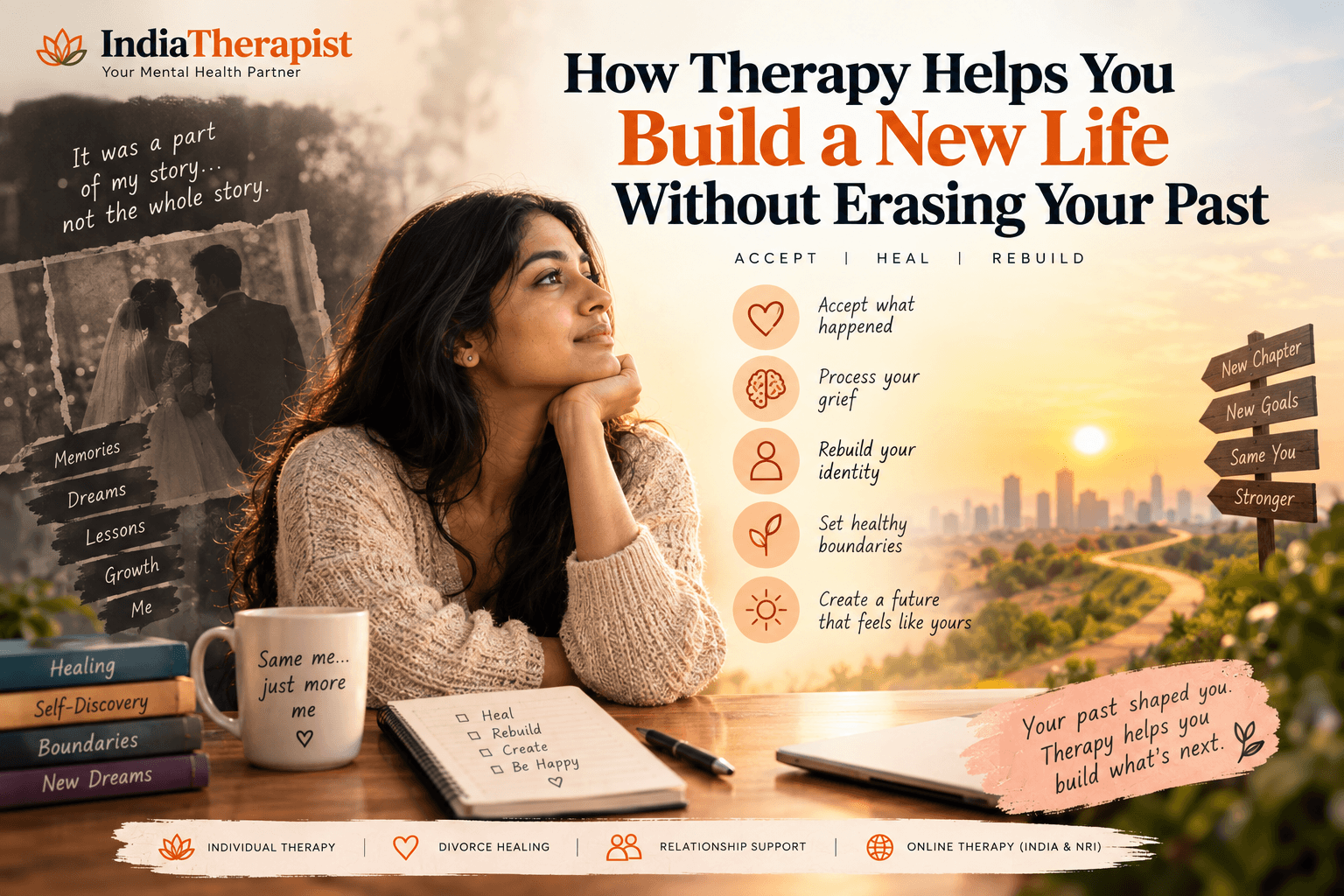
How Therapy Helps You Build a New Life Without Erasing Your Past
How Therapy Helps You Build a New Life Without Erasing Your Past
Focus: Acceptance, healing, rebuilding
Starting over after divorce or separation can feel like you are expected to erase an entire chapter of your life.
People may tell you to “move on,” “forget the past,” or “start fresh.” But healing does not mean pretending that your past never happened.
Your marriage, relationship, memories, disappointments, dreams, and difficult experiences were all part of your story. You do not have to erase them to build a better future.
Healing is about understanding what happened, accepting what you cannot change, learning from your experiences, and slowly creating a life that feels like yours again.
Why Starting Over Can Feel So Difficult
After divorce, life can suddenly feel unfamiliar.
Your daily routine may change. Your home may change. Your relationship with family and friends may change. Even simple decisions that once involved another person may now become decisions you have to make alone.
But the biggest change may happen internally.
You may start asking yourself:
Who am I now?
What does my future look like?
Can I really be happy again?
Did I waste those years?
Will I ever trust someone again?
What if I make the same mistakes?
These questions can create fear, confusion, sadness, and emotional exhaustion.
A therapist in India can help you explore these questions without judging you or rushing you toward a version of “moving on” that you are not ready for.
Moving On Does Not Mean Forgetting
One of the biggest misunderstandings about healing is that you have to forget your past.
You don't.
You may remember your marriage for many years. Certain songs, places, photographs, anniversaries, or family occasions may bring emotions back.
That does not mean you have failed to heal.
The goal is not to make the memories disappear. The goal is to reach a point where your memories no longer control your present.
You can remember something without reliving it.
You can acknowledge the pain without allowing it to define your identity.
You can appreciate the good parts of your past while accepting that the relationship has ended.
That is a much healthier form of moving forward.
Accepting What Happened
Acceptance does not mean saying that everything that happened was okay.
It means recognizing reality as it is.
Sometimes people spend years thinking about what they could have done differently.
“What if I had tried harder?”
“What if I had noticed the signs earlier?”
“What if things had changed?”
“What if we had stayed together?”
These questions are understandable, but constantly living inside them can keep you emotionally connected to a life that no longer exists.
Therapy can help you separate what you wish had happened from what actually happened.
That distinction can be painful, but it can also be freeing.
Rebuilding Your Identity
A long-term relationship can become deeply connected to your identity.
You may have been someone's husband or wife, someone's partner, someone's daughter-in-law or son-in-law, or part of a particular family structure.
After separation, you may suddenly wonder who you are without that role.
This can be especially difficult when your family or society continues to define you by your marriage.
Rebuilding your identity does not mean becoming a completely different person.
It means rediscovering yourself.
You can start asking:
What do I want now?
What matters to me?
What kind of relationships do I want?
What boundaries do I need?
What kind of life would make me feel fulfilled?
Therapy can provide a safe space to explore these questions and rebuild your sense of self.
You Don't Have to Carry the Past Alone
Sometimes healing becomes harder because people feel they have nobody they can truly talk to.
Friends may give advice.
Family members may tell you to forget everything.
Others may simply expect you to be strong.
But advice is not always the same as emotional support.
You may need someone who can simply listen to what happened and help you understand what you are feeling.
An Indian therapist can also help you explore the cultural and family expectations that may influence how you experience divorce, separation, relationships, and starting over.
When Family Pressure Makes Healing Harder
For many Indians, divorce does not affect only two people.
It can involve parents, relatives, children, social expectations, financial concerns, and questions about reputation.
You may hear things like:
“Why couldn't you adjust?”
“What will people say?”
“Maybe you should have tried one more time.”
“Don't think about yourself too much.”
These comments can create guilt even when you know that ending the relationship was necessary.
Therapy can help you understand the difference between taking responsibility for your choices and carrying responsibility for everyone's opinions.
You are allowed to build a life that is emotionally healthy for you.
Healing Does Not Have a Deadline
Some people feel frustrated because they expected themselves to feel better after a few months.
But emotional healing is not a straight line.
You may feel strong one day and deeply sad the next.
You may feel relieved about your decision and still miss certain parts of your old life.
You may feel excited about the future and afraid of it at the same time.
These emotions can exist together.
Healing does not require you to feel positive every day.
It means gradually becoming more comfortable with your emotions and learning how to move forward even when difficult feelings appear.
What Therapy Can Help You Rebuild
Therapy is not about erasing your past.
It can help you:
Understand and process painful experiences
Reduce guilt and self-blame
Rebuild confidence and self-worth
Develop healthier boundaries
Understand patterns in past relationships
Process grief and emotional loss
Reconnect with your identity
Learn to trust yourself again
Handle family and social pressure
Build healthier relationships in the future
With the right support, starting over can become less about “becoming someone new” and more about reconnecting with who you are.
Your Past Can Be Part of Your Story Without Being Your Future
You don't have to hate your past to move forward.
You don't have to forget your marriage.
You don't have to pretend that the relationship meant nothing.
And you don't have to erase the person you were before.
Your past can remain part of your story while you create something new.
The goal is not to erase where you have been.
It is to make peace with it so that it no longer prevents you from becoming who you want to be.
If you are struggling to move forward after divorce, separation, or a major relationship change, speaking with an Indian therapist online can give you a safe and private space to process what you are going through.
At India Therapist, you can connect with therapists who understand Indian family dynamics, relationships, cultural expectations, and the emotional challenges that can come with starting over.
You don't have to forget your past to heal from it.
Your past deserves acknowledgment. Your present deserves care. And your future deserves a chance.
Ready to talk to someone who understands?
Connect with an Indian therapist who speaks your language and understands your cultural context.