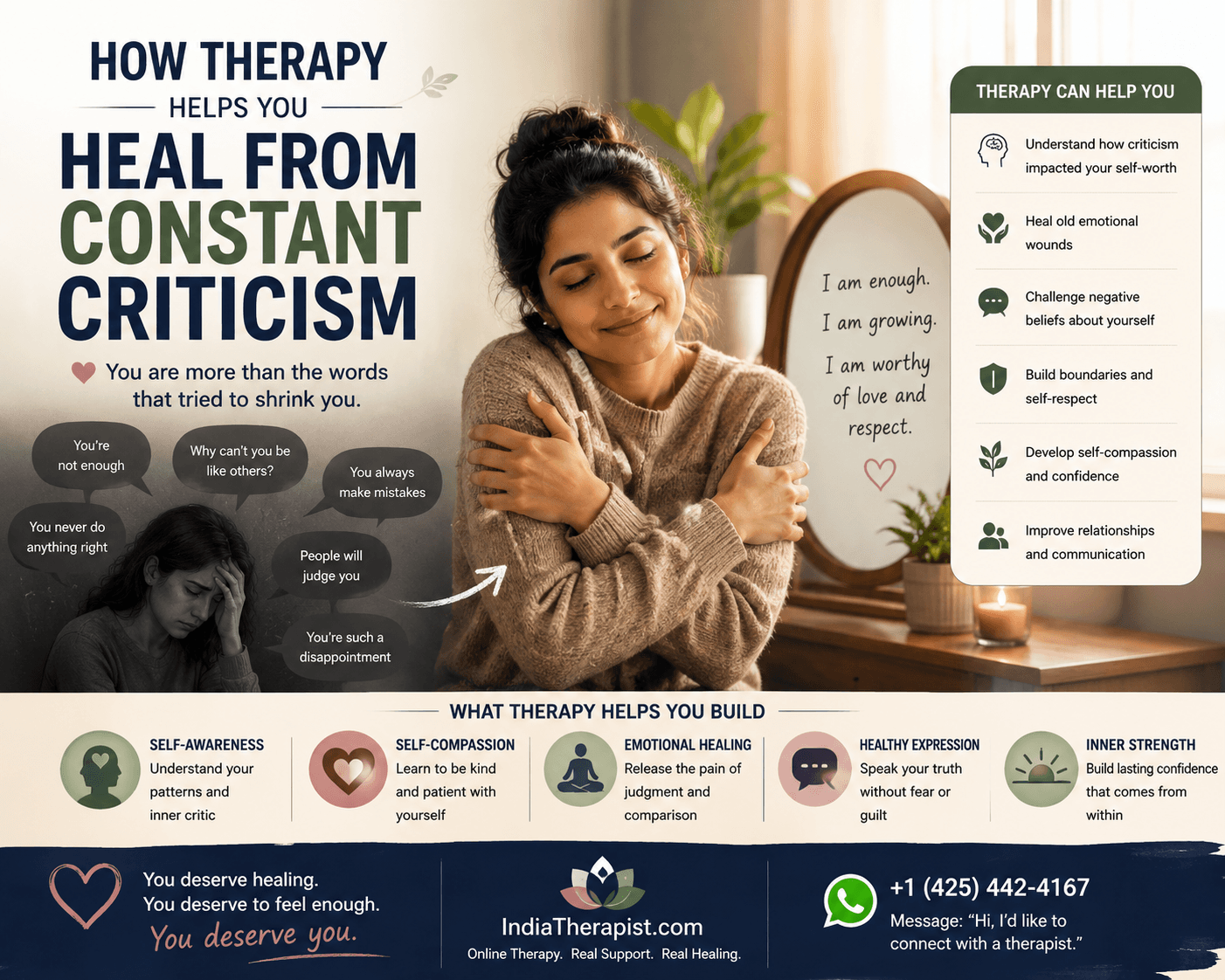
How Therapy Helps You Heal From Constant Criticism
How Therapy Helps You Heal From Constant Criticism
Constant criticism can quietly shape the way you see yourself. It may come from parents, teachers, partners, relatives, friends, or even your own inner voice. At first, criticism may sound like guidance. But when it happens repeatedly, it can turn into emotional pain, self-doubt, anxiety, and low self-worth.
Many people who grew up around criticism do not realize how deeply it affected them. They may believe they are simply “sensitive” or “not confident enough.” But the truth is, when someone is constantly judged, corrected, compared, or made to feel not good enough, their mental health and emotional wellbeing can suffer.
At India Therapist, many clients come to therapy saying, “I don’t know why I’m so hard on myself.” As therapy continues, they often discover that their inner critic was not born inside them — it was learned from years of being criticized.
Healing from constant criticism does not mean blaming your past forever. It means understanding how criticism shaped you, learning to separate your worth from others’ opinions, and rebuilding a kinder relationship with yourself.
How Constant Criticism Affects Mental Health
Criticism hurts most when it comes from people we expect love, safety, or approval from. When a child repeatedly hears comments like “You are not good enough,” “Why can’t you be like others?” or “You always make mistakes,” those words can slowly become part of their identity.
Over time, criticism can lead to anxiety, depression, overthinking, perfectionism, people-pleasing, and emotional exhaustion. A person may become afraid of making mistakes because every mistake feels like proof that they are not enough.
Many therapists in India see this pattern in adults who appear successful on the outside but constantly doubt themselves inside. They work hard, achieve goals, and still feel like they are falling short. This is often because the voice of criticism continues long after the critic is no longer present.
The Inner Critic: When Other People’s Words Become Your Own
One of the biggest effects of constant criticism is the development of a harsh inner critic. This is the voice inside that says, “You should have done better,” “You are not capable,” or “Everyone else is ahead of you.”
The inner critic can become so familiar that you stop questioning it. You may think it is your own truth, when it is actually a repeated emotional pattern.
Therapy helps you identify this voice. A therapist in India or an Indian therapist online can help you understand where this self-critical thinking came from and how it affects your confidence, relationships, and daily life.
You begin to realize that not every thought deserves to be believed.
Why Indian Family Criticism Feels So Personal
In many Indian families, criticism is often used as a way to motivate children. Parents may compare, correct, or push their children because they want them to succeed. While the intention may be care, the emotional impact can still be painful.
A child may grow up believing love is connected to performance. Good marks, good behavior, career success, marriage choices, and social approval may become linked to self-worth.
This can continue into adulthood. Even when people become independent, they may still carry the fear of disappointing family. For NRIs, this pressure can feel heavier because they are balancing life abroad with expectations from home.
This is why culturally sensitive therapy in India is important. Indian therapy understands that healing does not require rejecting family. It helps you respect your background while also protecting your emotional wellbeing.
The Link Between Criticism and Perfectionism
People who face constant criticism often become perfectionists. They believe that if they do everything perfectly, they can avoid judgment, rejection, or shame.
But perfectionism is exhausting. It creates constant pressure to perform, prove, and please. Even small mistakes can feel unbearable.
A person may spend hours overthinking a simple conversation, email, task, or decision. They may avoid trying new things because failure feels too risky.
Through therapy India services, clients learn that perfectionism is often a protection strategy. It is not about being disciplined; it is often about trying to feel safe.
Therapy helps you replace perfectionism with self-compassion, balance, and healthier standards.
How Criticism Affects Relationships
Constant criticism can also affect relationships. If you were criticized often, you may become highly sensitive to rejection or disapproval. You may over-apologize, avoid conflict, hide your needs, or try to keep everyone happy.
Some people become people-pleasers because they learned that being approved of feels safer than being honest. Others may become defensive because even gentle feedback feels like an attack.
In romantic relationships, criticism can create emotional distance. You may fear vulnerability because you expect judgment. You may struggle to believe compliments or accept care.
Relationship counselling India can help individuals and couples understand these patterns. Therapy helps people communicate with less fear, express needs clearly, and build healthier emotional safety.
How Therapy Helps You Heal
Therapy gives you a safe space to explore the emotional impact of constant criticism without minimizing your pain. A therapist helps you understand how criticism shaped your beliefs about yourself and teaches you how to rebuild self-worth.
Therapy can help you recognize self-critical thoughts, challenge negative beliefs, process childhood wounds, build emotional awareness, set boundaries, and practice self-compassion.
An Indian therapist online can be especially helpful for Indians and NRIs because cultural context matters. Many people are not only healing from criticism; they are also healing from comparison, family pressure, achievement pressure, and fear of judgment.
At IndiaTherapist.com, clients can connect with Indian therapists online and therapists in India who understand these emotional and cultural layers.
Healing the Voice Inside You
The goal of therapy is not to erase every painful memory. The goal is to change the way those memories control your present life.
You begin to notice when your inner critic is speaking. You learn to pause before believing it. You begin asking, “Is this thought true, or is this an old voice I learned?”
Slowly, the harsh voice becomes softer. You begin speaking to yourself with more patience. You stop treating every mistake like a failure. You learn that growth does not require self-punishment.
This is emotional healing.
For NRIs, Criticism Can Follow Across Borders
Many NRIs move abroad physically but continue carrying emotional patterns from home. Family expectations, comparison, marriage pressure, career pressure, and guilt can continue even from a distance.
Some NRIs feel they must prove that moving abroad was worth it. Others feel criticized for changing, becoming independent, or making choices that do not fit traditional expectations.
NRI counselling mental health support helps individuals process these struggles in a safe and culturally aware space. Speaking with an online Indian therapist allows NRIs to explore family criticism, identity stress, anxiety, and self-worth without feeling misunderstood.
You Are More Than the Criticism You Received
If you grew up with constant criticism, you may have spent years trying to prove your worth. But your worth was never something you had to earn.
You are allowed to make mistakes. You are allowed to grow slowly. You are allowed to choose peace over perfection. You are allowed to stop repeating the words that hurt you.
Therapy helps you rebuild the parts of yourself that criticism made you doubt.
At India Therapist, we believe healing begins when you stop seeing yourself through the eyes of those who criticized you and start seeing yourself with compassion.
📱 WhatsApp: +1 (425) 442-4167
💬 Message: “Hi, I’d like to connect with a therapist.”
Because you do not need more criticism to grow.
You need understanding, support, and healing.
Ready to talk to someone who understands?
Connect with an Indian therapist who speaks your language and understands your cultural context.