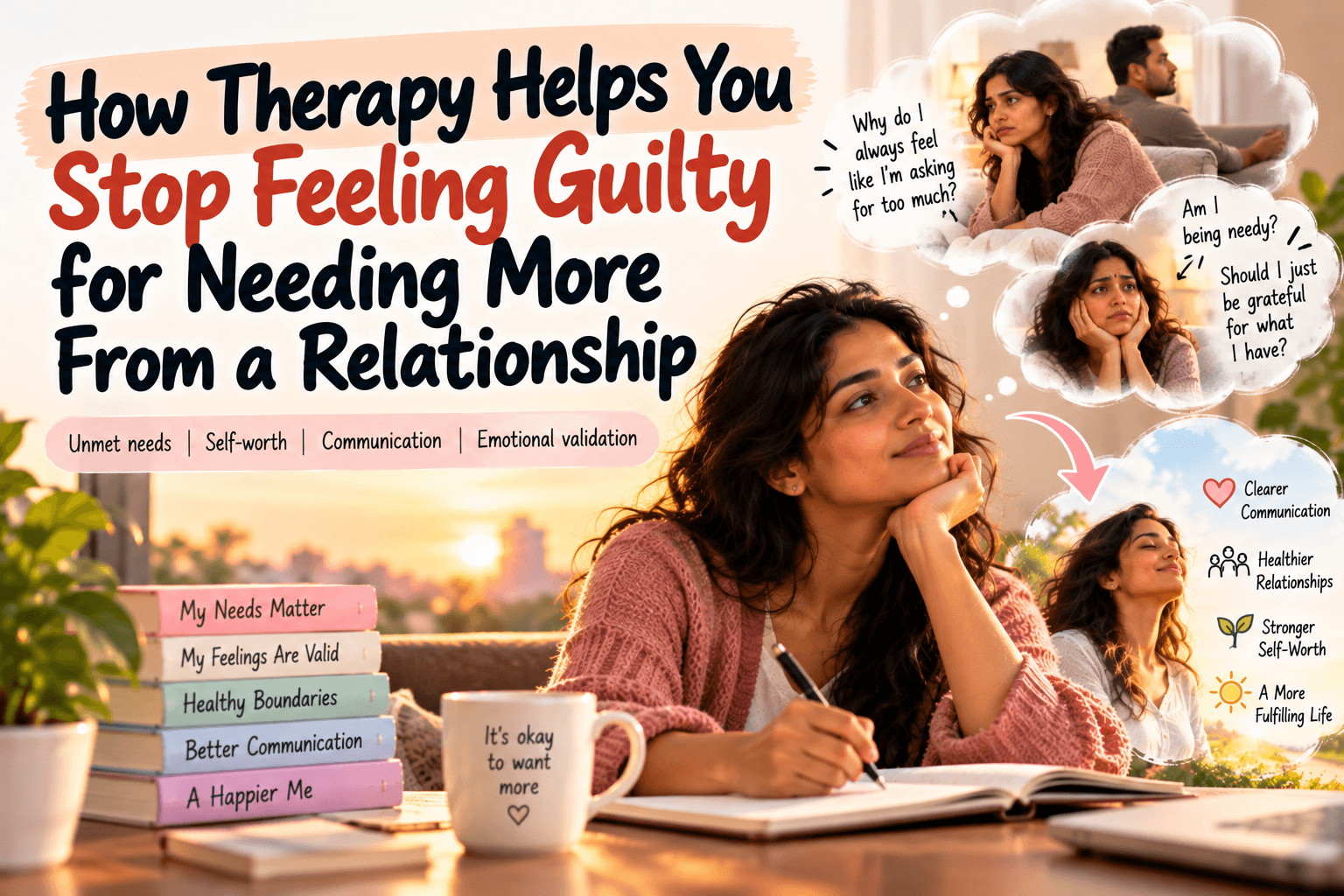
How Therapy Helps You Stop Feeling Guilty for Needing More From a Relationship
How Therapy Helps You Stop Feeling Guilty for Needing More From a Relationship
Focus: Unmet needs, self-worth, communication, emotional validation
Wanting more from a relationship can bring up a surprising amount of guilt. You may tell yourself that you should be grateful, that your partner is “good enough,” or that asking for more affection, communication, attention, or emotional support makes you demanding. Over time, you may minimize your own needs just to avoid conflict or disappointment.
At India Therapist, many people come to therapy because they are unsure whether their needs are valid. They may feel lonely inside a relationship but still blame themselves for wanting more. Therapy helps you understand that having emotional needs does not make you difficult. It helps you communicate more clearly, strengthen self-worth, and recognize whether the relationship has space for mutual care.
Why You May Feel Guilty for Having Needs
Many people learn early that being easy to love means not asking for too much. You may have been praised for being independent, understanding, low-maintenance, or emotionally strong. As a result, you may now believe that needing reassurance, affection, time, or deeper communication is a weakness.
This can lead to a pattern where you silence yourself before anyone else has the chance to respond. A therapist in India can help you recognize that emotional needs are not automatically excessive. The important question is not whether you have needs, but whether they can be communicated and understood in a healthy way.
Unmet Needs Can Slowly Turn Into Resentment
When needs go unspoken for too long, resentment often builds. You may continue showing up, supporting your partner, and keeping the relationship functioning while quietly feeling unseen.
At first, you may tell yourself that it is not a big deal. But over time, small disappointments can accumulate. You may become more irritable, emotionally distant, or tired of always being the one who adjusts.
Therapy helps you notice resentment before it becomes the only language left in the relationship. It gives you space to name what is missing and understand whether the issue is communication, incompatibility, or a deeper pattern of emotional neglect.
Wanting More Does Not Mean You Are Ungrateful
One of the biggest sources of guilt is the belief that if your partner has good qualities, you should not want anything else. But gratitude and unmet needs can exist at the same time.
You can appreciate that someone is loyal, hardworking, or caring and still feel that you need more emotional closeness. You can love someone and still feel lonely. You can recognize the good in a relationship without pretending that important needs do not exist.
An Indian therapist online can help you hold these truths together without turning your needs into shame.
Self-Worth Affects What You Believe You Deserve
If your self-worth is low, you may accept less than you actually need because you are afraid of being seen as difficult or ungrateful. You may think, “Maybe this is all I should expect,” or “Maybe I am asking for too much.”
This is especially common if you have experienced rejection, criticism, emotional invalidation, or inconsistent affection in the past. Over time, you may learn to expect disappointment and lower your standards before anyone else can.
Therapy helps rebuild self-worth so you can ask a different question: “What kind of relationship feels emotionally healthy and respectful for me?”
Communication Is More Than Just Speaking Up
Sometimes people do express their needs, but only after months of frustration. By then, the conversation may come out as anger, accusation, or withdrawal.
Therapy can help you communicate earlier and more clearly. Instead of saying, “You never care about me,” you may learn to say, “I feel disconnected when we do not spend meaningful time together.” That difference can make difficult conversations more productive.
Healthy communication is not about demanding that your partner meet every need perfectly. It is about being honest enough for both people to understand what is happening emotionally.
Emotional Validation Matters
Sometimes what you need most is not a solution. It is to feel understood. You may want your partner to listen, acknowledge your feelings, or show that your emotional experience matters.
When that validation is repeatedly missing, you may begin doubting yourself. You may wonder whether you are too sensitive or whether your feelings are unreasonable.
Therapy helps you understand that emotional validation does not mean everyone must agree with you. It means your experience can be acknowledged without being dismissed.
How Family and Cultural Expectations Can Complicate This
For many Indians, relationships are shaped by beliefs about adjustment, compromise, and maintaining harmony. You may have grown up hearing that good relationships require sacrifice or that asking for too much creates unnecessary conflict.
These values can be meaningful, but they can also make it difficult to recognize when compromise has become self-neglect. Therapy in India can help you separate healthy adjustment from constantly abandoning your own needs.
You can value commitment without believing that your emotional wellbeing should always come second.
Therapy Helps You Understand What You Actually Need
Sometimes people feel guilty because they do not even know exactly what is missing. They just know they feel dissatisfied, lonely, or disconnected.
Therapy helps you identify your emotional needs more clearly. You may discover that you need more affection, better communication, greater consistency, more shared responsibility, or simply the freedom to express yourself without fear.
Therapy can help you:
identify unmet emotional needs
build stronger self-worth
reduce guilt around asking for more
communicate more clearly
recognize emotional invalidation
strengthen boundaries
understand whether the relationship is mutually supportive
separate healthy compromise from self-abandonment
At India Therapist, culturally sensitive therapists in India and Indian therapists online can support people dealing with relationship dissatisfaction, emotional neglect, communication difficulties, and self-worth struggles.
Needing More Does Not Automatically Mean the Relationship Is Wrong
It is important to remember that unmet needs do not always mean a relationship should end. Sometimes the issue is communication. Sometimes both people are overwhelmed. Sometimes one person simply does not realize how disconnected the other feels.
Therapy can help you explore whether the relationship has room for change. It can also help you notice whether your needs have been expressed repeatedly without meaningful response.
The goal is not to label the relationship too quickly. The goal is clarity.
You Are Allowed to Want a Relationship That Feels Emotionally Fulfilling
You do not need to feel ashamed for wanting closeness, affection, attention, honesty, or emotional support. These needs do not make you needy or difficult.
You are also allowed to notice when a relationship consistently leaves you feeling unseen. Therapy helps you move away from asking, “Am I asking for too much?” and toward asking, “Are my needs being heard, respected, and taken seriously?”
At India Therapist, therapy can help you develop the confidence to express what you need without guilt and the clarity to understand whether the relationship can meet you there.
Therapy helps you move from “Maybe I should just be grateful for what I have” to “I can appreciate what is good and still be honest about what I need.”
Ready to talk to someone who understands?
Connect with an Indian therapist who speaks your language and understands your cultural context.