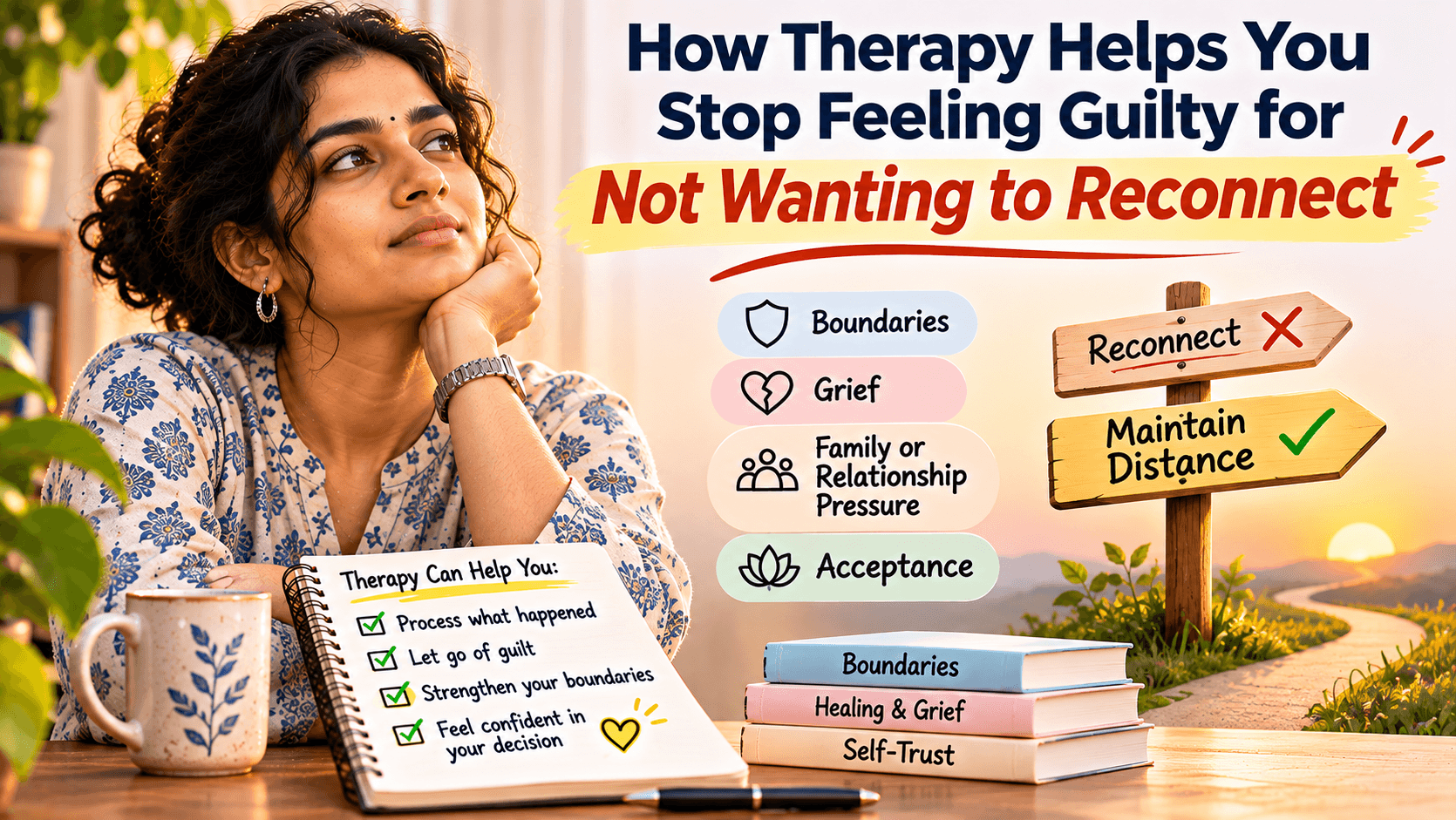
How Therapy Helps You Stop Feeling Guilty for Not Wanting to Reconnect
How Therapy Helps You Stop Feeling Guilty for Not Wanting to Reconnect
Focus: Boundaries, grief, family or relationship pressure, acceptance
Not every relationship needs to be repaired. Sometimes you have already spent months or years trying to understand what happened, giving second chances, rebuilding trust, or hoping the relationship will eventually feel different. Then one day, you realize something that can be difficult to admit: you do not actually want to reconnect.
That realization may bring relief, but it can also bring guilt. You may wonder whether choosing distance makes you cold, unforgiving, selfish, or emotionally immature. You may feel pressure from family, mutual friends, or even your own beliefs about forgiveness and loyalty.
At India Therapist, many people come to therapy because they feel torn between protecting their emotional wellbeing and meeting other people’s expectations around reconciliation. Therapy can help you understand that forgiveness, healing, and reconnection are not the same thing. You can process what happened, release resentment, and still decide that distance is healthier for you.
Why Not Wanting to Reconnect Can Feel Wrong
Many of us grow up with strong ideas about what “good” relationships are supposed to look like. We may hear that family should always stay together, friendships should survive disagreements, relationships deserve another chance, and mature people should forgive and move forward.
Because of these messages, choosing not to reconnect can feel like a moral failure rather than a personal boundary. You may tell yourself that you are holding a grudge or that you should be the bigger person.
A therapist in India can help you explore whether this guilt actually reflects your values or whether it comes from pressure to make other people comfortable. Sometimes distance is not about punishment. It is simply about recognizing that the relationship no longer feels emotionally healthy for you.
Forgiveness Does Not Automatically Mean Reconnection
One of the most important things to understand is that forgiveness and reconnection are separate decisions. You may stop feeling angry at someone, understand why they behaved the way they did, or even genuinely wish them well without wanting them back in your life.
Forgiveness may happen internally. Reconnection requires something different: trust, emotional safety, accountability, consistency, and your genuine willingness to rebuild the relationship.
An Indian therapist online can help you separate these two ideas. You do not need to reopen a relationship simply to prove that you have healed. Healing can happen even when the relationship remains in the past.
Guilt Often Appears When Other People Do Not Like Your Boundary
Boundaries can feel easier when everyone respects them. The challenge comes when someone wants more access to you than you are comfortable giving.
They may say they have changed. Family members may tell you that enough time has passed. Friends may encourage you to “just talk once.” Repeated pressure can make you question yourself even when distance still feels right.
Therapy helps you understand that another person disliking your boundary does not automatically make the boundary unfair. You are allowed to decide how much access someone has to your life, even when they would prefer something different.
Family Pressure Can Make Distance Feel Like Betrayal
For many Indians, family relationships carry strong expectations around loyalty, duty, respect, and maintaining connection. You may hear phrases such as “family is family,” “you cannot stay distant forever,” or “what will relatives think?”
These messages can make emotional distance feel like betrayal rather than self-protection. You may feel that maintaining your boundary means rejecting your culture or failing your family.
At India Therapist, culturally sensitive therapists understand how difficult it can be to balance family expectations with emotional wellbeing. Therapy can help you respect your cultural background without believing that family ties require unlimited access regardless of what has happened.
You can value family and still have boundaries.
You Can Grieve a Relationship Without Wanting It Back
Missing someone does not necessarily mean you should reconnect. You may miss certain memories, traditions, conversations, or the version of yourself that existed during the relationship.
This can create confusion because grief often feels like longing. You may think that if you still miss them, perhaps you should contact them.
But grief is not always a sign that something should be restored. Sometimes it simply means the relationship mattered. Therapy can help you make space for sadness without interpreting it as an instruction to reopen the connection.
You can miss someone and still know that distance is healthier.
You Are Allowed to Remember the Good Without Returning
Relationships are rarely entirely good or entirely bad. Someone may have brought joy into your life while also hurting you deeply. A friendship may contain beautiful memories and still become emotionally unhealthy. A family member may have supported you in some ways while repeatedly crossing important boundaries in others.
You do not need to erase the good parts of the relationship to justify your decision to stay away. Therapy helps you hold complexity without forcing yourself into an all-or-nothing story.
You can acknowledge that the relationship had meaningful moments and still decide that returning to it would not be good for you.
Sometimes You Already Tried More Than Other People Realize
People encouraging reconciliation often see only the final distance. They may not know about the repeated conversations, broken promises, emotional exhaustion, or years of trying that came before it.
Because they do not see the full history, your decision may look sudden or extreme from the outside.
Therapy can help you trust your own experience instead of feeling obligated to prove your reasons repeatedly. You know what the relationship cost you. You know how many chances were already given.
You do not owe everyone the complete story simply to make your boundary acceptable.
Fear of Being Seen as Cold Can Keep You Connected Too Long
If you struggle with people-pleasing, you may find it especially difficult to maintain distance. You may worry that others will see you as unforgiving, dramatic, selfish, or emotionally immature.
That fear can pull you back into relationships you no longer want, not because reconnecting feels right, but because being misunderstood feels unbearable.
Therapy helps you shift the question from “What will they think about me?” to “What is emotionally healthy for me?” Your wellbeing does not have to be sacrificed simply to protect your image.
An Apology Does Not Automatically Restore Trust
Sometimes someone apologizes and expects the relationship to return to normal. An apology can be meaningful, but trust usually requires more than words.
You may need consistent behavioral change, accountability, respect for your boundaries, and time. Even after those things happen, you may still decide that you do not want the relationship back.
Therapy helps you understand that another person changing does not create an obligation for you to return. Their growth may be genuine, and your distance can still be valid.
Acceptance Means Letting the Relationship Be What It Became
One of the hardest parts of healing is accepting that the relationship did not become what you hoped it would become.
You may wish they had listened sooner, apologized differently, or taken your needs seriously before things reached this point. You may still imagine a version of the relationship that could have worked.
Therapy helps you grieve the relationship you hoped for and accept the one that actually existed. Acceptance does not mean approving of what happened. It means stopping the ongoing emotional struggle with reality.
Sometimes acceptance is what finally allows you to move forward.
You Do Not Need a Dramatic Reason to Maintain Distance
Many people believe they need a major betrayal or severe conflict before they are “allowed” to walk away from a relationship.
But sometimes your reasons are quieter. Perhaps the relationship consistently leaves you drained. Maybe you no longer feel like yourself around the person. Perhaps years of emotional mismatch simply changed what you want.
Those experiences matter too.
You do not need to turn someone into a terrible person before deciding that the relationship no longer belongs in your life. Sometimes incompatibility, emotional exhaustion, or repeated disappointment are enough.
How Therapy Helps You Work Through the Guilt
Therapy can help you understand what your guilt is actually telling you. Sometimes guilt points toward something you genuinely want to reflect on. Other times, it comes from people-pleasing, family pressure, fear of judgment, or old beliefs about loyalty.
Therapy can help you separate guilt from responsibility, process grief without reopening the relationship, strengthen boundaries, understand cultural and family pressure, reduce people-pleasing, and rebuild self-trust.
At India Therapist, culturally sensitive therapists in India and Indian therapists online can support people navigating estrangement, breakup recovery, family conflict, complicated grief, and difficult relationship boundaries.
The goal is not to push you toward reconnection or permanent distance. The goal is to help you make a decision that feels emotionally clear and grounded in your own wellbeing.
Distance Can Be Part of Healing
Sometimes distance gives you the emotional space you were unable to create inside the relationship. You may begin thinking more clearly, sleeping better, or feeling calmer because you are no longer constantly managing conflict, disappointment, or emotional uncertainty.
These changes matter.
Therapy can help you pay attention to what happens to your wellbeing when the relationship is no longer taking up so much emotional space. Healing does not always look like bringing people back together. Sometimes it looks like finally feeling peaceful apart.
You Can Change Your Mind Later Without Reconnecting Now
One reason people feel pressured to reconnect is the fear that choosing distance now makes the decision permanent.
But you do not have to decide the rest of your life today.
You can choose not to reconnect right now because that is what feels healthiest. If your feelings change in the future, you can reconsider then. If they never change, that is also okay.
Therapy can help you make decisions based on what is true in the present instead of forcing yourself into contact because you are afraid of future regret.
Closure Does Not Require Renewed Contact
You may never have the perfect final conversation. You may never receive the explanation, apology, or understanding you hoped for.
Still, closure can happen internally.
You may eventually stop replaying conversations. You may remember the person without feeling the same urgency to resolve everything. You may begin building a life that no longer revolves around what happened.
That can be enough.
You do not need to reopen a relationship simply to prove that you have healed.
You Are Allowed to Protect the Peace You Built
Sometimes the clearest reason you do not want to reconnect is simple: your life feels more peaceful now.
You may have spent a long time rebuilding confidence, emotional stability, routines, or a sense of self after the relationship changed. Reopening contact may feel like returning to something you worked hard to recover from.
Protecting that peace is not selfish.
You can care about what someone once meant to you without giving them renewed access to your present life.
Therapy helps you move from “Maybe I am a bad person because I do not want to reconnect” to “I can grieve, forgive, heal, and still decide that distance is the healthiest choice for me.”
Ready to talk to someone who understands?
Connect with an Indian therapist who speaks your language and understands your cultural context.