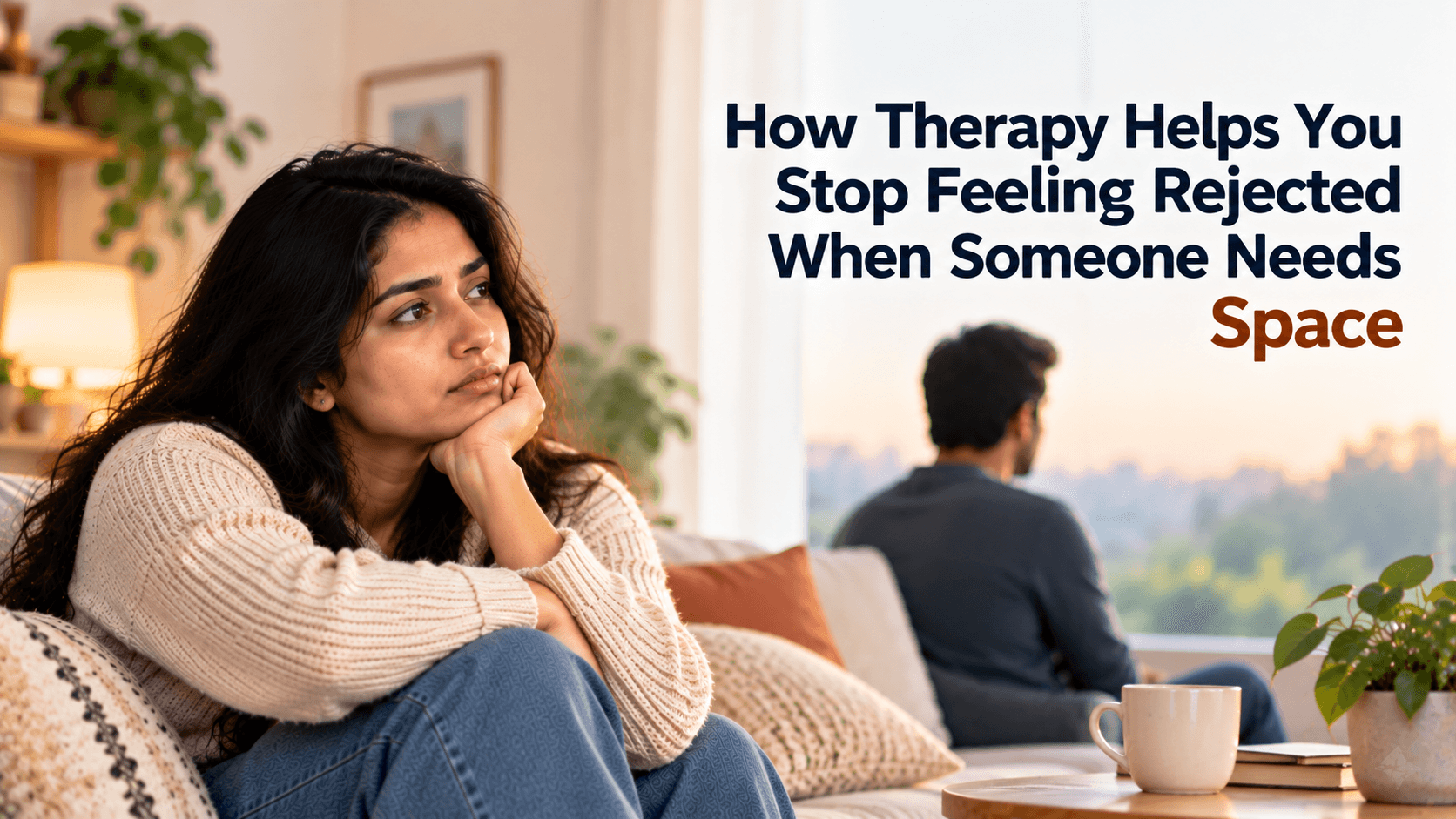
How Therapy Helps You Stop Feeling Rejected When Someone Needs Space
How Therapy Helps You Stop Feeling Rejected When Someone Needs Space
Focus: Attachment anxiety, insecurity, emotional regulation, self-trust
When someone you care about asks for space, it can feel much bigger than the words themselves. You may immediately wonder whether they are pulling away, losing interest, becoming tired of you, or preparing to leave. Even when they clearly say they just need time alone, part of you may still experience the distance as rejection.
At India Therapist, many people come to therapy because space in relationships feels emotionally unsafe. They may understand logically that healthy people sometimes need time alone, yet their body and mind react with anxiety. Therapy can help you understand why space feels threatening, regulate the fear it triggers, strengthen self-trust, and learn that distance does not always mean abandonment.
Why Someone Needing Space Can Feel Like Rejection
When you are emotionally attached to someone, closeness often provides a sense of security. Frequent communication, affection, shared routines, and emotional availability can reassure you that the relationship is safe. When that connection suddenly becomes quieter, your mind may quickly interpret the change as danger.
You may think, “If they want space from me, they must not want me anymore.” A therapist in India can help you recognize that this conclusion often comes from fear rather than evidence. Someone can need time alone while still caring deeply about you.
Space can be about stress, exhaustion, emotional processing, work, family responsibilities, or simply the need to recharge. It does not automatically mean the relationship is ending.
Attachment Anxiety Can Make Distance Feel Dangerous
Attachment anxiety can make changes in closeness feel especially intense. You may become highly sensitive to shorter messages, fewer calls, or changes in someone’s tone. When they ask for space, your mind may treat it as confirmation that something is wrong.
You may start checking your phone repeatedly, replaying conversations, or searching for signs that you caused the distance. The more anxious you become, the harder it is to tolerate uncertainty.
An Indian therapist online can help you understand the attachment patterns underneath these reactions. Feeling afraid does not mean the fear is telling you the truth.
Insecurity Can Turn Space Into a Judgment About Your Worth
When self-worth is fragile, another person’s need for distance can quickly become personal. Instead of thinking, “They need time to themselves,” you may think, “I am too much,” “I annoyed them,” or “They would rather be without me.”
This can make normal relationship boundaries feel like evidence that you are unwanted.
Therapy helps you separate another person’s needs from your value. Someone wanting quiet, independence, or time to process emotions does not automatically say anything about whether you are lovable.
Your worth does not decrease because another person needs space.
Past Rejection Can Shape How You Respond Now
Sometimes the fear comes from earlier experiences. Perhaps someone in the past became distant before ending a relationship. Maybe a caregiver withdrew affection when upset. You may have learned that space is what happens just before abandonment.
Because of this, your nervous system may react strongly even when the present situation is different.
Therapy helps you notice when an old experience is being activated in a new relationship. The person in front of you may not be repeating the past, even if your body reacts as though they are.
Understanding this can reduce the urge to immediately chase reassurance.
Why You May Want to Close the Distance Immediately
When space triggers anxiety, your instinct may be to reconnect as quickly as possible. You may send more messages, ask repeatedly whether everything is okay, call several times, or try to solve the situation immediately.
These actions can temporarily reduce anxiety if the other person responds, but they can also make it harder for them to actually receive the space they asked for.
Therapy helps you tolerate the discomfort instead of immediately acting on it. You can notice the fear, regulate yourself, and give the other person room without assuming the relationship is disappearing.
Emotional Regulation Helps You Respond Instead of React
Emotional regulation means learning how to stay with difficult feelings without letting them control your behavior. When someone asks for space, anxiety may still appear, but you do not have to respond automatically.
You might pause, take a walk, journal, talk to a trusted friend, or remind yourself that you do not have enough information to assume the worst.
Therapy helps you create space between the feeling and the reaction. Over time, you begin to realize that anxiety can rise and fall without requiring immediate reassurance.
This can make relationships feel much safer.
Healthy Relationships Need Both Closeness and Space
A healthy relationship is not defined by constant contact. Both people need room for friendships, hobbies, work, rest, and personal reflection.
Space can actually protect closeness because it allows both people to return to the relationship with more energy and clarity.
If you believe love requires constant availability, space may feel threatening. Therapy helps you build a more flexible understanding of connection. Someone can enjoy time alone and still choose you.
Independence and intimacy can exist together.
Why Reassurance Is Helpful but Cannot Do All the Work
It is normal to want reassurance when you feel insecure. A partner may tell you, “I care about you. I just need some time to myself.” That reassurance can be meaningful.
The problem begins when you need reassurance repeatedly because you cannot trust it once it is given. You may ask the same question again a few hours later because the anxiety returns.
Therapy helps you build enough internal security that reassurance supports you rather than becoming the only thing keeping you calm.
You learn to tell yourself, “They already explained what they need. I can respect that and trust myself to handle the uncertainty.”
Self-Trust Makes Space Easier to Tolerate
One reason space feels so frightening is that you may not trust yourself to cope if the relationship actually changes. You may think, “What if they leave? I will not be okay.”
Therapy helps you build confidence in your own emotional resilience.
Self-trust means knowing that you can ask questions when needed, notice unhealthy patterns, communicate clearly, and take care of yourself if something difficult happens.
When you trust yourself, uncertainty becomes less threatening because you know you can respond to reality rather than trying to prevent every possible loss.
Communication Can Reduce Misunderstandings
Healthy communication makes space easier to understand. Instead of disappearing without explanation, a partner might say, “I am overwhelmed and need tonight to myself. I will call you tomorrow.”
Clear communication reduces ambiguity.
You can also communicate your own needs without demanding constant closeness. You might say, “I respect that you need space. It helps me feel secure when I know when we will reconnect.”
Therapy can help you communicate this kind of vulnerability without turning it into accusation or control.
Therapy Helps You Understand the Fear Beneath the Reaction
The fear of space often points to something deeper. You may be afraid of abandonment, rejection, replacement, or being forgotten. Therapy helps you understand these fears instead of only trying to stop the surface behavior.
Therapy can help you:
recognize attachment triggers
reduce catastrophic thinking
regulate anxiety during periods of distance
communicate more clearly
strengthen self-worth
tolerate uncertainty
reduce reassurance-seeking
build trust in yourself and your relationships
At India Therapist, culturally sensitive therapists in India and Indian therapists online can support people dealing with attachment anxiety, relationship insecurity, fear of rejection, and emotional regulation difficulties.
Space Does Not Automatically Mean Something Is Wrong
A quiet day is not necessarily a warning sign. Someone needing time alone is not automatically rejecting you. A partner having an independent life does not mean the relationship is becoming weaker.
Of course, ongoing emotional withdrawal can sometimes indicate a real relationship issue. Therapy does not teach you to ignore patterns. It helps you avoid treating every temporary change as proof that you are being abandoned.
You learn to look at the full pattern of the relationship rather than reacting to one moment.
You Can Respect Someone’s Space Without Abandoning Yourself
Respecting another person’s need for space does not mean you have to ignore your own needs. You are still allowed to want communication, consistency, and emotional safety.
The goal is balance.
You can give someone room while still noticing whether the relationship overall feels reciprocal and secure. You can respect independence without accepting chronic emotional unavailability.
Therapy helps you understand the difference.
You Do Not Have to Chase Connection to Keep It
One of the most powerful shifts in healing is learning that healthy connection does not need to be chased constantly.
Someone who cares about you can take space and still come back. A relationship can become quieter for a day without disappearing. You can tolerate uncertainty without immediately assuming rejection.
Therapy helps you move from “If they need space, I must be losing them” to “They can need space, I can respect it, and I can trust myself without turning distance into rejection.”
Ready to talk to someone who understands?
Connect with an Indian therapist who speaks your language and understands your cultural context.