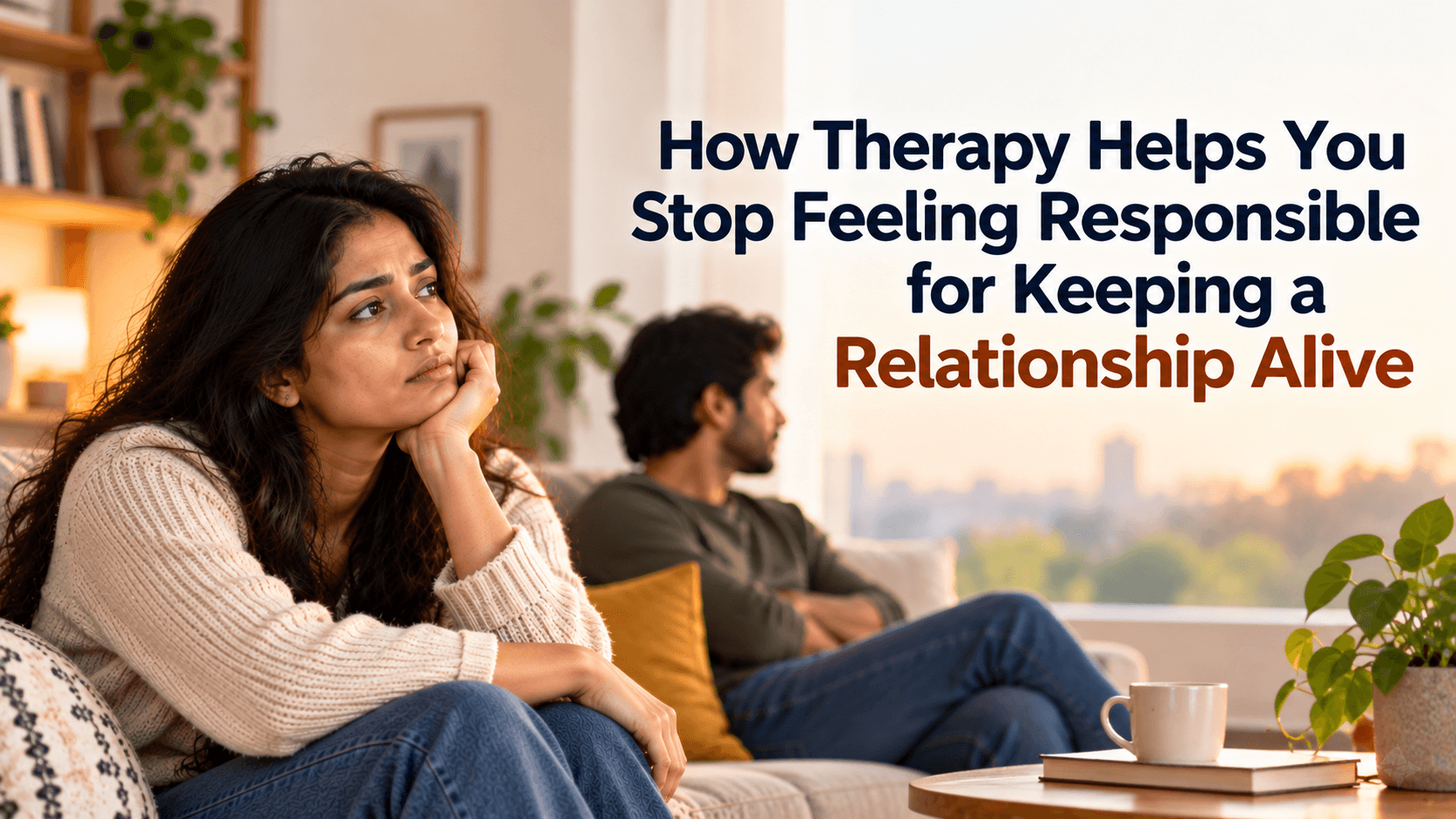
How Therapy Helps You Stop Feeling Responsible for Keeping a Relationship Alive
How Therapy Helps You Stop Feeling Responsible for Keeping a Relationship Alive
Focus: Over-functioning, resentment, self-worth, emotional freedom
A relationship should not survive only because one person keeps carrying it. Yet many people find themselves becoming the one who starts every difficult conversation, plans every date, repairs every argument, checks in first, forgives first, and constantly tries to prevent emotional distance. Over time, love can begin to feel less like connection and more like responsibility.
At India Therapist, many people come to therapy feeling exhausted because they believe the relationship will fall apart if they stop trying. They may feel responsible for keeping communication alive, maintaining closeness, managing their partner’s emotions, or solving every problem. Therapy can help you recognize over-functioning, rebuild self-worth, understand resentment, and learn that a healthy relationship requires effort from both people.
When You Become the Person Holding Everything Together
Most relationships go through periods when one person gives more support than the other. That can be completely normal. The problem begins when the imbalance becomes permanent.
You may be the one who always notices when something feels wrong. You initiate conversations, suggest solutions, make plans, apologize, and try to restore connection whenever there is tension. If you stop doing these things, very little seems to happen.
A therapist in India can help you recognize when healthy effort has turned into over-functioning. Love requires effort, but one person should not have to constantly generate the emotional energy that keeps the relationship functioning.
Over-Functioning Can Feel Like Love
Over-functioning is often difficult to recognize because it can look caring. You may tell yourself that you are simply more emotionally aware, more responsible, or more committed to the relationship.
But underneath the constant effort may be fear. You may worry that if you stop checking in, your partner will become distant. If you stop solving problems, conflict will grow. If you stop making plans, the relationship may become empty.
This fear can keep you working harder and harder. Therapy helps you ask an important question: Am I contributing to this relationship, or am I carrying it?
That distinction can change how you understand your role.
Why You May Feel Responsible for Their Emotions
Sometimes keeping a relationship alive means managing the other person’s emotional state. You may carefully choose your words, avoid topics that could upset them, or immediately try to fix things when they become distant.
You may believe that keeping your partner happy is necessary for keeping the relationship safe.
An Indian therapist online can help you understand that emotional support is different from emotional responsibility. You can listen to your partner, care about their feelings, and communicate respectfully without taking responsibility for every mood or reaction they experience.
A relationship becomes healthier when both people learn how to carry their own emotions.
Resentment Often Builds When Effort Is Not Mutual
Giving constantly without receiving similar effort can eventually create resentment. You may begin feeling irritated when your partner does not notice what needs to be done. Small things can become frustrating because they represent a much larger imbalance.
You may think, “Why am I always the one trying?” or “Would this relationship even exist if I stopped doing everything?”
These thoughts can bring guilt because you may still love the person. But resentment is often a sign that your emotional limits have been ignored for too long.
Therapy helps you understand resentment instead of simply judging it. Often, resentment points toward unmet needs, missing reciprocity, or responsibilities that have become uneven.
Self-Worth Can Become Connected to Being Needed
Some people feel most valuable when they are useful. You may feel secure when your partner depends on you, asks for advice, or needs help solving problems.
If the relationship becomes more balanced, you may strangely feel less important. This can lead you to keep taking on responsibilities that do not actually belong to you.
Therapy helps you separate your worth from what you provide. You should not have to earn love by constantly fixing, supporting, or carrying someone else.
You are valuable even when you are not solving anything.
Fear of Losing the Relationship Can Keep You Over-Investing
Sometimes people continue over-functioning because they are afraid of discovering what would happen if they stopped.
You may already suspect that your partner would not initiate conversations, make plans, or repair conflict without your effort. Stepping back can therefore feel terrifying because it might reveal an uncomfortable truth about the relationship.
But constantly compensating for another person's lack of effort can prevent you from seeing the relationship clearly.
Therapy in India can help you tolerate the uncertainty of stepping back. Instead of automatically rescuing the relationship every time something feels wrong, you allow space to see whether the other person will participate.
A Relationship Should Not Depend on One Person’s Anxiety
Many people mistake constant effort for commitment. But sometimes that effort is being driven by anxiety.
You may be checking in because silence scares you. You may be planning constantly because emotional distance feels dangerous. You may be resolving conflict immediately because uncertainty feels unbearable.
This can make the relationship feel active, but underneath there may be a fear that if you stop moving, everything will collapse.
Therapy helps you understand the difference between actions that come from love and actions that come from fear. Healthy relationships should not require constant emotional emergency management.
Learning to Step Back Without Becoming Cold
Stopping over-functioning does not mean becoming distant, passive-aggressive, or deliberately withholding affection. It means creating enough space for both people to participate.
You might stop reminding your partner about every responsibility. You may wait to see whether they initiate contact. You may communicate your needs once instead of repeatedly explaining them.
This can feel uncomfortable at first because you are used to filling every gap. But stepping back gives you important information about whether the relationship is capable of becoming more balanced.
Therapy can help you do this without turning the process into a test or punishment.
Mutual Effort Creates Emotional Safety
Healthy relationships are not perfectly equal every day, but over time there should be a sense of mutuality. Both people should initiate, communicate, repair, support, and invest.
You should not be the only person asking how the relationship is going. You should not be the only one trying to restore closeness after conflict. You should not have to constantly convince someone to participate.
Mutual effort creates emotional safety because you know the relationship does not disappear the moment you stop carrying it.
At India Therapist, culturally sensitive therapists in India and Indian therapists online can support people struggling with one-sided relationships, resentment, emotional exhaustion, attachment anxiety, and low self-worth.
Therapy Helps You Understand Why You Over-Function
Therapy can help you explore where the pattern began. You may have grown up in a family where you were responsible for keeping peace, managing emotions, or solving problems. You may have learned that love requires sacrifice or that relationships survive only when you work hard enough.
Once you understand the origin of the pattern, you can start making different choices.
Therapy can help you identify emotional triggers, reduce people-pleasing, set clearer boundaries, tolerate uncertainty, strengthen self-worth, and communicate expectations more directly.
You begin learning that a relationship is something two people create together, not something one person constantly rescues.
Letting Someone Else Carry Their Share Can Feel Uncomfortable
If you are used to taking responsibility, allowing someone else to struggle can feel wrong. You may want to step in immediately when they forget something, avoid a difficult conversation, or become uncomfortable.
But stepping in every time can prevent them from developing responsibility.
Sometimes the healthier choice is allowing the other person to notice the consequences of their own choices. You can still care without taking over.
Therapy helps you become more comfortable watching someone carry their share without assuming you need to rescue them.
Emotional Freedom Begins When You Stop Trying to Control the Outcome
There is a certain kind of freedom that comes from recognizing that you cannot force a relationship to succeed.
You can communicate honestly. You can show care. You can take responsibility for your own behavior. But you cannot make another person become more emotionally available, more committed, or more willing to participate.
Accepting this can be painful, but it can also reduce enormous pressure.
You no longer have to constantly ask, “What else can I do to save this?” You can begin asking, “Is this relationship meeting me halfway?”
You Are Allowed to Stop Carrying the Relationship Alone
Stepping back does not mean you stopped caring. It may mean you finally recognized that love cannot survive indefinitely through one person’s effort.
You deserve a relationship where someone checks in on you too, where repair is mutual, and where connection does not depend entirely on your energy.
You are allowed to stop over-explaining, over-giving, and over-functioning.
Therapy helps you move from “If I stop trying, this relationship will fall apart” to “If this relationship can only survive when I carry it alone, that is important information I deserve to see.”
Ready to talk to someone who understands?
Connect with an Indian therapist who speaks your language and understands your cultural context.