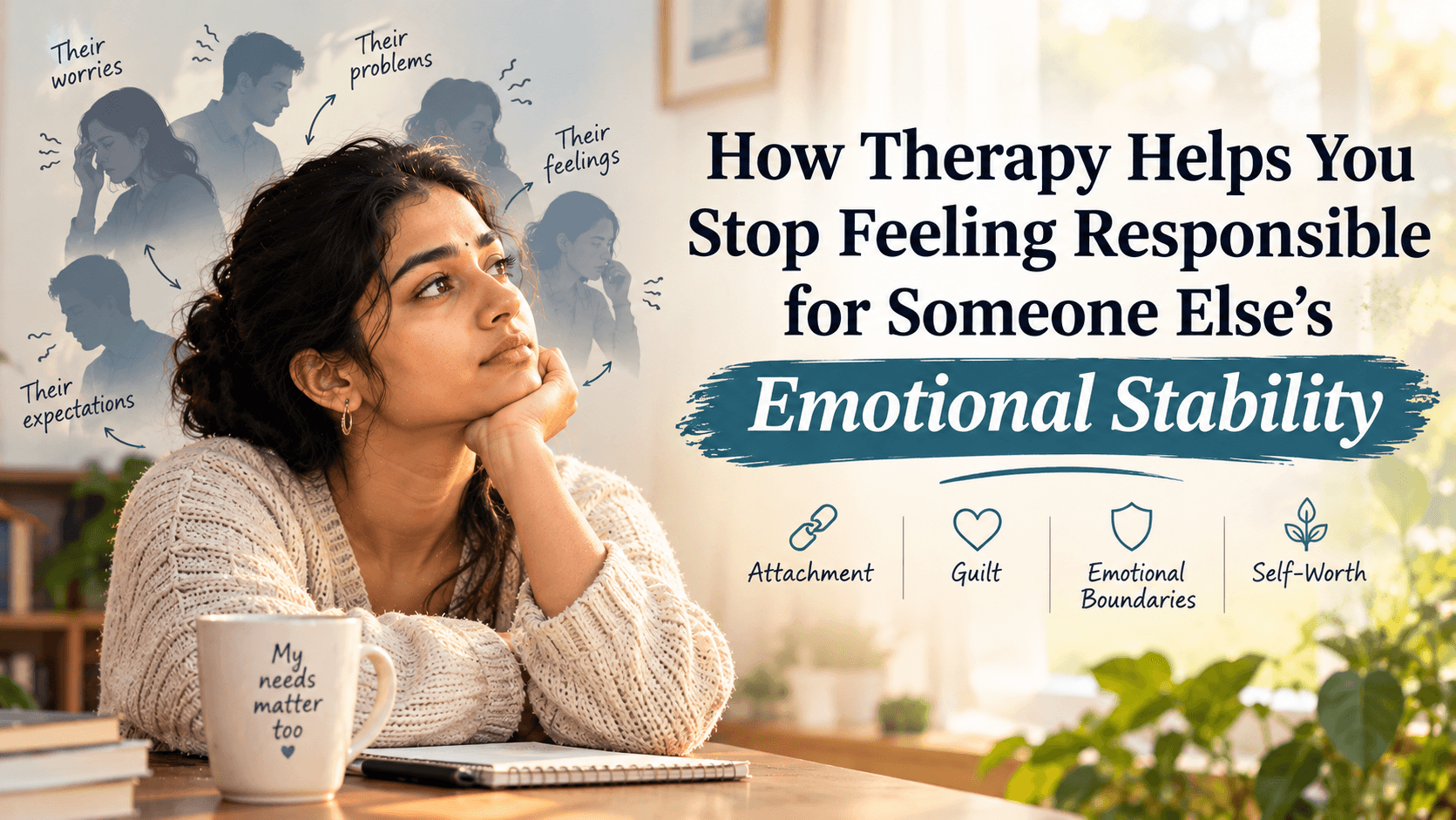
How Therapy Helps You Stop Feeling Responsible for Someone Else’s Emotional Stability
How Therapy Helps You Stop Feeling Responsible for Someone Else’s Emotional Stability
Focus: Attachment, guilt, emotional boundaries, self-worth
When someone you care about becomes upset, anxious, withdrawn, or overwhelmed, you may immediately feel responsible for helping them feel better. You might change your tone, cancel your own plans, avoid difficult conversations, or carefully monitor what you say because you are afraid of making their emotional state worse.
Over time, this can create a relationship where you are constantly watching, adjusting, and trying to keep another person emotionally stable. Their mood begins influencing your decisions, your energy, and even your sense of safety. You may start believing that if they are upset, you must have done something wrong or failed to support them properly.
At India Therapist, many people come to therapy because they feel responsible for maintaining someone else’s emotional balance. Therapy can help you understand where this responsibility came from, recognize attachment and guilt patterns, build healthier emotional boundaries, and develop self-worth that does not depend on keeping everyone around you calm.
Why Another Person’s Mood Can Feel Like Your Responsibility
When you care deeply about someone, it is natural to notice when their mood changes. The problem begins when you immediately interpret their sadness, anger, anxiety, or silence as something you need to fix.
You may ask yourself, “What did I do?” even when the emotion has nothing to do with you. You might start adjusting your behavior before the other person has even explained what they are feeling.
A therapist in India can help you separate awareness from responsibility. You can notice that someone is struggling without automatically assuming that you caused it or that it is your job to make the feeling disappear.
Attachment Anxiety Can Make Emotional Changes Feel Threatening
Attachment anxiety can make another person’s emotional withdrawal or irritation feel especially intense. If someone becomes quiet, less affectionate, or frustrated, your nervous system may interpret the change as a sign that the relationship is in danger.
Because of this, you may rush to restore emotional closeness. You apologize quickly, offer reassurance, ask repeatedly whether everything is okay, or change your behavior in order to reduce tension.
An Indian therapist online can help you understand that these reactions may come from fear of abandonment rather than from what the current situation actually requires. Their difficult emotion does not automatically mean the relationship is collapsing.
Guilt Can Keep You Constantly Adjusting
If you are highly sensitive to other people’s feelings, guilt can become one of the strongest forces shaping your behavior. You may feel uncomfortable enjoying yourself when someone you love is upset, or guilty for setting a boundary when you know the other person will be disappointed.
This can lead you to over-accommodate. You may say yes when you want to say no, avoid important conversations, or stay emotionally available long after you are exhausted because their discomfort feels harder to tolerate than your own.
Therapy helps you understand that guilt does not always mean you have done something wrong. Sometimes guilt simply appears when you stop taking responsibility for emotions that never belonged entirely to you.
Emotional Boundaries Help You Know What Belongs to You
Emotional boundaries help you recognize the difference between your feelings and someone else’s. Without them, another person’s sadness can become your sadness, their anger can become your emergency, and their disappointment can become something you immediately need to repair.
Healthy emotional boundaries do not make you uncaring. They allow you to remain compassionate without absorbing every emotion around you.
Therapy in India can help you practice thinking, “I can care that they are upset without making it my responsibility to change how they feel.” This distinction can significantly reduce anxiety and emotional exhaustion.
You May Have Learned to Monitor Other People Early in Life
For some people, this pattern begins in childhood. You may have grown up around a parent or family member whose mood strongly affected the atmosphere at home. Learning to notice emotional changes quickly may have helped you avoid conflict or understand when it was safe to speak.
You may have become skilled at reading facial expressions, tone of voice, silence, or small changes in behavior. That skill may have once helped you feel safer, but in adulthood it can become exhausting when you continue monitoring everyone around you.
Therapy can help you recognize that you no longer have to manage the emotional environment the way you once did. Other adults can be responsible for communicating and regulating their own feelings.
Their Emotional Stability Is Not Proof That You Are Doing Well
When you become responsible for someone’s emotions, you may use their mood as feedback about yourself. If they are happy, you feel relieved. If they are upset, you start questioning what you did.
This creates unstable self-worth because your sense of being a good partner, friend, or family member depends on another person staying emotionally comfortable.
Therapy helps you build a more stable sense of self. You can evaluate your behavior based on your values, honesty, and respect rather than using someone else’s emotional reaction as the final measure of whether you did something wrong.
You May Avoid Necessary Conversations to Keep Them Calm
When emotional stability becomes your responsibility, honesty can begin feeling dangerous. You may avoid raising concerns because you know the conversation could upset the other person.
You may think, “This is not the right time,” or “I do not want to make things worse.” Eventually, important needs, disappointments, and boundaries remain unspoken.
This can create emotional distance and resentment. A relationship may appear peaceful, but the peace depends on one person staying quiet.
Therapy helps you understand that healthy relationships need enough emotional safety for both people to express difficult truths. Protecting someone from every uncomfortable feeling is not the same as protecting the relationship.
Reassurance Can Become an Endless Cycle
If someone depends heavily on you for emotional reassurance, you may feel responsible for calming every fear. You explain repeatedly, confirm that everything is okay, and provide the same reassurance whenever anxiety returns.
This can offer temporary relief, but it may also create a cycle where both people become dependent on reassurance rather than developing internal security.
Therapy can help you identify when reassurance is supportive and when it has become a form of emotional over-functioning. You can still be caring while encouraging the other person to develop their own ways of managing uncertainty.
You Are Allowed to Let Someone Feel Disappointed
One of the most difficult emotional boundaries is allowing another person to feel disappointed in you without immediately changing your decision.
They may be disappointed because you cannot attend something, need space, or choose differently from what they hoped. Your instinct may be to fix the feeling by changing your boundary.
But disappointment is part of relationships.
Therapy helps you understand that another person can be disappointed and still be okay. You do not have to remove every uncomfortable emotion in order to maintain connection.
Their Anger Does Not Automatically Mean You Are Wrong
Many people become especially anxious when someone they love is angry. You may immediately assume that you crossed a line or behaved badly.
Sometimes that may be true, and accountability is important. But anger can also come from frustration, unmet expectations, stress, or disagreement.
Therapy helps you pause before turning another person’s anger into self-blame. You can ask whether you acted respectfully and whether your boundary aligns with your values.
Someone being angry with your decision does not automatically make the decision wrong.
Self-Worth Can Become Tied to Keeping Everyone Calm
If you are known as the peacemaker, emotional caretaker, or stable one, you may receive a lot of validation from keeping relationships calm. People may praise your patience or depend on your ability to de-escalate tension.
Over time, you may begin believing that your value comes from your ability to prevent conflict and help everyone feel okay.
This can make it difficult to step back because you may wonder who you are if you are not regulating the emotional environment.
Therapy can help you build self-worth outside the caretaker role. You are valuable even when someone around you is upset.
Emotional Responsibility Can Create Resentment
Constantly managing another person’s emotional stability can become exhausting. You may begin feeling irritated by their moods or anxious whenever they seem upset because you know you will soon feel responsible for fixing the situation.
This resentment can create guilt, especially when you love the person.
But resentment often points to an imbalance. It may be telling you that you are carrying emotional responsibilities that should be shared.
Therapy helps you respond to resentment as information rather than judging yourself for feeling it.
Healthy Relationships Allow Emotional Independence
A healthy relationship does not mean both people always feel the same way. One person can be upset while the other remains grounded. One person can have a difficult day without the other person having to abandon their own emotional state.
This kind of emotional independence creates stronger relationships because both people learn to regulate themselves while still supporting each other.
At India Therapist, culturally sensitive therapists in India and Indian therapists online can help people understand the difference between emotional support and emotional dependence.
You can care deeply without becoming responsible for keeping another person emotionally stable at all times.
How Therapy Helps You Build Healthier Emotional Boundaries
Therapy can help you explore why another person’s emotional state affects you so strongly. You may discover patterns related to attachment anxiety, childhood hypervigilance, family roles, people-pleasing, or the belief that relationships stay safe only when everyone is calm.
Understanding these patterns makes it easier to respond differently.
Therapy can help you notice emotional triggers, reduce guilt, stop excessive reassurance-seeking, communicate boundaries more clearly, tolerate someone else’s disappointment, and strengthen your sense of self-worth.
The goal is not to stop caring about how others feel. It is to stop making their emotional state the central measure of your own safety.
You Can Support Without Taking Over
Support can look like listening, asking what someone needs, offering comfort, or simply being present. It does not always require solving, calming, or changing the emotion.
Sometimes the healthiest response is allowing another person to experience their feelings while knowing you are nearby.
You might say, “I can see that you are upset, and I am here if you want to talk.” That response offers care without assuming responsibility for making the feeling disappear.
Therapy can help you become more comfortable with this kind of presence.
You Are Allowed to Stay Grounded When Someone Else Is Not
One of the biggest shifts in healing is learning that you do not have to emotionally follow someone every time their mood changes.
If they are anxious, you can remain calm. If they are disappointed, you can still trust your decision. If they are upset, you can listen without immediately abandoning your own needs.
This does not make you detached. It means you are learning emotional boundaries.
Over time, staying grounded can actually create healthier relationships because neither person needs the other to constantly regulate their emotional state.
Their Emotional Stability Belongs to Them
You can influence another person’s experience, and your behavior matters. If you hurt someone, taking accountability is important. If your actions affect the relationship, those issues deserve attention.
But you cannot guarantee another person’s emotional stability.
Their emotional wellbeing is shaped by their history, coping skills, circumstances, relationships, support systems, and choices. You may be one important part of their life, but you cannot become responsible for all of it.
Therapy helps you move from “If they are upset, I need to make everything okay” to “I can care about their feelings, take responsibility for my actions, and still allow them to manage emotions that belong to them.”
Ready to talk to someone who understands?
Connect with an Indian therapist who speaks your language and understands your cultural context.