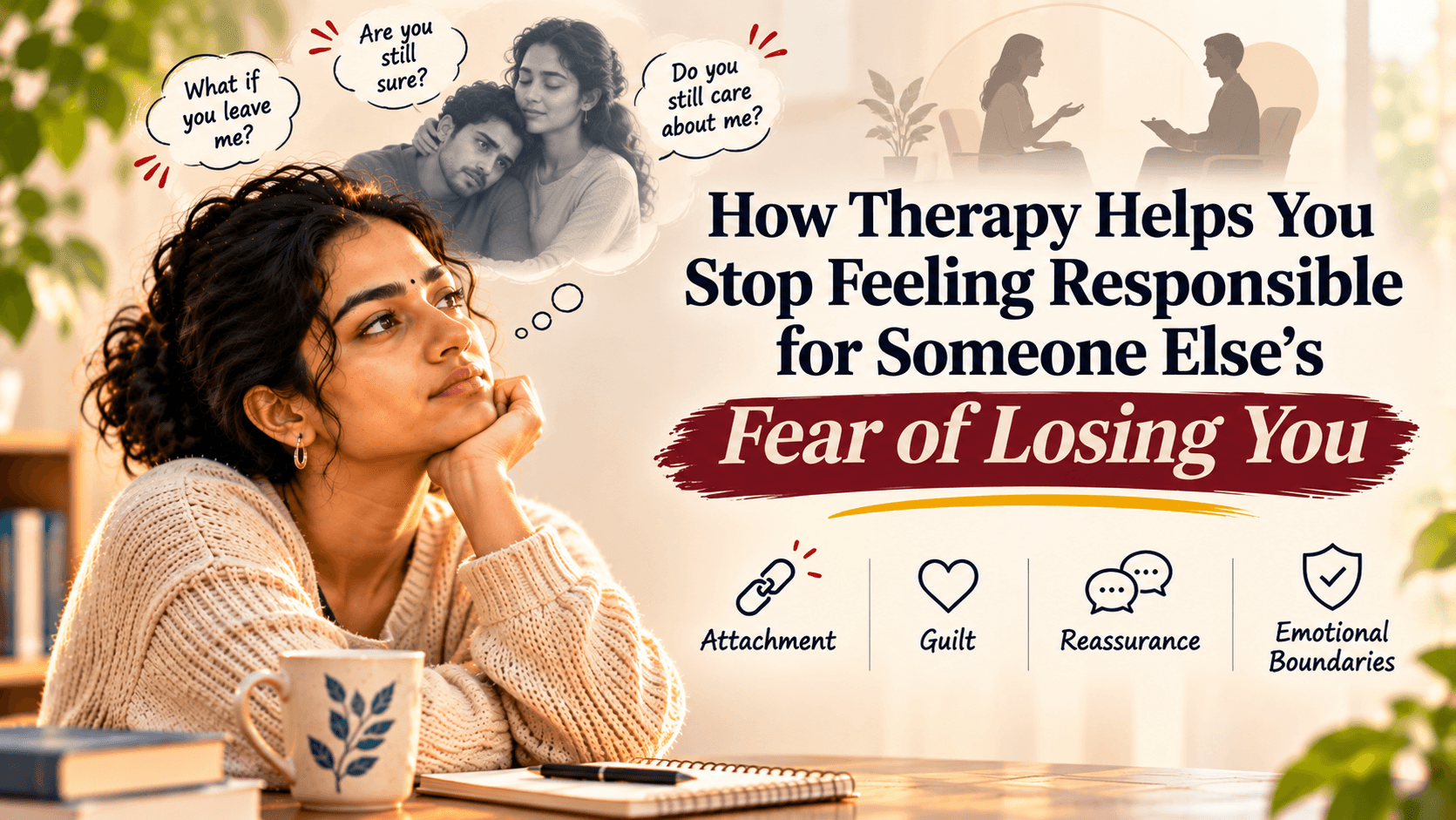
How Therapy Helps You Stop Feeling Responsible for Someone Else’s Fear of Losing You
How Therapy Helps You Stop Feeling Responsible for Someone Else’s Fear of Losing You
Focus: Attachment, guilt, reassurance, emotional boundaries
When someone is afraid of losing you, it can create a powerful sense of responsibility. You may feel pressure to reassure them constantly, explain every change in your mood, stay available more often, or avoid making choices that might trigger their insecurity. At first, these responses may feel like care, but over time you may begin carrying emotional responsibility that does not fully belong to you.
You might start believing that if they feel anxious, you need to fix it. If they worry you will leave, you may feel obligated to repeatedly prove that you will not. This can slowly create a relationship where your freedom, boundaries, and emotional energy become organized around preventing someone else from feeling afraid.
At India Therapist, many people come to therapy because they feel guilty when someone they love struggles with fear of abandonment. Therapy can help you understand the difference between offering reassurance and becoming responsible for another person’s emotional security, while helping you build healthier boundaries without becoming emotionally distant.
Why Someone Else’s Fear Can Quickly Become Your Responsibility
When you care deeply about someone, their fear naturally affects you. If they tell you they are scared of losing you, you may immediately want to comfort them and make them feel safe. There is nothing wrong with reassurance, especially when it comes from genuine care.
The difficulty begins when reassurance becomes something you feel obligated to provide constantly. You may start monitoring their reactions, anticipating what might upset them, or changing your behavior to avoid triggering their fear.
A therapist in India can help you recognize when compassion has turned into emotional responsibility. You can care about someone’s fear without making yourself responsible for eliminating it completely.
Attachment Anxiety Can Make Reassurance Feel Necessary
Fear of losing someone is often connected to attachment anxiety. A person may become highly sensitive to changes in communication, availability, affection, or routine. Even small changes can feel like signs that the relationship is becoming less secure.
When this happens, they may seek reassurance more frequently. They might ask whether you still care, whether everything is okay, or whether you are becoming distant.
An Indian therapist online can help you understand that reassurance can be supportive, but repeated reassurance does not always resolve attachment anxiety. Sometimes it provides temporary relief while keeping the underlying fear active. Emotional security also needs to develop internally.
You May Feel Guilty for Having Normal Boundaries
When someone fears losing you, ordinary boundaries can suddenly feel cruel. You may hesitate to ask for alone time, spend time with friends, focus on work, or delay responding to a message because you know these things might make the other person anxious.
You may begin thinking, “If I really care about them, maybe I should not do anything that makes them insecure.” Over time, this can become emotionally exhausting because healthy relationships require room for individuality, privacy, rest, friendships, and separate interests.
Therapy helps you understand that boundaries are not evidence that you are preparing to leave. You can love someone deeply and still need space.
Reassurance Can Become an Endless Cycle
Reassurance often works temporarily. Someone feels afraid, you reassure them, and their anxiety decreases. But after another trigger, the fear may return, creating a cycle where both people begin relying on reassurance as the main way to manage insecurity.
The anxious person repeatedly looks for confirmation while the other person becomes responsible for providing it. Eventually, both people may become exhausted because no amount of reassurance seems to create lasting security.
Therapy helps you recognize that reassurance is healthiest when it supports connection rather than becoming the only way the relationship feels secure. Long-term security usually comes from trust, consistency, self-regulation, communication, and emotional growth.
You Cannot Prove Forever That You Will Never Leave
One of the most difficult realities in relationships is that absolute certainty does not exist. You can communicate commitment, behave consistently, and show love through your actions, but you cannot remove every possible fear about the future.
If someone asks for constant guarantees, you may feel pressure to promise more and more. But no amount of reassurance can completely eliminate uncertainty.
Therapy in India can help you understand that a secure relationship is not built by pretending uncertainty does not exist. It is built by developing enough trust to remain connected even though neither person can control everything that may happen in the future.
Their Fear Does Not Automatically Mean You Did Something Wrong
When someone becomes afraid of losing you, you may quickly assume that your behavior caused the fear. Sometimes your actions may genuinely need attention, and accountability is important, but not every fear is evidence that you have behaved badly.
Their anxiety may be connected to previous abandonment, past relationships, childhood experiences, insecurity, or earlier losses. Your behavior may trigger those fears without necessarily causing them.
Therapy helps you distinguish between taking responsibility for your actions and taking responsibility for someone else’s entire emotional history.
People-Pleasing Can Make This Dynamic Harder
If you already struggle with people-pleasing, someone else’s fear of losing you can create enormous pressure. You may become highly focused on keeping them comfortable because you cannot tolerate seeing them upset.
You might overexplain where you are, respond immediately even when busy, avoid saying no, or repeatedly sacrifice your own preferences. These behaviors may temporarily reduce conflict, but they can also create emotional exhaustion and resentment.
Therapy helps you understand that protecting someone from every uncomfortable emotion is not the same as maintaining a healthy relationship. You can be compassionate without constantly abandoning yourself.
Emotional Boundaries Allow Both People to Have Feelings
Emotional boundaries mean recognizing that both people are allowed to have different emotional experiences at the same time. Someone can feel afraid while you still maintain your boundary, and they can feel disappointed while you continue making a decision that is healthy for you.
You can acknowledge their feelings without automatically changing your behavior. This is an important part of emotional maturity because a relationship should be able to contain discomfort without requiring one person to erase themselves.
Therapy can help you practice responses such as, “I understand that this brings up fear for you, and I still need some time to myself.” This communicates care while maintaining your emotional autonomy.
You May Begin Walking on Eggshells
When you feel responsible for preventing someone’s fear, you may become overly careful about everything you do. You monitor your tone, avoid certain topics, and think constantly about how your choices might be interpreted.
Over time, this can make the relationship feel emotionally restrictive. You may stop acting naturally because you are constantly trying to prevent a reaction, and your life can slowly become organized around managing another person’s insecurity.
Therapy can help you notice when compassion has turned into hypervigilance. Healthy relationships should allow both people to feel safe enough to be honest and authentic.
Their Fear Deserves Compassion, Not Control Over Your Life
Someone’s fear of losing you may be genuine and deeply painful, and that fear deserves compassion. But compassion does not mean allowing fear to control every decision in the relationship.
If someone’s insecurity determines who you can see, how quickly you must respond, what activities you can enjoy, or how much space you are allowed to have, the relationship may become increasingly restrictive.
Therapy helps you support emotional vulnerability without allowing fear to become a reason for controlling behavior. Both people deserve emotional safety and personal autonomy.
Your Self-Worth Should Not Depend on Keeping Someone Reassured
When you are constantly responsible for someone’s emotional security, you may begin measuring yourself by how calm they feel. If they are reassured, you feel like a good partner or friend; if they become anxious, you may feel that you have failed.
This creates unstable self-worth because your sense of being good enough becomes dependent on another person’s emotional state. Their fear begins determining how you evaluate yourself.
Therapy helps you evaluate yourself based on your values, honesty, consistency, and behavior instead. You can be caring and trustworthy even when someone still experiences fear.
Healthy Love Allows Space Without Panic
One sign of emotional security is the ability to tolerate temporary distance without assuming the relationship is ending. You can spend time apart, focus on separate responsibilities, or have different emotional needs without automatically interpreting those differences as rejection.
This does not mean people never need reassurance. Everyone occasionally needs reminders of love, care, or commitment, especially during difficult periods.
The difference is that reassurance supports the relationship rather than holding it together. At India Therapist, culturally sensitive therapists in India and Indian therapists online can support people struggling with attachment anxiety, reassurance cycles, relationship guilt, emotional boundaries, and fear of abandonment.
You Can Be Consistent Without Becoming Constantly Available
Consistency is important in healthy relationships. Following through on promises, communicating honestly, and showing emotional reliability can build trust over time.
But consistency does not mean constant accessibility. You do not need to respond instantly to every message or remain available for every anxious moment in order to prove that you care.
You can still be trustworthy while having your own schedule, needs, friendships, and responsibilities. Therapy helps you separate reliability from unlimited availability.
Their Healing Cannot Depend Entirely on You
If someone has a strong fear of abandonment, your support can matter deeply. But lasting healing usually requires more than reassurance from one person.
They may need to understand their attachment patterns, strengthen self-worth, learn emotional regulation, or work through previous experiences that shaped their fear. You cannot complete that emotional work for them.
Therapy can help you support their growth without becoming their entire emotional support system. Encouraging independence does not mean you care less; it can help the relationship become healthier for both people.
How Therapy Helps You Step Out of the Reassurance Role
Therapy can help you explore why another person’s fear affects you so strongly. You may discover that you learned to manage other people’s emotions early in life or that guilt makes it difficult to tolerate someone else’s discomfort.
Once you understand these patterns, you can begin responding differently. Therapy can help you build emotional boundaries, reduce people-pleasing, communicate limits clearly, tolerate another person’s anxiety, and strengthen your own self-worth.
The goal is not to become emotionally detached. It is to offer reassurance because you genuinely want to, rather than because fear or guilt makes you feel obligated.
You Are Allowed to Let Someone Work Through Their Own Fear
One of the hardest parts of changing this dynamic is allowing someone to feel anxious without immediately trying to remove the feeling. You can remain present, listen, and remind them of your care without taking over responsibility for what happens next.
You do not always have to provide another explanation, another promise, or another sacrifice. Sometimes emotional growth requires allowing a person to experience uncertainty and learn that they can tolerate it.
Therapy can help you trust that process without automatically stepping in to rescue them every time fear appears.
Love Does Not Require You to Prove Yourself Every Day
Healthy love should gradually create more trust, not more pressure to constantly demonstrate your loyalty. You should not have to repeatedly prove that you care every time someone becomes afraid.
Your consistent actions over time should also matter. If reassurance never seems to be enough, the issue may not be that you need to give more; the deeper fear itself may need attention.
Therapy can help both people move away from constant proof and toward more secure connection based on trust, communication, and emotional responsibility.
You Can Care Without Carrying Their Fear
Their fear of losing you may be real, but it does not have to become yours to carry every day. You can respond with compassion while still maintaining your life, boundaries, and emotional independence.
You can say, “I understand that this fear is difficult for you, and I care about you,” without promising to organize your entire life around preventing that fear from appearing.
Therapy helps you move from “If they are afraid of losing me, I need to keep proving that I will stay” to “I can be loving, consistent, and reassuring while allowing them to take responsibility for building their own emotional security.”
Ready to talk to someone who understands?
Connect with an Indian therapist who speaks your language and understands your cultural context.