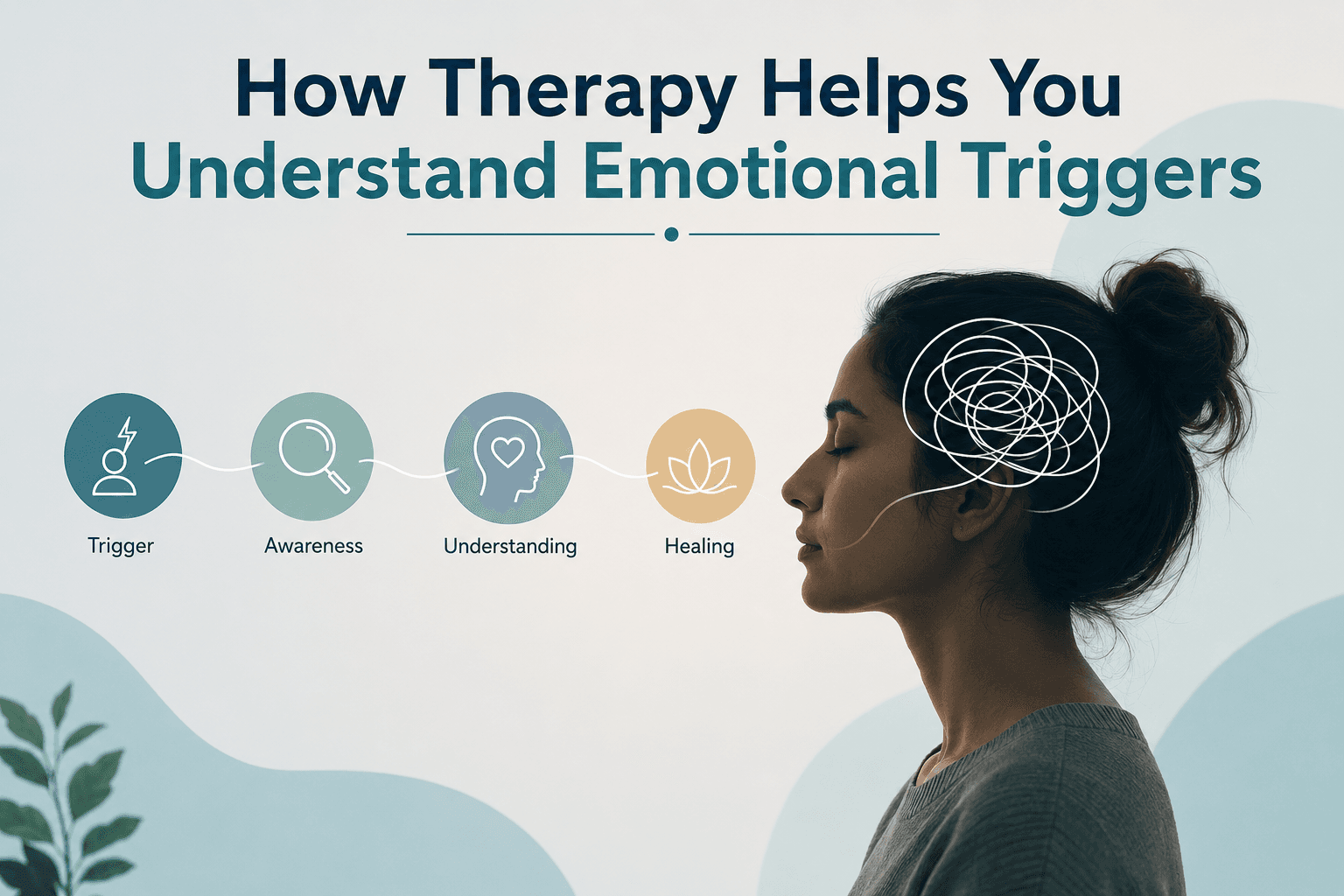
How Therapy Helps You Understand Emotional Triggers
How Therapy Helps You Understand Emotional Triggers
Introduction
Have you ever reacted strongly to a small comment, felt anxious after a simple conversation, or become upset without fully understanding why? These reactions may be connected to emotional triggers. An emotional trigger is a situation, word, memory, behaviour, or experience that produces an intense emotional response.
Triggers are not always obvious. A delayed reply may create fear of rejection. Constructive feedback may feel like personal criticism. A disagreement may bring up memories of earlier conflict. In these moments, the present situation may activate emotions connected to past experiences, unmet needs, or deeply held beliefs.
Understanding emotional triggers is not about blaming yourself for your reactions. It is about becoming aware of what is happening inside you so that you can respond more thoughtfully. Therapy can help people identify triggers, understand their origins, regulate difficult emotions, and develop healthier responses.
Working with an experienced Indian therapist, choosing therapy in India, or connecting with an Indian therapist online can provide structured and culturally sensitive support. For Indians living abroad, NRI counseling mental health services can help address triggers related to family expectations, cultural identity, relationships, loneliness, immigration stress, and the pressure to succeed.
What Are Emotional Triggers?
Emotional triggers are experiences that activate strong feelings such as anger, sadness, fear, shame, guilt, jealousy, or anxiety. The emotional response may feel much larger than the immediate situation appears to require.
For example, someone who grew up feeling ignored may become deeply upset when their partner becomes distracted during a conversation. A person who was frequently criticised as a child may feel ashamed when a manager gives ordinary feedback. Someone who experienced abandonment may panic when a friend cancels plans.
The trigger is the present event, but the emotional intensity may be connected to an earlier experience or belief.
Emotional triggers can also produce physical reactions. A person may experience a rapid heartbeat, sweating, muscle tension, stomach discomfort, trembling, or difficulty breathing. Thoughts, feelings, physical sensations, and behaviour can all influence one another.
A qualified therapist in India can help clients observe these connections without judging or dismissing their emotions.
Why Do Emotional Triggers Develop?
Triggers can develop from many different experiences. Childhood criticism, emotional neglect, bullying, rejection, betrayal, relationship conflict, loss, trauma, or repeated pressure may shape how a person reacts in the present.
Family and cultural environments also influence emotional responses. Some individuals are taught not to express sadness, anger, or vulnerability. Others may learn that love and approval depend on achievement, obedience, or meeting family expectations.
These beliefs can continue into adulthood. A person may become highly sensitive to criticism because mistakes were not accepted at home. Someone may struggle to set boundaries because they were taught that prioritising themselves is selfish. Another person may fear disagreement because conflict in their family felt unsafe.
Not every strong reaction is caused by trauma. Stress, poor sleep, burnout, hormonal changes, relationship problems, and physical exhaustion can also make people more emotionally reactive.
The purpose of therapy is not to search for one person or event to blame. It is to understand how earlier experiences, present circumstances, thoughts, and coping patterns interact.
How Therapy Helps Identify Emotional Triggers
The first step in managing triggers is learning to recognise them. Many people notice only the final reaction, such as anger, withdrawal, crying, or panic. Therapy helps slow down the experience and examine what happened before the reaction.
An India therapist may help you explore the situation, the thoughts that appeared, the emotions you felt, the physical sensations in your body, and the action you took. Over time, patterns often become visible.
You may discover that you feel most triggered when you are ignored, criticised, compared with others, excluded, controlled, or misunderstood. You may also notice that certain relationships, family conversations, or workplace situations repeatedly activate the same emotions.
The best therapists in India may use journaling, emotion tracking, mindfulness, body awareness, and guided conversation to help clients identify triggers in a way that feels manageable.
Understanding the Beliefs Behind Your Reactions
Emotional triggers are often connected to deeper beliefs about yourself, relationships, or the world.
A delayed message may activate the belief, “People always leave me.” Feedback may activate, “I am not good enough.” A partner asking for space may trigger, “I am being rejected.” Someone setting a boundary may be interpreted as, “They do not care about me.”
These beliefs can feel completely true in the moment, even when the present evidence does not support them.
Therapy helps clients examine where these beliefs came from and whether they still serve them. Cognitive Behavioural Therapy, or CBT, focuses on the relationship between thoughts, emotions, and behaviour and helps people develop more balanced ways of thinking and responding.
The aim is not to force positive thinking. It is to develop a more accurate and compassionate understanding of the situation.
Learning to Regulate Difficult Emotions
Recognising a trigger is important, but awareness alone may not immediately reduce the emotional intensity. Therapy also teaches emotional regulation skills.
A therapist may help you practise slowing your breathing, grounding yourself in the present, naming the emotion, noticing physical sensations, or taking a short pause before responding.
Naming emotions can create space between the feeling and the action. Instead of immediately reacting, you may learn to say, “I feel rejected and anxious right now,” or “This criticism is bringing up shame.”
Mindfulness can help clients observe thoughts and feelings without automatically treating them as facts. An online Indian therapist can teach these skills during virtual sessions and help clients practise them between appointments.
Changing Unhealthy Coping Patterns
People often develop coping behaviours to protect themselves from emotional pain. They may avoid difficult conversations, seek constant reassurance, become defensive, withdraw, overwork, please others, or try to control situations.
These responses may offer temporary relief but create long-term problems. Avoidance can increase anxiety. Reassurance-seeking may strain relationships. Anger may push away the people whose support is needed.
Therapy helps clients understand the purpose behind these behaviours and replace them with healthier alternatives. Instead of withdrawing, a person may learn to communicate that they need time to calm down. Instead of assuming rejection, they may ask for clarification. Instead of agreeing to everything, they may practise respectful boundaries.
This process takes time because coping patterns are often deeply learned. Progress means becoming more aware and choosing healthier responses more often, not reacting perfectly in every situation.
How Relationship Counselling Helps with Triggers
Emotional triggers frequently appear in close relationships because intimacy can activate fears involving rejection, abandonment, trust, control, and self-worth.
A couple may repeatedly argue about small issues when the deeper problem is that one partner feels unheard and the other feels constantly criticised. Without understanding the underlying trigger, both partners may continue reacting defensively.
Relationship counselling India services can help couples recognise these cycles, communicate emotions more clearly, and respond with greater empathy. Therapy can support couples dealing with jealousy, trust concerns, emotional distance, family involvement, cultural differences, or recurring conflict.
Culturally informed therapists in India can also understand how family expectations, arranged marriage experiences, gender roles, and intergenerational patterns may influence relationship triggers.
Emotional Triggers Among NRIs
Indians living abroad may face emotional triggers related to homesickness, isolation, discrimination, immigration uncertainty, career pressure, or feeling divided between two cultures.
A family call may activate guilt about living far away. Workplace criticism may intensify fears about visa stability or professional success. A partner’s different cultural expectations may create confusion or emotional distance.
NRI counseling mental health services provide a space to discuss these concerns with someone who understands both emotional experiences and Indian cultural contexts.
People may search for support using terms such as India therapist online, therapist online India, Indian therapists online, online Indian therapist, therapist India, therapists India, therapist Indian, or therapist, India. Whatever phrase is used, it is important to choose a qualified professional who offers confidentiality and culturally respectful care.
Can Emotional Triggers Completely Disappear?
Some triggers may become much less intense with therapy, while others may continue to appear occasionally. The goal is not always to remove every trigger. It is to understand the response and prevent it from controlling your decisions, relationships, and quality of life.
Progress may look like noticing the trigger earlier, calming down more quickly, communicating instead of withdrawing, or recovering without spending days replaying the situation.
Understanding emotional triggers can improve self-awareness, emotional regulation, relationships, and the ability to cope with everyday stress.
Conclusion
Therapy can help you understand emotional triggers by identifying patterns, exploring their origins, examining the beliefs behind your reactions, and teaching healthier coping skills.
Whether you choose Indian therapy, an in-person therapist in India, an Indian therapist online, or specialised NRI counseling mental health, professional support can help you respond to difficult emotions with greater clarity and self-compassion.
At India Therapist, Indians and NRIs worldwide can connect with culturally sensitive Indian psychologists for confidential online therapy. You do not have to wait until emotional reactions begin damaging your relationships or daily life. Understanding your triggers can be the first step toward feeling calmer, communicating more clearly, and creating healthier emotional patterns.
Take the First Step with India Therapist
When the same situations repeatedly create intense emotions, professional support can help you understand why. Connect with a compassionate online Indian therapist through India Therapist to identify your triggers, manage difficult emotions, and build healthier responses.
Ready to talk to someone who understands?
Connect with an Indian therapist who speaks your language and understands your cultural context.