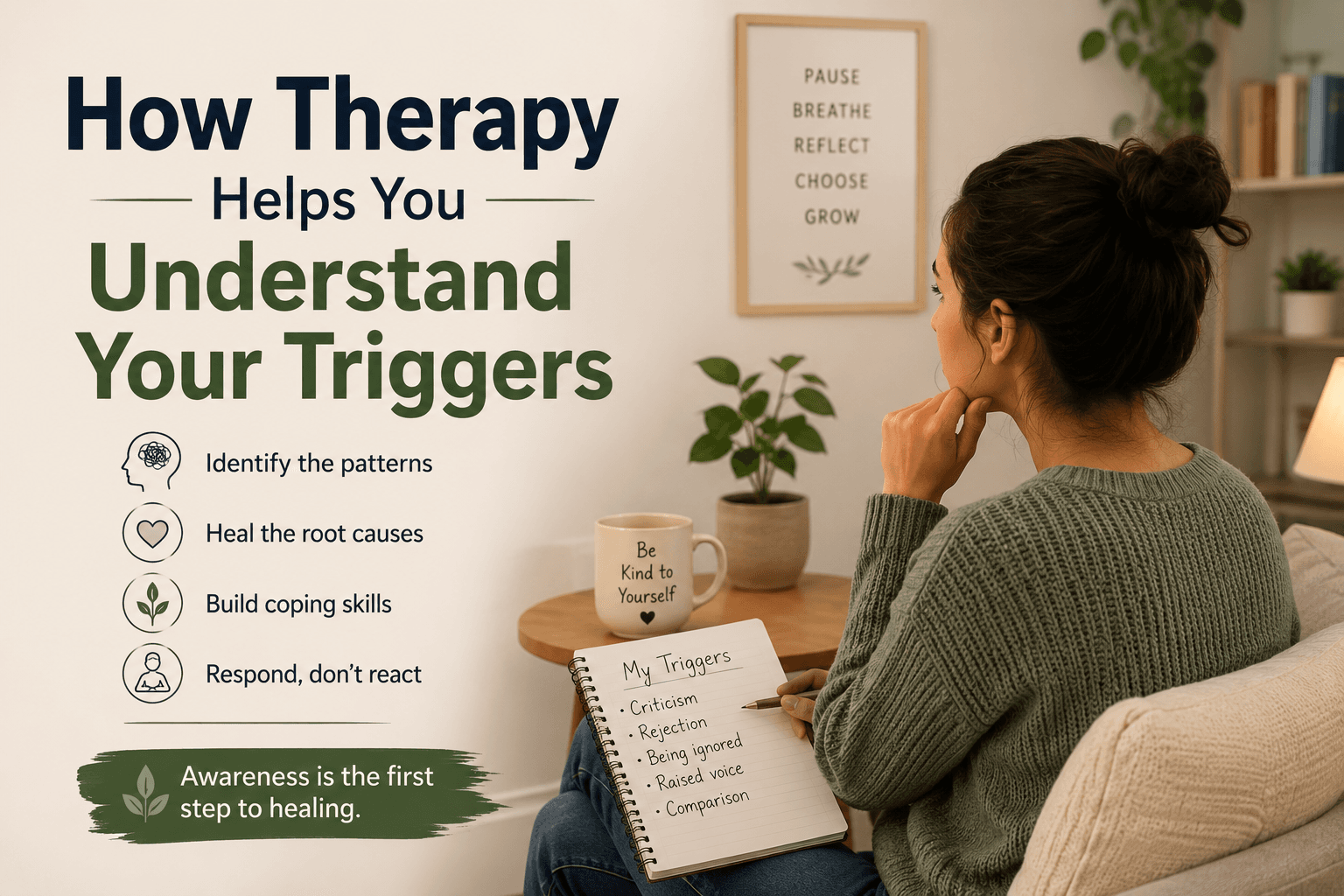
How Therapy Helps You Understand Your Triggers
How Therapy Helps You Understand Your Triggers
Many people react strongly to certain situations without fully understanding why. A small comment may ruin the whole day. A delayed reply may create anxiety. A disagreement may feel much bigger than it actually is. Sometimes, the present moment seems small, but the emotional reaction feels intense. This is often because of emotional triggers.
A trigger is not a sign that you are weak or overreacting. It is usually a sign that something deeper inside you has been touched. Triggers are often connected to past experiences, anxiety, unresolved pain, trauma, emotional neglect, or repeated patterns from childhood and relationships.
At India Therapist, many clients come to therapy saying, “I know my reaction was big, but I don’t know why.” Therapy helps people slow down, understand what their triggers are, where they come from, and how to respond with greater awareness instead of automatic fear, anger, or shutdown.
Understanding your triggers is one of the most powerful steps in emotional healing.
What Are Emotional Triggers?
Emotional triggers are situations, words, behaviors, or memories that activate a strong emotional response. A trigger can bring up fear, sadness, anger, shame, panic, or emotional withdrawal, even if the current situation does not fully explain the intensity of the reaction.
For example, you may feel deeply upset when someone ignores your message, criticizes your work, raises their voice, or seems disappointed in you. On the outside, these may look like ordinary situations. But inside, they may activate an older emotional wound.
Triggers are often connected to experiences where you once felt unsafe, unseen, rejected, controlled, abandoned, criticized, or emotionally overwhelmed. Therapy helps you recognize that a trigger is not only about what is happening now. It is often about what your mind and body remember.
Why Triggers Feel So Strong
Triggers feel powerful because they activate both emotion and memory. Even when you are not consciously thinking about the past, your nervous system may react as if an old hurt is happening again.
This is why a small event in the present can create a very big emotional response. A delayed reply may trigger abandonment fears. A critical tone may trigger childhood criticism. Being left out may trigger old feelings of rejection. Conflict may trigger fear if anger once felt unsafe in your home.
Many people blame themselves for being “too sensitive,” but sensitivity is not the real issue. Often, the reaction is connected to unresolved emotional pain.
A therapist in India can help you understand these reactions with compassion rather than shame.
The Link Between Triggers, Anxiety, and Trauma
Triggers are closely connected to anxiety and trauma. Anxiety often makes the mind scan for danger, even in ordinary situations. Trauma teaches the nervous system to stay alert, protect itself, and expect pain.
This does not always mean a person experienced one major traumatic event. Trauma can also come from emotional neglect, constant criticism, instability, rejection, family conflict, or never feeling emotionally safe.
Over time, the mind learns to react quickly in order to protect you. The problem is that it may continue using old survival responses even when the current situation is different.
This is why therapy in India often focuses not just on behavior, but on the deeper emotional story behind the behavior. Once you understand the root, your reactions begin to make more sense.
Common Signs That You Are Triggered
A trigger can show up in many ways. Some people react outwardly, while others shut down inwardly.
You may notice:
Sudden anxiety or panic
Overthinking after a conversation
Feeling rejected very quickly
Getting defensive during feedback
Shutting down during conflict
Feeling emotionally numb
People-pleasing to avoid tension
Anger that feels bigger than the situation
Crying unexpectedly
Wanting to withdraw or disappear
Some people also experience physical signs such as a tight chest, racing heart, stomach discomfort, trembling, restlessness, or mental fog. This is because triggers affect both the mind and body.
A therapist helps you identify these signs early so you can respond with awareness instead of being fully controlled by them.
How Therapy Helps You Identify Your Triggers
One of the first ways therapy helps is by increasing emotional awareness. Many people know they are upset but do not know exactly what activated them. Therapy helps you notice patterns.
A therapist may ask questions like:
What happened right before you felt this way?
What emotion came up first?
What did you tell yourself in that moment?
Have you felt this same way before?
Does this situation remind you of anything familiar?
These questions help connect the present reaction to the deeper emotional wound behind it. Over time, you begin to recognize your triggers more clearly.
For example, you may realize that you are not just upset about a missed call. You are triggered by feeling unimportant. You are not only stressed by feedback. You are triggered by old fears of failure or rejection.
This level of self-awareness is a major part of emotional healing.
Therapy Helps You Understand the Root Cause
Triggers do not come from nowhere. Therapy helps you go beyond surface reactions and understand the emotional history behind them.
Some triggers may come from:
Childhood criticism
Emotional invalidation
Abandonment or neglect
Family pressure
Unpredictable parenting
Bullying
Relationship betrayal
Shame around emotions
Repeated rejection
Past trauma
At IndiaTherapist.com, many clients find relief simply by understanding that their reactions are connected to real experiences. They stop seeing themselves as “dramatic” and start seeing themselves as someone carrying emotional pain that deserves care.
This shift from self-blame to self-understanding is powerful.
Therapy Teaches Coping Skills for Triggers
Understanding triggers is important, but therapy also helps you manage them in healthier ways. This is where coping skills become essential.
Coping skills do not erase triggers overnight, but they help you stay grounded when they arise.
Therapy may teach you skills such as:
Deep breathing and grounding techniques
Naming the emotion you are feeling
Pausing before reacting
Journaling emotional patterns
Challenging anxious thoughts
Practicing self-compassion
Setting boundaries
Communicating your needs clearly
Learning how to calm the nervous system
These tools help you move from automatic reaction to conscious response. Instead of being pulled completely into fear, anger, or shutdown, you begin to feel more in control.
How Therapy Helps With Relationships and Triggers
Triggers often show up strongly in relationships. A partner’s silence, a family member’s tone, or a friend’s distance may activate deep feelings of rejection, guilt, or insecurity.
Without awareness, triggers can create repeated conflict. You may overreact, withdraw, over-apologize, or expect others to understand pain you have not yet fully understood yourself.
Relationship counselling India can help individuals and couples recognize how triggers affect communication, emotional safety, and conflict. Therapy teaches healthier ways to express feelings, ask for reassurance, and respond to one another with empathy.
When people understand their triggers, relationships often become less reactive and more connected.
Why This Matters for NRIs
For NRIs, triggers can be shaped by many emotional pressures: homesickness, loneliness, cultural disconnection, work stress, family expectations, and the pressure to succeed abroad.
A small conflict at work may trigger feelings of not belonging. Distance from family may trigger guilt. A relationship issue may feel heavier because there is less in-person support.
NRI counselling mental health support with an Indian therapist online can be especially helpful because cultural context matters. Therapy gives NRIs a space where emotional triggers are understood not just psychologically, but culturally as well.
Healing Is Not About Never Being Triggered Again
Therapy does not make you emotionless. The goal is not to remove every difficult feeling forever. The goal is to help you understand your triggers so they no longer control your life in the same way.
Healing means you begin to notice the trigger sooner. You understand why it is happening. You respond with more compassion. You learn that the feeling is real, but it does not have to define the entire moment.
With time, the same trigger may feel less overwhelming. The old wound begins to soften because it is finally being understood.
You Can Learn to Feel Safe Within Yourself
If certain situations keep affecting you deeply, there is a reason. You do not need to judge yourself for it. You need support, awareness, and healing.
Therapy helps you understand your triggers, reduce anxiety, process unresolved pain, and build coping skills that support emotional wellbeing.
At India Therapist, individuals and NRIs can connect with trusted Indian therapists online, therapists in India, and mental health professionals who help with anxiety, trauma, emotional triggers, coping skills, relationship struggles, and personal growth.
📱 WhatsApp: +1 (425) 442-4167
💬 Message: “Hi, I’d like to connect with a therapist.”
Because your triggers are not random.
They are messages.
And therapy helps you understand them.
Ready to talk to someone who understands?
Connect with an Indian therapist who speaks your language and understands your cultural context.