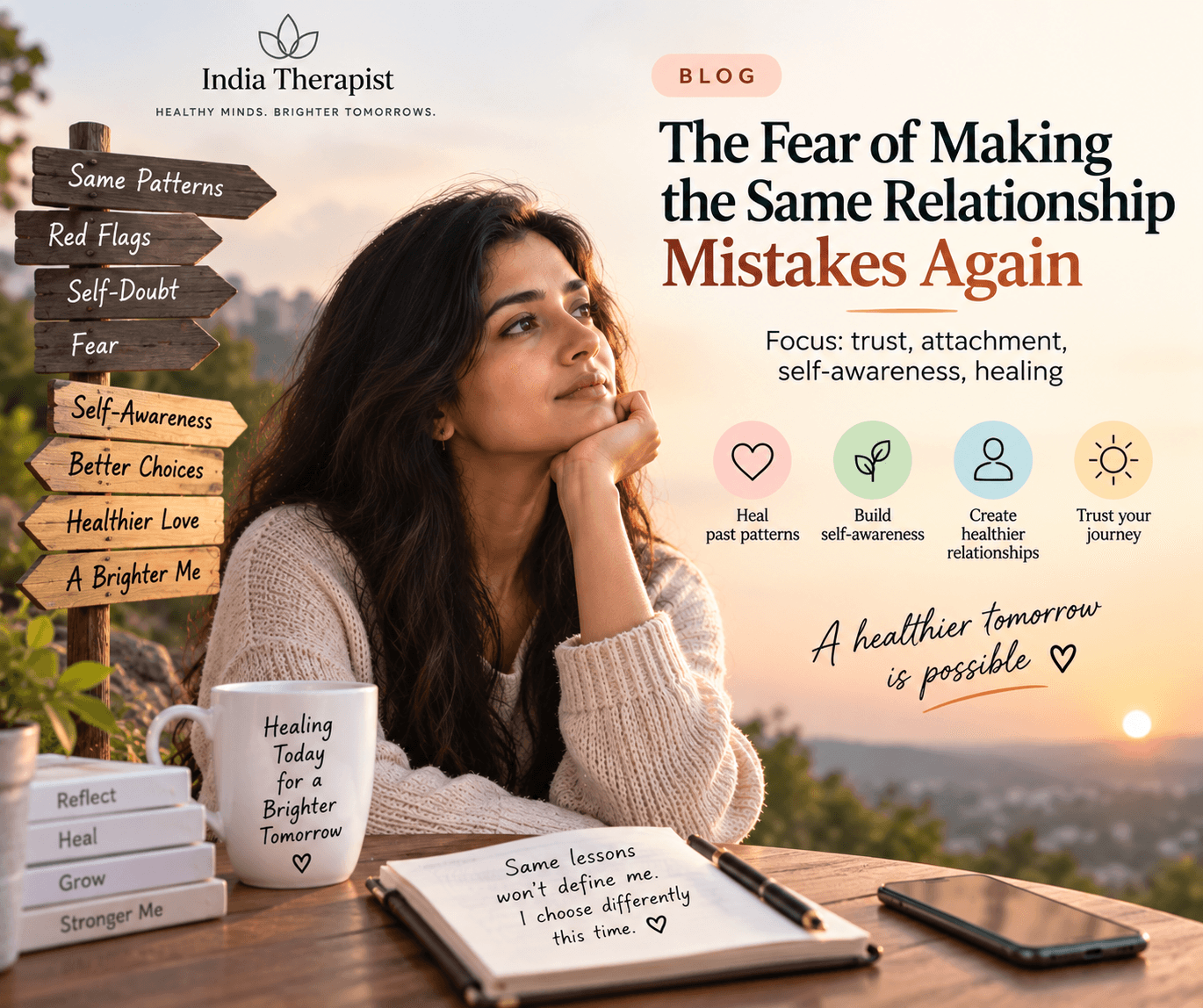
The Fear of Making the Same Relationship Mistakes Again
The Fear of Making the Same Relationship Mistakes Again
Focus: Trust, attachment, self-awareness, healing
After a painful relationship ends, one of the hardest fears is not simply being alone. It is wondering whether the same pattern will happen again. You may ask yourself, “What if I choose the wrong person again?” “What if I miss the warning signs?” or “What if I end up in the same kind of relationship with someone different?”
This fear can make new relationships feel emotionally risky. You may want connection, but another part of you may stay guarded. You may question your instincts, overanalyze small behaviors, or compare every new person with someone from your past.
At India Therapist, many people come to therapy because they want healthier relationships but do not fully trust themselves anymore. Therapy can help you understand the patterns behind past choices, recognize attachment wounds, strengthen self-awareness, and rebuild trust in your ability to make healthier decisions.
Why Past Relationship Pain Can Affect Future Choices
When a relationship ends badly, it is natural to look back and ask what went wrong. You may think about the red flags you ignored, the boundaries you did not set, or the moments when you stayed even though something felt wrong.
Reflection can be useful, but it can also become self-blame. You may begin to believe that you cannot trust your own judgment.
The truth is that most people make relationship decisions based on what they know, feel, and understand at that time. You may have loved the person, believed their promises, hoped things would improve, or felt pressure from family or society to make the relationship work.
A therapist in India can help you understand the past with more compassion. The goal is not to punish yourself for what happened. It is to learn from the experience without letting it make you afraid of every future relationship.
Attachment Patterns Can Repeat Without You Realizing It
Attachment plays a major role in how people experience closeness, trust, rejection, and emotional safety. Sometimes, people are drawn toward familiar emotional patterns even when those patterns are unhealthy.
If you grew up around inconsistent affection, you may feel strongly attracted to partners who are warm one day and distant the next. If you learned that love requires sacrifice, you may become the person who constantly overgives. If emotional closeness once felt unsafe, you may pull away when someone starts getting too close.
These patterns do not mean something is wrong with you. They often developed as ways of protecting yourself emotionally.
An Indian therapist online can help you recognize attachment patterns and understand how they show up in relationships. Once you become aware of the pattern, you have more choice about whether to repeat it.
Fear Can Make You Look for Red Flags Everywhere
After being hurt, caution can become hypervigilance. You may begin analyzing every message, tone change, disagreement, or delay in communication.
A small misunderstanding may feel like proof that the relationship is going in the wrong direction. You may become suspicious of kindness because you are afraid it will disappear later. You may also test the other person repeatedly to see whether they will leave.
Some caution is healthy. But when fear becomes too strong, it can make genuine connection difficult.
Therapy helps you learn the difference between a real warning sign and a trigger from your past. Instead of reacting immediately, you can pause and ask yourself whether the current situation is actually unsafe or simply reminds you of something painful.
Self-Awareness Helps You Notice Your Own Patterns
Healing is not only about identifying unhealthy behavior in other people. It is also about understanding your own responses.
You may notice that you avoid difficult conversations because you fear conflict. You may stay silent when something hurts you because you do not want to appear demanding. You may become emotionally attached quickly because attention feels reassuring. Or you may push people away before they have the chance to disappoint you.
Therapy helps you become curious about these reactions rather than ashamed of them.
You can start asking:
What usually attracts me to someone?
What do I ignore when I really like a person?
What makes me afraid of losing a relationship?
What boundaries do I struggle to maintain?
What does emotional safety actually feel like to me?
These questions build self-awareness and make future choices more intentional.
Healthy Boundaries Can Change Relationship Patterns
One of the strongest protections against repeating unhealthy patterns is learning how to set boundaries.
Boundaries help you recognize what you need and what you cannot accept. They also help you see how another person responds when you communicate those needs.
A healthy partner may not always agree with you, but they should be able to respect your boundaries, listen to your concerns, and communicate without intimidation or manipulation.
Therapy can help you become more comfortable saying things like, “That does not feel okay to me,” “I need time,” or “I want us to talk about this before moving forward.”
Boundaries are not walls. They are one of the ways trust is built safely.
Trust Should Be Built Slowly
After a painful relationship, you may feel pressure either to trust completely or not trust at all. Healthy trust usually develops gradually.
You can observe whether someone's actions match their words. You can notice how they respond to disappointment, conflict, and boundaries. You can see whether they are consistent rather than relying only on chemistry or intensity.
Trust grows through repeated experiences of respect and reliability.
Therapy in India can help you understand what healthy trust looks like so you do not feel pressured to give someone complete emotional access before they have earned it.
Family Pressure Can Make Relationship Decisions Harder
For many Indians, relationship decisions are rarely completely private. Family may have opinions about whom you date, when you marry, whether you should reconcile, or how quickly you should move forward after a breakup or divorce.
This can make it harder to hear your own instincts. You may choose someone because they are approved by family, stay in a relationship because you fear social judgment, or ignore your discomfort because everyone else thinks the match is good.
Therapy helps you separate family guidance from your own emotional reality.
You can respect your family while still asking whether a relationship feels safe, respectful, and right for you.
Healing Means Trusting Yourself Again
The goal of therapy is not to make sure you never experience another difficult relationship. No one can guarantee that. The goal is to strengthen your ability to notice problems, communicate clearly, set boundaries, and make decisions when something no longer feels healthy.
Self-trust means believing that if you notice a pattern, you can respond differently. If someone repeatedly disrespects you, you can speak up. If a relationship becomes unhealthy, you can ask for support or leave. If you make a mistake, you can learn from it instead of deciding that you cannot trust yourself anymore.
At India Therapist, culturally sensitive therapists in India and Indian therapists online can help people work through attachment wounds, relationship anxiety, fear of repeating the past, self-worth, and emotional healing.
Your Past Can Teach You Without Controlling You
Past relationships can leave scars, but they can also leave knowledge. You may now understand your needs more clearly. You may recognize red flags earlier. You may know which boundaries matter to you and what kind of communication feels healthy.
The past does not have to become a prediction of your future.
You do not need to enter every new relationship expecting pain. You also do not need to ignore what you learned in order to love again.
Healing means carrying the wisdom forward while leaving the fear behind. Therapy can help you trust yourself enough to choose differently, communicate more clearly, and build relationships from awareness instead of old wounds.
Ready to talk to someone who understands?
Connect with an Indian therapist who speaks your language and understands your cultural context.