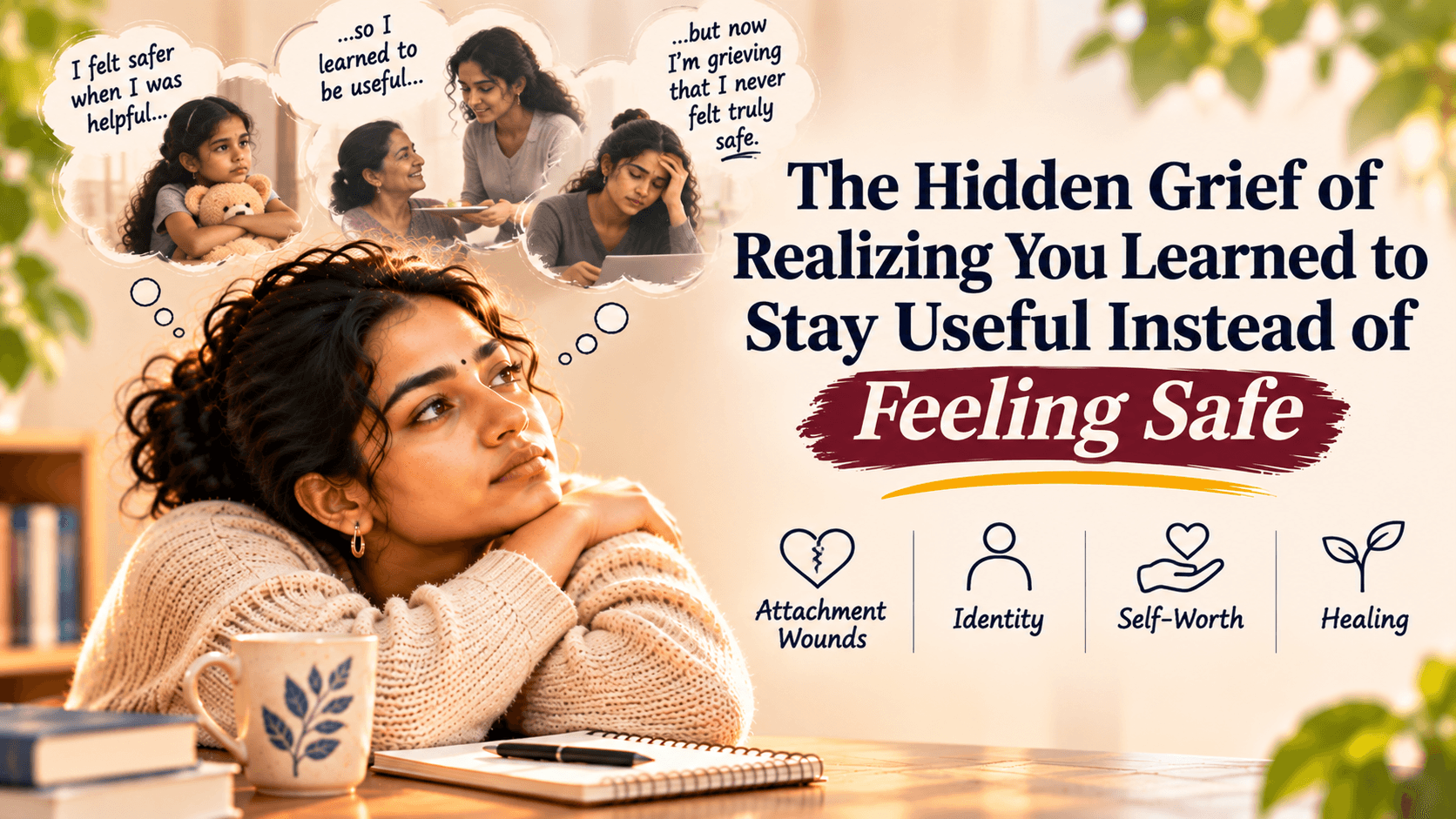
The Hidden Grief of Realizing You Learned to Stay Useful Instead of Feeling Safe
The Hidden Grief of Realizing You Learned to Stay Useful Instead of Feeling Safe
Focus: Attachment wounds, identity, self-worth, healing
Sometimes the hardest realization is not that you were doing too much for everyone else. It is realizing why you were doing it. You may have learned early that being useful, dependable, helpful, or emotionally available made relationships feel safer. If people needed you, appreciated you, or relied on you, perhaps you felt less likely to be rejected or forgotten.
Over time, usefulness can become a survival strategy. You may become the person who solves problems, listens without judgment, keeps everything organized, and makes life easier for others. From the outside, this can look like strength. Inside, however, you may be carrying a quieter belief: “If I stop being useful, will I still be loved?”
At India Therapist, many people come to therapy after realizing that they learned how to be needed before they learned how to feel emotionally safe. Therapy can help you understand the attachment wounds behind this pattern, reconnect with your identity, strengthen self-worth, and build relationships where you do not have to earn security through usefulness.
Why Usefulness Can Feel Safer Than Vulnerability
Being useful gives you something concrete to do. You can solve a problem, offer advice, help someone feel better, or take responsibility for something that needs to be handled. That role can feel much safer than simply trusting that someone will care about you without needing anything from you.
Vulnerability works differently. It asks you to believe that you can be tired, uncertain, imperfect, or emotionally needy and still remain worthy of love. If that kind of safety was not consistently available earlier in life, usefulness may have become the easier path.
A therapist in India can help you recognize that this pattern was often an adaptation, not a personal failure. You learned how to create security using the tools that felt available to you.
Attachment Wounds Can Make Being Needed Feel Like Protection
Attachment wounds can develop when closeness feels inconsistent, unpredictable, or conditional. You may have learned that attention came more reliably when you were helpful, mature, responsible, or emotionally easy to deal with.
Because of this, being needed can begin to feel like protection against abandonment. If someone depends on you, perhaps they are less likely to leave. If you become important enough, maybe the relationship feels safer.
An Indian therapist online can help you understand how these old attachment patterns may still shape present relationships. You may no longer be in the same environment, but your nervous system may still believe that usefulness is the safest way to stay connected.
Healing means learning that security can come from trust, consistency, and mutual care instead of dependence.
Identity Can Become Built Around Being the Helpful One
When people repeatedly praise you for being dependable, responsible, or emotionally strong, those qualities can become central to your identity. You may begin thinking of yourself as the person who handles things, keeps everyone calm, and rarely needs much in return.
This identity can feel meaningful, but it can also become restrictive. If you are always the useful one, there may be very little room to be confused, exhausted, vulnerable, or in need of support yourself.
Therapy helps you explore who you are beyond the roles you perform for other people. You may discover parts of yourself that have been overshadowed by responsibility, including curiosity, creativity, playfulness, rest, ambition, or needs that you learned to ignore.
You are more than the function you serve in other people’s lives.
Self-Worth Can Become Tied to What You Provide
If usefulness has been one of the main ways you receive appreciation, self-worth can become dependent on what you do for others. You may feel valuable when someone needs your help and strangely empty when there is nothing to solve.
This can create a cycle of over-functioning. You keep finding ways to help, advise, organize, or support because each act temporarily reassures you that you matter.
The problem is that this kind of self-worth is unstable. The moment someone becomes more independent, needs less help, or turns to someone else, insecurity can appear.
Therapy helps you build a more internal sense of worth. You can be valuable when you are helpful, but also when you are resting, receiving support, making mistakes, or simply existing without proving anything.
You May Have Learned to Notice Everyone Except Yourself
People who become highly useful often become very skilled at noticing what everyone else needs. You may know when someone is overwhelmed, what will make them feel better, or what problem needs to be solved before they even ask.
Over time, that outward attention can make it difficult to notice yourself. You may know exactly what your partner, family, or friends need while struggling to answer, “What do I need right now?”
Therapy in India can help you redirect some of that attention inward. Learning to notice your own emotions, fatigue, preferences, and limits is an important part of healing.
Your needs do not become less important simply because you became skilled at managing everyone else’s.
Feeling Safe Is Different From Feeling Needed
Being needed can create temporary security because it gives you a clear role. You know what you contribute and why the other person keeps turning to you.
Feeling safe is quieter. It means trusting that you can remain connected even when nobody needs anything. You can say no, take space, make mistakes, and still believe that the relationship can survive.
This kind of security may feel unfamiliar if usefulness has always been your main way of staying close.
Therapy can help you gradually tolerate relationships where connection does not depend on performance. You begin learning that someone can value you because of who you are, not only because of what you provide.
You May Feel Anxious When People Become More Independent
If being needed has made you feel secure, another person’s independence can trigger unexpected anxiety. They may start solving their own problems, relying on other sources of support, or becoming more confident in their own decisions.
You may genuinely want this growth for them while also feeling unsettled. Part of you may wonder whether their independence means your importance is shrinking.
Therapy helps you separate independence from rejection. Someone becoming more capable does not automatically mean they care about you less.
Healthy relationships allow both people to grow without requiring one person to remain dependent so the other can feel safe.
Over-Giving Can Become a Way to Protect Relationships
You may give more time, attention, energy, or emotional support than you actually have because giving feels protective. If you are helpful enough, perhaps nobody will be disappointed. If you stay available enough, maybe they will not pull away.
This can look generous, but over time it becomes exhausting. You may start resenting people for needing what you repeatedly offered because the giving was not always coming from genuine capacity.
Therapy helps you notice the difference between generosity and fear-driven over-giving. You can still be kind without using self-sacrifice as insurance against rejection.
Your relationships become healthier when your care comes from choice rather than anxiety.
You May Struggle to Let Other People Care for You
When usefulness becomes part of your identity, receiving care can feel uncomfortable. You may be very comfortable helping someone else but minimize your own needs when they ask how you are doing.
You may say, “I’m fine,” because you do not want to become a burden. You might worry that needing support changes how others see you or makes you less valuable.
Over time, this creates relationships where people know how to rely on you but may not fully know your vulnerable side.
Therapy helps you practice receiving. Allowing someone else to help, comfort, or support you can challenge the belief that your worth depends on always being the stronger person.
The Grief Comes From Realizing How Long You Lived This Way
There can be real grief in realizing how much of your life was organized around being useful. You may look back and notice how often you ignored exhaustion, stayed in one-sided relationships, or made yourself indispensable because it felt safer than asking whether you were genuinely cared for.
This grief can include sadness for the parts of yourself that did not receive enough attention. You may wonder who you would have become if you had felt secure enough to simply be yourself.
Therapy can help you process this grief without turning it into self-blame. The pattern often developed for a reason, and understanding that reason can create compassion for the version of you who was trying to stay emotionally safe.
Healing is not about judging the past. It is about creating something different now.
Family Roles Can Reinforce the Need to Stay Useful
For many Indians, being responsible within the family can be deeply valued. You may have become the child who helps parents, the sibling who handles problems, or the person relatives turn to when something needs to be organized.
These roles can create pride and connection, but they can also reinforce the belief that usefulness is what makes you valuable within the family.
At India Therapist, culturally sensitive therapists understand how family duty, emotional responsibility, and identity can become deeply intertwined.
Therapy can help you remain caring and involved without believing that your worth depends on how much you manage for everyone else.
Healing Requires Learning That Rest Does Not Make You Less Valuable
People who build identity around usefulness often struggle to rest. If there is nothing productive happening, guilt can appear quickly.
You may think about who you could help, what task you could finish, or what responsibility you are neglecting. Rest can feel like wasted time rather than something your body and mind need.
Therapy helps you challenge the belief that value comes from constant output. You are allowed to rest before you are exhausted. You are allowed to have moments where nobody needs anything from you.
Learning to rest without guilt can be a powerful way of teaching yourself that your worth remains even when you are not performing.
You Are Allowed to Ask What You Want
When usefulness dominates your identity, your decisions may become organized around what other people need. You may choose based on what will make life easier for family, partners, friends, or colleagues.
Over time, you can lose contact with your own preferences.
Therapy can help you begin asking different questions: “What do I want?” “What feels right for me?” “What am I tired of?” and “What would I choose if I did not have to prove my usefulness?”
These questions may feel unfamiliar at first, but they help rebuild an identity that belongs to you.
How Therapy Helps You Move From Usefulness Toward Safety
Therapy can help you explore when usefulness became connected to love and emotional security. You may discover patterns related to childhood responsibility, inconsistent affection, family roles, previous abandonment, or relationships where your value seemed tied to what you provided.
Understanding these patterns helps you respond with more choice.
Therapy can help you strengthen self-worth, reduce over-functioning, build emotional boundaries, practice receiving care, tolerate other people’s independence, and develop a stronger sense of identity outside the helper role.
At India Therapist, culturally sensitive therapists in India and Indian therapists online can support people navigating attachment wounds, self-neglect, relationship insecurity, emotional exhaustion, and the pressure to remain useful.
Security Means You Can Be Known, Not Just Needed
Being needed tells you what you can do for someone. Being known allows someone to see who you actually are.
They see your strengths and your uncertainty. They know when you are tired, what you enjoy, what scares you, and what you need. You do not have to hide difficult parts of yourself in order to remain lovable.
This kind of connection may initially feel more vulnerable because there is less performance protecting you.
But over time, being known can create a deeper sense of security than being indispensable ever could.
Your Relationships Can Survive You Doing Less
One of the fears behind usefulness is that relationships will weaken if you stop giving so much. Some relationships may indeed change when you begin setting boundaries.
That does not necessarily mean the boundaries are wrong.
Healthy relationships can adjust. People who genuinely care about you can learn to handle more responsibility, respect your limits, and remain connected even when you are not constantly solving problems for them.
Therapy can help you tolerate this transition without automatically returning to old patterns simply because change feels uncomfortable.
You Do Not Have to Earn Safety Through Usefulness
Emotional safety should not require constant performance. You should not have to remain endlessly helpful, agreeable, dependable, or emotionally available in order to feel confident that you belong.
You deserve relationships where you can have needs too. You deserve connection that survives your boundaries, your rest, and your imperfect moments.
Therapy helps you move from “If I stay useful, maybe I will be safe” to “I can build relationships where I feel safe enough to be myself, even when I have nothing to prove or provide.”
Ready to talk to someone who understands?
Connect with an Indian therapist who speaks your language and understands your cultural context.