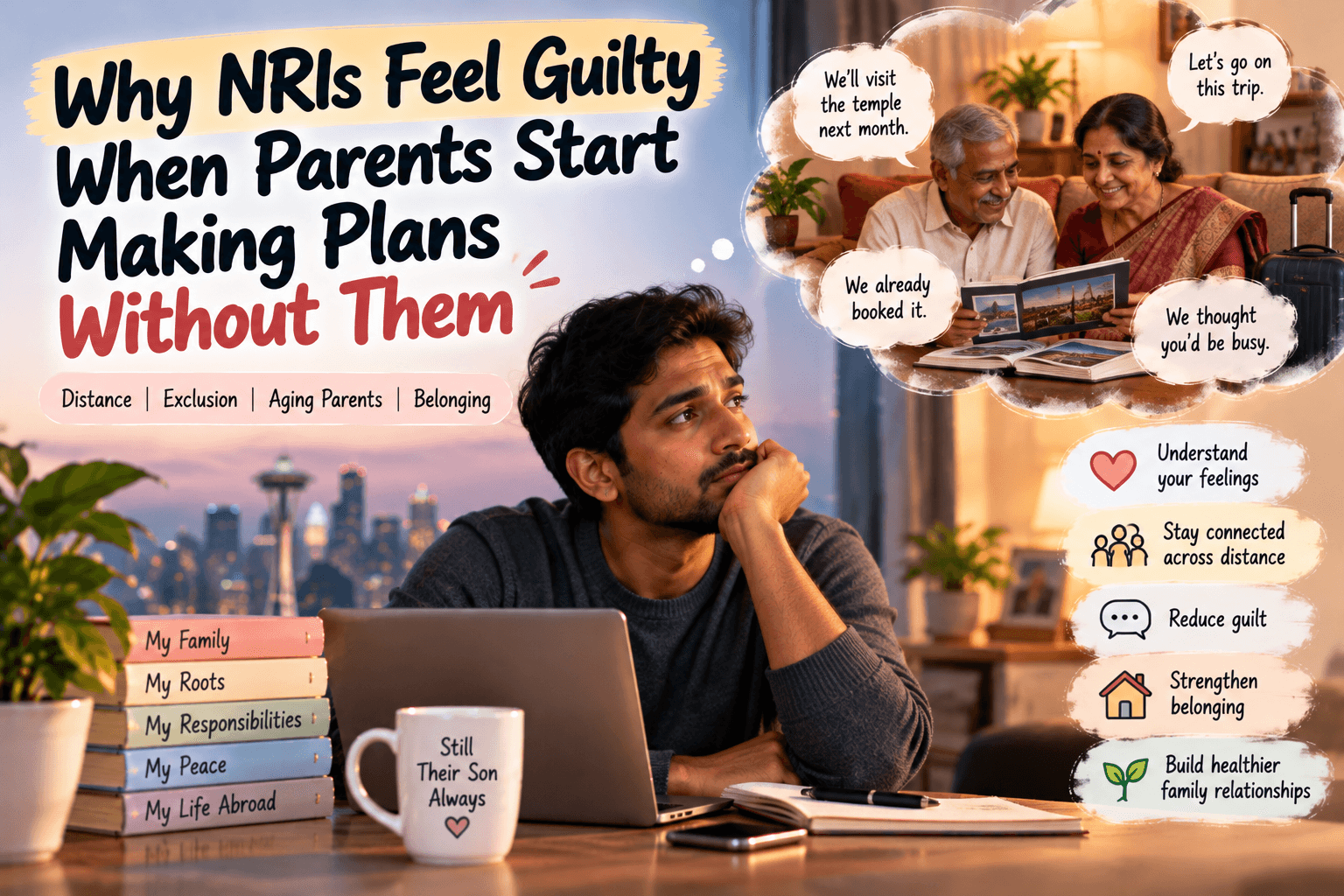
Why NRIs Feel Guilty When Parents Start Making Plans Without Them
Why NRIs Feel Guilty When Parents Start Making Plans Without Them
Focus: Distance, exclusion, aging parents, belonging
One of the quieter emotional struggles of living abroad is realizing that family life back home continues without you. At first, this may seem normal. Parents make decisions, attend events, visit relatives, plan trips, handle appointments, and manage daily life. But over time, you may notice something changing: they stop checking with you before making plans.
That can hurt more than expected.
You may suddenly think, “Do they not need me anymore?” or “Am I becoming less important in their life?” For many NRIs, this creates a complicated mix of guilt, sadness, exclusion, and grief. At India Therapist, many NRIs seek therapy because they feel emotionally caught between the life they built abroad and the family life that keeps moving forward in India. Therapy can help you process these feelings without turning every family decision into proof that you no longer belong.
Why Being Left Out Can Feel So Personal
When you live far away, you already miss many ordinary moments. You may not be there for spontaneous dinners, small family conversations, neighborhood events, or last-minute decisions. Because of that, being included in plans can become an emotional reminder that you are still part of the family.
So when parents suddenly say, “We already decided,” or “We thought you would be busy,” it can feel like more than a scheduling issue. It can feel like emotional distance.
A therapist in India can help you understand that the pain often comes from what the decision represents. You may not actually need to approve every family plan. What you may be missing is the feeling that your presence still matters.
Parents May Be Adapting to Your Absence
Sometimes parents start making plans without you because they have learned to adapt. They may know you are busy, living in another time zone, or handling responsibilities abroad. Over time, they may stop asking simply because they do not want to disturb you.
This can create a painful misunderstanding. From their side, they may believe they are making life easier for you. From your side, it may feel like you are slowly being removed from family life.
Therapy can help you separate intention from impact. Your parents may not be excluding you emotionally, even if the situation feels excluding. Sometimes the healthiest step is an honest conversation about wanting to stay involved, even when you cannot physically participate.
Aging Parents Can Make This Feeling Stronger
This can become even more emotional as parents get older. You may notice that they are making healthcare decisions, travel plans, financial choices, or family arrangements without involving you as much as before.
That can trigger fear.
You may think, “What if something happens and I do not know?” or “What if they stop telling me things because I am too far away?” You may feel guilty that another sibling, relative, or neighbor knows more about their daily life than you do.
An Indian therapist online can help you process the grief underneath this fear. Sometimes the pain is not only about missing one plan. It is about realizing that your parents are building routines that no longer naturally include you.
Guilt Can Make You Overcompensate
When NRIs feel left out, guilt often follows. You may start calling more frequently, trying to manage more from abroad, booking extra trips, or becoming overly involved in decisions because you are afraid of losing connection.
At first, this may feel like care. But if it is driven mainly by guilt, it can become exhausting.
You may start thinking, “I need to prove that I still care,” or “I have to stay involved in everything because I am not physically there.” Therapy helps you recognize that love does not have to be proved through constant monitoring or over-functioning.
Connection can still be strong even when daily life is no longer shared in the same way.
Siblings Back Home Can Become Part of the Emotional Conflict
If you have siblings living closer to your parents, this dynamic can become even more complicated. They may naturally know more about appointments, family plans, household problems, or your parents’ daily routines simply because they are nearby.
You may feel grateful that someone is there while also feeling jealous, guilty, or replaced. These feelings can be difficult to admit because you may believe you should only feel thankful.
But both can be true.
You can appreciate what your sibling does and still grieve the closeness that distance has changed. NRI counselling mental health support can help you process those emotions without turning them into conflict or self-judgment.
Why Belonging Changes When You Live Abroad
Living abroad often changes your sense of belonging in subtle ways. You may still think of your parents’ home as “home,” but each visit reminds you that routines have changed. Furniture moves. Family roles shift. Parents develop new habits. Relatives stop updating you about small things.
None of this means you are unloved. But it can create a feeling that you are becoming a visitor in a place that once felt completely yours.
Therapy helps you understand that belonging can evolve. You may no longer belong in exactly the same way you did before moving abroad, but that does not mean the connection is gone. It may simply need to be rebuilt in a new form.
How Therapy Helps With Feelings of Exclusion
Therapy gives you space to talk about emotions that may otherwise feel embarrassing. You may not want to tell your parents, “I feel hurt that you planned this without me,” because you worry it will sound childish or controlling.
But underneath that sentence may be a much deeper need: “I still want to feel like part of this family.”
Therapy can help you:
understand why exclusion feels so painful
separate guilt from genuine responsibility
process grief around changing family roles
communicate with parents more openly
reduce anxiety about being forgotten
handle sibling comparisons
build connection without overcompensating
create a healthier sense of belonging across distance
At India Therapist, culturally sensitive therapists in India and Indian therapists online can support NRIs dealing with family distance, aging parents, guilt, belonging, and emotional disconnection.
You Can Ask to Be Included Without Controlling Everything
Sometimes the solution is not more involvement in every decision. It is better communication.
You might tell your parents, “You do not need my permission, but I would still like to know what is happening.” That kind of conversation can help both sides understand each other better.
You can also create new ways of staying involved: regular family calls, shared photo groups, updates after appointments, or planning certain decisions together. Small routines can help you feel connected without making everyone feel monitored.
Therapy helps you find that balance between connection and control.
Family Life Moving On Does Not Mean You Were Replaced
One of the hardest truths about living abroad is that life at home continues. Parents adapt. Siblings take on new responsibilities. Family traditions change. People learn to function without your physical presence.
That reality can hurt.
But adaptation does not equal replacement.
Your role may change, but your relationship does not automatically disappear. You can still be deeply loved even if your parents no longer wait for you before making every decision.
You Still Belong, Even If Belonging Looks Different Now
The goal is not to recreate the exact family life you had before leaving India. That may no longer be possible. The goal is to build a new kind of connection that fits the reality of distance, adulthood, and changing family roles.
At India Therapist, therapy can help NRIs stop interpreting every family change as rejection and start creating more intentional ways to stay emotionally connected.
You may not be present for every plan, every appointment, or every ordinary day. But that does not mean you have lost your place.
Therapy helps you move from “They are learning to live without me” to “Our relationship is changing, but I still belong.”
Ready to talk to someone who understands?
Connect with an Indian therapist who speaks your language and understands your cultural context.