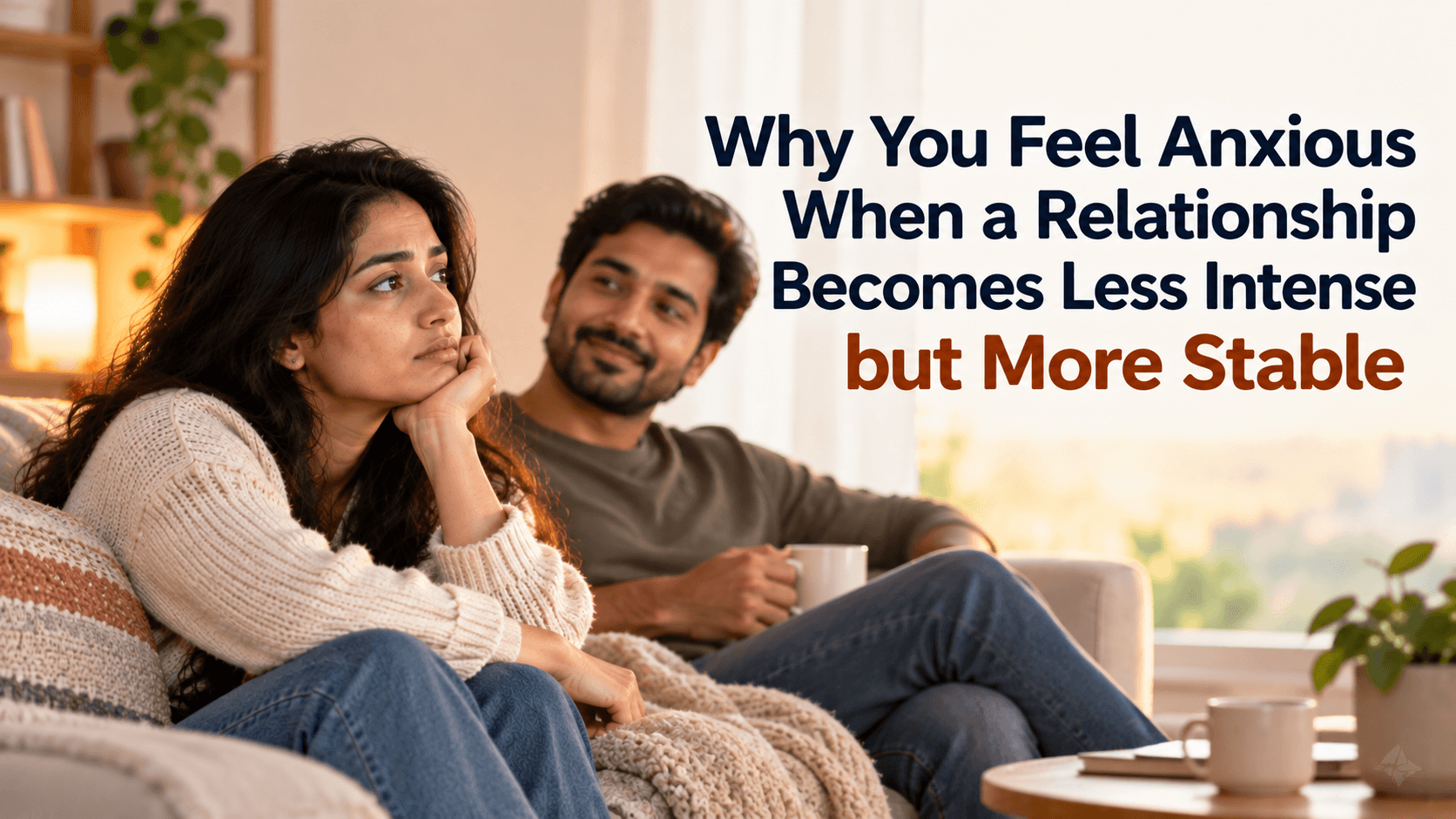
Why You Feel Anxious When a Relationship Becomes Less Intense but More Stable
Why You Feel Anxious When a Relationship Becomes Less Intense but More Stable
Focus: Attachment wounds, emotional safety, healthy love, nervous system
A relationship becoming calmer should feel reassuring, but sometimes it does the opposite. When the intense texting, constant reassurance, emotional highs, dramatic conversations, or fear of losing each other begin to settle, you may suddenly feel uneasy. Instead of enjoying the stability, you may start wondering whether something is missing.
At India Therapist, many people come to therapy because they feel confused by this experience. They may finally be in a relationship that feels more consistent, respectful, and emotionally safe, yet part of them misses the intensity they were used to. Therapy can help you understand how attachment wounds and your nervous system influence what love feels like, and why healthy stability can initially feel unfamiliar rather than comforting.
Why Intensity Can Feel Like Love
For some people, love becomes associated with strong emotional activation. Frequent communication, passionate arguments, jealousy, uncertainty, constant reassurance, and dramatic reconciliations can create powerful emotional highs and lows.
When these patterns repeat, your mind may begin confusing intensity with emotional connection. You may feel most attached when you are worried about losing someone because the fear makes the relationship feel important.
A therapist in India can help you recognize that intensity and intimacy are not always the same. Healthy intimacy usually grows through consistency, trust, vulnerability, and emotional safety rather than constant emotional activation.
Attachment Wounds Can Make Stability Feel Unfamiliar
Attachment wounds often develop through earlier experiences where closeness felt inconsistent. You may have experienced affection that changed depending on someone's mood, attention that came and went, or relationships where you were never completely sure where you stood.
When love has historically felt unpredictable, your nervous system can become accustomed to uncertainty. You may learn to stay alert for signs of rejection and feel relief whenever closeness returns.
Later, a stable relationship can feel strangely quiet. An Indian therapist online can help you understand that the discomfort may not mean something is wrong with the relationship. It may mean that your emotional system is adjusting to a kind of connection that feels different from what it previously learned.
Your Nervous System May Be Used to Emotional Highs and Lows
Relationships do not exist only in your thoughts. Your body also responds to them. Uncertainty can create stress, anticipation, adrenaline, and relief. If you repeatedly experience emotional highs and lows, your nervous system may begin treating that pattern as normal.
A calmer relationship can therefore feel unfamiliar simply because your body is no longer being activated in the same way.
You may mistake the absence of anxiety for the absence of chemistry. You may think, “Why am I not thinking about them every second?” or “Why does this feel so calm?”
Therapy helps you understand that feeling regulated does not necessarily mean feeling disconnected. Sometimes calm is what emotional safety actually feels like.
Healthy Love Can Feel Less Dramatic
Healthy relationships can still be exciting, passionate, and emotionally meaningful. But they usually do not require constant uncertainty to maintain connection.
You may know when you will hear from your partner. Their affection may feel consistent. Disagreements may be resolved without threats, silence, or dramatic withdrawal. You may not need to constantly prove your value or wonder whether the relationship is about to end.
If you are used to emotional unpredictability, this can initially seem boring.
Therapy helps you redefine what connection looks like. Instead of measuring love by intensity, you can begin noticing reliability, respect, emotional availability, and the feeling that you can relax around someone.
Why You May Start Creating Problems When Things Feel Calm
Sometimes people unconsciously create tension when stability begins to feel uncomfortable. You may start questioning the relationship, testing your partner, picking arguments, withdrawing, or looking for signs that something is wrong.
You may not consciously want conflict. Your nervous system may simply be trying to return to a familiar emotional state.
For example, if you are used to receiving reassurance after conflict, creating tension may eventually produce the reassurance your attachment system has learned to seek.
Therapy can help you notice this pattern before acting on it. Once you understand what calmness is activating inside you, you can respond with curiosity rather than automatically creating distance or conflict.
Anxiety Can Make You Question Whether You Still Love Them
When a relationship becomes stable, you may notice that you think about your partner less obsessively. You may feel more comfortable focusing on work, friendships, hobbies, or your own life.
Instead of seeing this as a healthy sign, you may worry that your feelings are disappearing.
But emotional security often means you no longer need to monitor the relationship constantly. You trust that the connection will still be there even when your attention is elsewhere.
Therapy in India can help you distinguish between genuine emotional disconnection and the healthier independence that often appears when a relationship becomes secure.
Emotional Safety Can Feel Strange at First
If you have spent years being emotionally alert, safety may not immediately feel safe. Quiet can feel suspicious. Consistency can feel unfamiliar. A partner who respects your boundaries may even make you wonder whether they care enough.
This happens because familiarity and safety are not always the same thing.
Something can feel familiar because you experienced it repeatedly, even when it was unhealthy. Therapy helps you build tolerance for healthier experiences. Over time, consistency can begin to feel comforting rather than empty.
You May Miss the Validation That Came With Intensity
Intense relationships often contain frequent moments of reassurance. After an argument, someone may say how much they love you. After emotional distance, reunion can feel incredibly powerful. These moments can temporarily strengthen your sense of being wanted.
In a stable relationship, that dramatic cycle may disappear. Affection becomes more consistent and less dependent on crisis.
At first, this may feel less emotionally powerful. But therapy can help you recognize that being consistently valued is often healthier than repeatedly needing reassurance after emotional disruption.
Trusting Calm Requires Self-Trust Too
Stable relationships become easier to tolerate when you trust yourself. If you believe you can recognize genuine problems, communicate clearly, and make decisions when necessary, you do not need to constantly search for warning signs.
Without self-trust, calmness can feel dangerous because part of you thinks you must stay vigilant or you may miss something.
Therapy helps strengthen your confidence in your own judgment. You can notice changes without immediately assuming something terrible is happening. You can allow yourself to enjoy stability without abandoning awareness.
How Therapy Helps Your Nervous System Adjust to Healthy Love
Therapy can help you understand what happens emotionally and physically when relationships become calmer. You may notice that uncertainty activates you while consistency initially makes you restless.
Therapy can help you recognize attachment triggers, understand old relationship patterns, develop emotional regulation skills, reduce reassurance-seeking, build self-trust, and become more comfortable with healthy independence.
At India Therapist, culturally sensitive therapists in India and Indian therapists online can support people navigating attachment anxiety, relationship insecurity, emotional safety, and repeated relationship patterns.
Stability Does Not Mean the Relationship Has Lost Passion
One fear people often have is that stability means the relationship has become boring or passionless. But healthy relationships can contain excitement without requiring instability.
You can build new experiences together, maintain attraction, communicate openly about intimacy, and continue discovering each other while still feeling emotionally secure.
The difference is that excitement no longer needs to come from uncertainty about whether the relationship will survive.
Healthy passion can exist alongside trust.
Learning to Recognize What Safe Love Feels Like
Safe love often feels quieter than anxious attachment. It may look like knowing where you stand, being able to disagree without fearing abandonment, and feeling free to have your own life without constantly worrying about the relationship.
You may notice that you sleep better, overthink less, and feel more comfortable expressing your needs. These changes may initially feel unusual if your previous relationships were emotionally intense.
Therapy helps you recognize these experiences as signs of security rather than signs that something is missing.
You Do Not Need Anxiety to Prove That You Care
Being constantly afraid of losing someone does not prove that you love them more. Thinking about someone every minute does not automatically mean the connection is deeper.
Sometimes love becomes healthier when fear becomes quieter.
You can care deeply about someone without needing constant reassurance. You can feel connected without emotional chaos. You can experience attraction without wondering every day whether the relationship is about to disappear.
Therapy helps you move from “If this relationship feels calm, maybe something is missing” to “Calm does not mean empty. It may mean I am finally experiencing a relationship where my nervous system does not have to fight for safety.”
Ready to talk to someone who understands?
Connect with an Indian therapist who speaks your language and understands your cultural context.