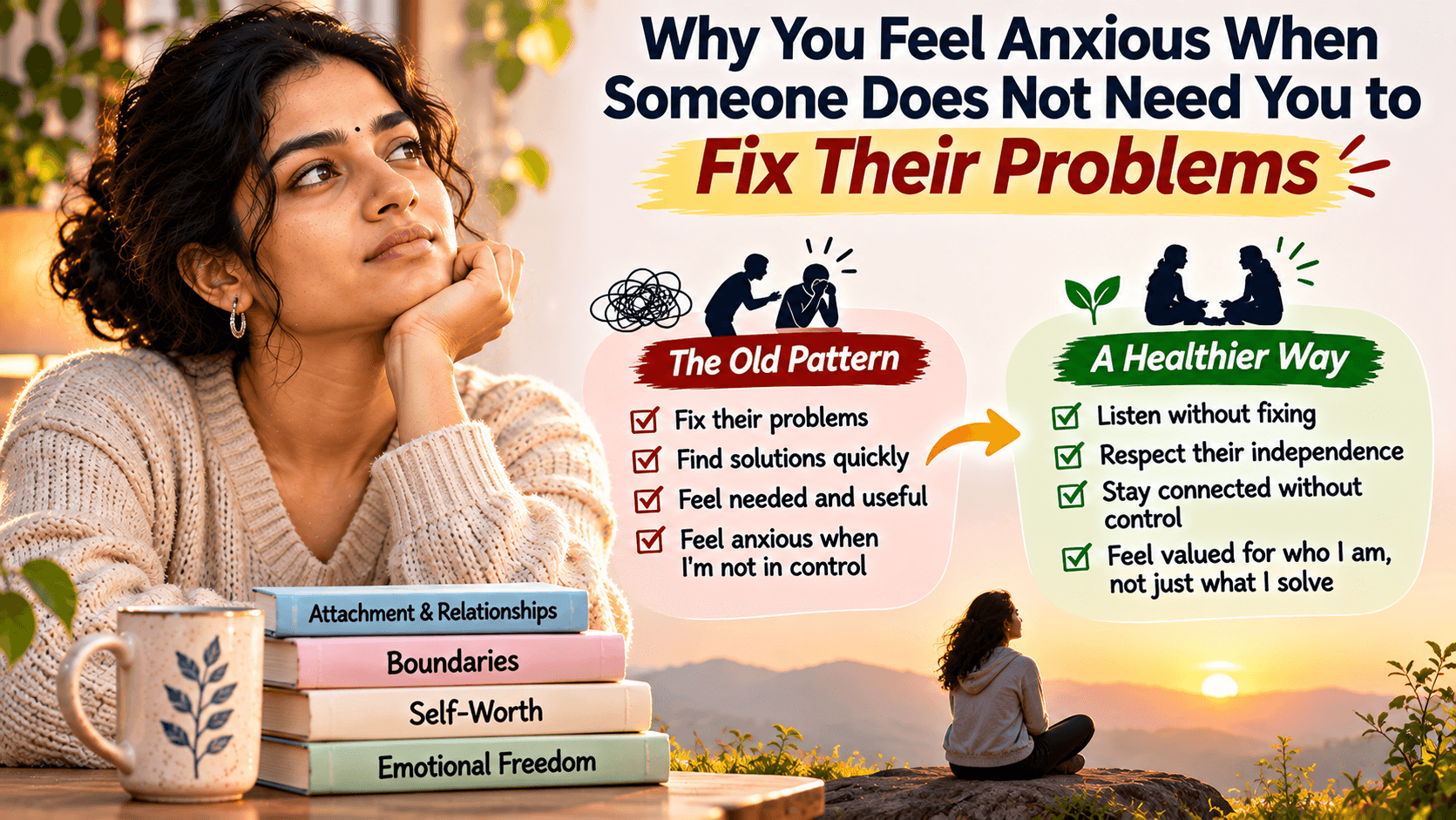
Why You Feel Anxious When Someone Does Not Need You to Fix Their Problems
Why You Feel Anxious When Someone Does Not Need You to Fix Their Problems
Focus: Usefulness, attachment wounds, control, self-worth
It can feel surprisingly uncomfortable when someone you care about has a problem and does not need you to solve it. They may already know what they want to do, prefer to handle the situation on their own, or simply want you to listen rather than offer advice. Instead of feeling relieved, you may notice anxiety, restlessness, or even a strange sense of rejection.
For some people, being helpful has become closely connected to feeling important in relationships. If you are usually the person who gives advice, fixes problems, organizes solutions, or steps in during difficult moments, another person saying, “I’ve got this,” can leave you wondering what your role is.
At India Therapist, many people come to therapy because their self-worth has become connected to being useful. Therapy can help you understand why another person’s independence feels threatening, explore attachment wounds, reduce the need to control outcomes, and build a stronger sense of worth that does not depend on constantly solving problems for others.
Why Being Needed Can Feel Like Proof That You Matter
Being helpful can create closeness. When someone comes to you for advice or support, it can make you feel trusted, valued, and important. There is nothing unhealthy about enjoying that feeling.
The difficulty begins when being needed becomes one of the main ways you know you matter. If people stop depending on you, you may start wondering whether they still value you in the same way.
A therapist in India can help you separate being needed from being loved. Someone can value your presence deeply even when they are capable of managing their own problems.
Your importance in a relationship does not have to depend on how much the other person relies on you.
Attachment Wounds Can Make Independence Feel Like Distance
Attachment wounds can influence how you interpret another person’s independence. If closeness earlier in life was connected to being helpful, responsible, or emotionally available, you may have learned that usefulness creates security.
Later, when someone handles something without you, your mind may interpret their independence as emotional distance. You may think, “Maybe they do not need me anymore,” and quickly turn that into, “Maybe they do not want me anymore.”
An Indian therapist online can help you recognize that these are not the same thing. Someone becoming more capable or independent does not automatically mean the relationship is becoming less meaningful.
Healthy attachment allows people to remain connected without needing to depend on each other for everything.
Fixing Problems Can Become Part of Your Identity
You may have spent years being known as the capable one. Perhaps family members call you when something goes wrong, friends ask for your advice, or your partner relies on you to think through difficult situations.
Over time, problem-solving can become part of how you see yourself. You may feel confident when there is something to fix because you know exactly what your role is.
When there is nothing to solve, uncertainty can appear. You may wonder what you contribute when you are not helping.
Therapy can help you build an identity that is larger than the role of problem-solver. You can be caring, interesting, valuable, and deeply connected to others without constantly being the person who finds the solution.
Control Can Sometimes Hide Underneath Helpfulness
Wanting to help usually comes from care, but sometimes fixing also provides a sense of control. If you can solve the problem, you may feel less anxious about what happens next.
Watching someone make their own decision can be harder because you cannot guarantee the outcome. They may choose differently than you would. They may make a mistake. They may have to experience discomfort.
That uncertainty can trigger anxiety.
Therapy helps you understand that support does not require controlling the outcome. Other adults are allowed to make choices, experience consequences, and learn in their own way.
You can care about what happens without taking over responsibility for what happens.
You May Offer Solutions When Someone Only Wants to Be Heard
Sometimes the people we love are not asking for advice. They may simply want to talk, feel understood, or process their emotions aloud.
If problem-solving is your automatic response, listening without fixing can feel uncomfortable. You may feel as though you are doing nothing.
But emotional support does not always require a solution.
Sometimes saying, “That sounds really difficult. I’m here with you,” can be more helpful than immediately explaining what someone should do next.
Therapy can help you become more comfortable with presence instead of performance.
Their Independence Is Not a Rejection of Your Care
When someone says, “I can handle this,” it can easily sound like, “I do not need you.”
But those statements are not necessarily the same.
Someone may appreciate your care while still wanting to solve the problem themselves. They may value your support without wanting advice. They may even feel safer in the relationship because they know they can be independent without losing your affection.
Therapy in India can help you stop interpreting another person’s autonomy as rejection.
Their ability to take care of themselves does not reduce the value of your relationship.
Self-Worth Can Become Tied to Usefulness
If you have been praised mainly for being responsible, helpful, mature, or dependable, usefulness may become one of the foundations of your self-worth.
You may feel good about yourself when you are solving problems and strangely empty when nobody needs anything.
This can lead to over-functioning. You start looking for ways to help, stepping in before you are asked, or carrying responsibilities that do not really belong to you.
Therapy helps you build self-worth around who you are rather than only what you provide.
You are still worthy when you are resting. You are still valuable when someone else finds the answer. You are still important when your role is simply to be present.
Why Other People’s Mistakes Can Feel Hard to Watch
If you can clearly see a better solution, allowing someone to make their own choice can be frustrating.
You may think, “I know how this will turn out,” and feel an intense urge to intervene.
But constantly preventing other people from making mistakes can create unhealthy dynamics. They may become overly dependent on you, while you become increasingly responsible for their decisions.
Therapy can help you tolerate the discomfort of watching someone choose differently.
Supporting autonomy sometimes means allowing people to learn through experiences you would have handled another way.
Healthy Relationships Do Not Require Constant Rescue
Relationships become exhausting when one person is always rescuing and the other is always being rescued.
Healthy relationships allow roles to change. Sometimes you provide support. Sometimes the other person does. Sometimes neither person needs help at all.
Connection can exist during ordinary moments when nobody is struggling.
At India Therapist, culturally sensitive therapists in India and Indian therapists online can support people who struggle with over-functioning, attachment anxiety, control, low self-worth, and difficulty allowing others to handle their own problems.
You Can Ask What Kind of Support Someone Needs
One of the simplest ways to change the fixing pattern is to ask instead of assuming.
You might say, “Do you want advice, or do you just want me to listen?”
This question creates space for the other person to decide what they need. It also helps you step out of the automatic belief that support always means solving.
They may want ideas. They may want reassurance. They may simply want company.
Therapy helps you become more flexible in the way you offer care.
Stepping Back Can Feel Like You Are Doing Something Wrong
When you have spent years solving problems, not intervening can feel almost irresponsible.
You may know what could help and still choose to let the other person handle it. Your mind may immediately say, “But what if something goes wrong?”
This discomfort is often part of changing an old pattern.
Therapy helps you sit with that anxiety without rushing back into control. Over time, you learn that other people can manage more than you thought and that relationships can remain close even when you are not directing the outcome.
Receiving Love Without Being Useful Can Feel Vulnerable
There is a particular vulnerability in being loved when you are not providing anything.
If someone still wants to spend time with you when they do not need advice, help, or solutions, you are being valued for your presence rather than your usefulness.
For people who are used to earning closeness through helping, this can feel unfamiliar.
Therapy can help you become more comfortable receiving that kind of love.
You do not have to continuously prove why someone should keep you in their life.
How Therapy Helps You Change the Pattern
Therapy gives you space to explore when being useful became so closely connected to emotional security. You may discover that you learned early to solve family problems, anticipate other people’s needs, or become responsible before you were ready.
Understanding the pattern can help you respond differently.
Therapy can help you strengthen self-worth, recognize attachment triggers, reduce over-functioning, tolerate uncertainty, respect other people’s autonomy, and learn to provide support without automatically taking control.
The goal is not to stop being helpful. It is to make helping a choice rather than the foundation of your identity.
You Are Allowed to Let Other People Be Capable
Allowing someone else to handle their problems does not mean you stopped caring.
It means you trust that they are capable of making decisions and finding their own way.
You can remain available if they genuinely need support without assuming that you must step in before they ask.
That shift creates healthier responsibility for both people.
Your Value Does Not Disappear When Nobody Needs Fixing
Relationships do not have to revolve around problems.
You can be close to someone while simply enjoying their company. You can laugh, rest, share experiences, and build memories without constantly proving your usefulness.
Healthy relationships allow you to exist without performing a function.
Therapy helps you move from “If they do not need me to fix things, maybe I am not important” to “I can be deeply valued for who I am, even when nobody needs me to solve anything.”
Ready to talk to someone who understands?
Connect with an Indian therapist who speaks your language and understands your cultural context.