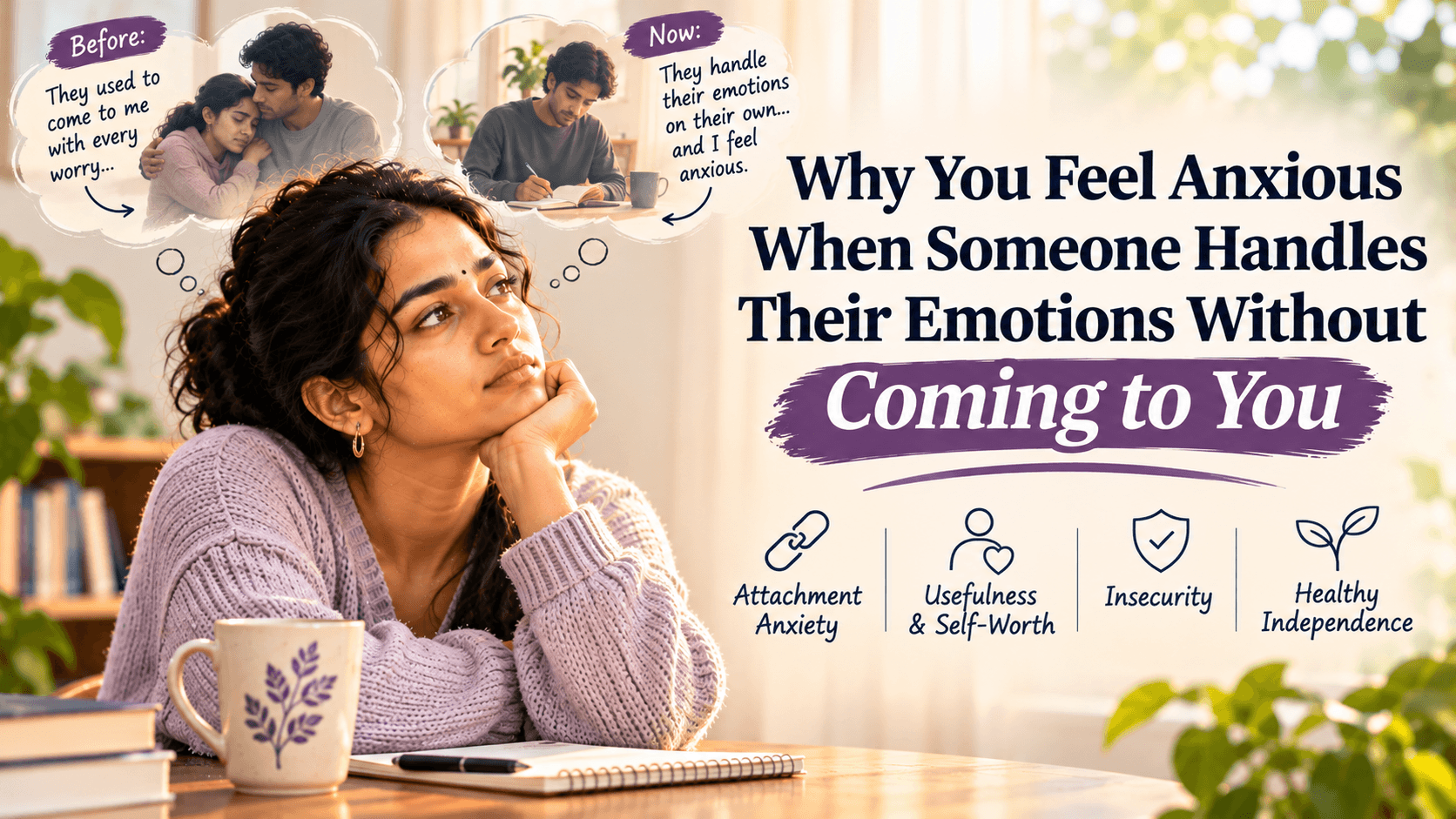
Why You Feel Anxious When Someone Handles Their Emotions Without Coming to You
Why You Feel Anxious When Someone Handles Their Emotions Without Coming to You
Focus: Attachment anxiety, usefulness, insecurity, healthy independence
It can feel surprisingly unsettling when someone you care about goes through something difficult and does not come to you for comfort. Maybe they used to call when they were anxious, talk through every problem with you, or rely on your reassurance when they felt overwhelmed. When they begin processing emotions on their own, talking to someone else, or simply needing less support, you may feel confused by your reaction.
Part of you may be glad that they are becoming more emotionally independent. Another part may wonder whether you are becoming less important. You may start asking yourself why they did not tell you, whether they still trust you, or whether the relationship is changing.
At India Therapist, many people come to therapy because another person’s growing emotional independence unexpectedly activates insecurity. Therapy can help you understand why being needed became connected to closeness, strengthen self-worth, reduce attachment anxiety, and build relationships where independence does not automatically feel like rejection.
Why Someone Coming to You Can Feel Like Proof of Closeness
When someone regularly turns to you during difficult moments, it can create a powerful sense of connection. You may feel trusted because they share vulnerable thoughts with you, and you may feel important because your presence helps them feel calmer.
Over time, this pattern can become one of the ways you measure closeness. If they call you when something goes wrong, you know you matter. If they suddenly handle something without you, the absence of that familiar interaction can feel emotionally significant.
A therapist in India can help you recognize that emotional closeness is larger than being someone’s first source of support. A person can trust you deeply while also developing the ability to manage some feelings independently.
Attachment Anxiety Can Turn Independence Into a Warning Sign
Attachment anxiety often makes changes in connection feel more threatening than they actually are. When someone becomes quieter or more self-reliant, your nervous system may quickly interpret that change as distance.
You may think, “Why did they not come to me?” and then move toward a more painful conclusion: “Maybe they do not need me anymore.” That thought can easily become, “Maybe they do not want me anymore.”
An Indian therapist online can help you slow down this emotional chain. Someone not coming to you for every difficult feeling does not automatically mean the relationship is weakening. It may simply mean they are learning to trust their own ability to cope.
Healthy relationships allow people to remain connected without needing constant emotional dependence.
Being Useful Can Become Part of Your Relationship Identity
If you are usually the person who comforts, reassures, advises, or helps others process emotions, usefulness may become part of how you understand your role in relationships.
You may feel secure when there is something you can do. You know how to listen, how to calm the other person, and how to help them make sense of what they are feeling.
When they begin handling emotions without you, you may feel uncertain about what you contribute.
Therapy can help you understand that your value is not limited to what you provide during difficult moments. Relationships are also built through companionship, affection, humor, shared memories, curiosity, trust, and simply enjoying each other’s presence.
You do not have to be emotionally necessary in order to be emotionally meaningful.
Their Independence May Trigger Fear of Being Replaced
Sometimes the discomfort is not really about the specific situation. It is about what their independence seems to represent.
You may worry that if they can handle their emotions alone, they could eventually handle life without you. If they speak to another friend, therapist, family member, or support system, you may wonder whether someone else is taking your place.
This fear often comes from insecurity rather than evidence.
Therapy can help you understand that relationships are not competitions for emotional usefulness. Someone having multiple sources of support does not reduce your importance. In fact, healthier support systems often reduce pressure on one relationship and make connection more sustainable.
Healthy Independence Is Not Emotional Rejection
There is a major difference between someone becoming emotionally independent and someone becoming emotionally unavailable.
Healthy independence means they can calm themselves, reflect on their feelings, make some decisions alone, and decide when they need support. They can still communicate openly and remain emotionally close.
Emotional rejection looks different. It may involve consistently shutting you out, refusing vulnerability, avoiding meaningful conversations, or making you feel excluded from important parts of the relationship.
Therapy in India can help you distinguish between these patterns. Not every moment of independence means someone is pulling away.
Sometimes the relationship is becoming healthier because both people are learning to carry more of their own emotional weight.
You May Miss Feeling Needed Even When the Change Is Healthy
It can be difficult to admit that being needed felt good. You may worry that this makes you selfish or controlling.
But wanting to feel important is deeply human. The challenge begins when another person’s dependence becomes the main source of that importance.
You may genuinely celebrate their growth while also grieving the familiar role you once played. Both reactions can exist at the same time.
Therapy gives you space to explore that complexity without shame. You can recognize that the old dynamic made you feel secure while still choosing to build something healthier.
You May Start Checking Whether Something Is Wrong
When someone stops coming to you as often, you may begin searching for an explanation. You might ask repeatedly whether they are okay, whether something changed between you, or why they did not tell you sooner.
These questions may come from concern, but repeated checking can also be an attempt to restore reassurance for yourself.
The more uncertain you feel, the more you may monitor the relationship.
Therapy helps you notice when checking has shifted from healthy communication into attachment anxiety. Instead of immediately assuming something is wrong, you can look at the broader pattern of the relationship.
Are they still affectionate, engaged, communicative, and present? If so, their independence may not be a threat at all.
Self-Worth Can Become Too Dependent on Emotional Importance
If you struggle with self-worth, another person’s reliance on you may become evidence that you matter. Being the one they call during difficult moments can make you feel special and emotionally significant.
When that pattern changes, your confidence may drop.
You might wonder whether you are less valuable now that they can handle more on their own. But emotional usefulness is only one small part of your worth.
Therapy helps you build a sense of self that does not rise and fall based on how much another person currently needs from you. Your value remains present even when nobody needs advice, reassurance, or emotional rescue.
Healthy Support Means Letting People Choose What They Need
One of the most respectful forms of support is allowing people to decide how they want to process their emotions.
Sometimes they may want to talk with you. Other times they may want quiet, journaling, exercise, therapy, prayer, time alone, or a conversation with someone who understands a specific issue.
If you interpret every choice that does not involve you as rejection, emotional support can become controlling without you intending it to.
Therapy helps you shift from “Why did they not come to me?” toward “What kind of support works best for them right now?”
That question creates room for genuine care rather than emotional ownership.
Their Emotional Growth Can Actually Strengthen the Relationship
When both people develop stronger emotional regulation, relationships often become more stable.
There may be fewer crisis-driven conversations and less pressure on one person to constantly provide reassurance. Each person becomes more capable of identifying feelings, calming themselves, and communicating intentionally.
This does not make the relationship less intimate. It can create more meaningful intimacy because conversations happen through choice rather than emotional dependence.
At India Therapist, culturally sensitive therapists in India and Indian therapists online can support people working through attachment anxiety, relationship insecurity, dependency patterns, and fear of becoming less important.
Trust Means Allowing Connection to Exist Without Constant Proof
When attachment anxiety is strong, you may need frequent evidence that the relationship is secure. Someone coming to you for support can become one form of proof.
Trust requires something quieter. It means believing in the relationship even when every moment does not confirm your importance.
You can allow someone to have a difficult day without telling you everything immediately. You can trust that they will share what they want when they are ready.
Therapy can help you become more comfortable with this uncertainty. Instead of demanding constant evidence of closeness, you begin relying more on the consistent pattern of the relationship.
You Are Allowed to Have Emotional Independence Too
Sometimes another person’s independence feels uncomfortable because you have not given yourself the same freedom.
You may automatically share every problem, ask for reassurance, or prioritize the relationship whenever you feel uncertain. Watching someone else regulate themselves may make you realize how much you depend on connection for your own stability.
This can become an opportunity for growth.
Therapy can help you develop your own ways of processing emotions, making decisions, calming anxiety, and building support outside one relationship.
Healthy independence should belong to both people.
How Therapy Helps You Feel Secure Without Being Needed
Therapy can help you understand why another person needing you has become so closely connected to feeling safe. You may discover patterns related to abandonment, inconsistent caregiving, past relationships, or a family role where being helpful created approval.
Once you understand the pattern, you can begin building a different kind of security.
Therapy can help you strengthen self-worth, recognize attachment triggers, tolerate another person’s independence, reduce reassurance-seeking, trust the broader relationship, and develop emotional independence of your own.
The goal is not to stop caring when someone comes to you. It is to stop needing them to come to you in order to believe that you matter.
You Can Be Important Without Being Their First Call Every Time
Someone may occasionally talk to a friend before speaking with you. They may process something privately or decide that they already know what they need to do.
None of those things automatically reduce your importance.
Healthy adults usually have multiple ways of coping and multiple sources of support. Expecting yourself to be someone’s only emotional outlet creates enormous pressure for both people.
You can be deeply loved and trusted without being involved in every internal emotional process.
Closeness Can Become More Secure When Dependency Decreases
At first, less dependence may feel like less connection. Over time, however, it can create a more stable relationship.
You begin discovering that the other person stays connected even when they are not in crisis. They talk to you because they want to, not only because they need reassurance. You share life together beyond problems and emotional emergencies.
This can create a deeper form of intimacy.
You are no longer connected mainly because one person needs support. You are connected because both people continue choosing the relationship.
You Do Not Have to Be Needed to Be Loved
One of the most important parts of healing is learning to separate love from dependence.
You can matter deeply to someone who knows how to soothe themselves. You can be valuable to someone who can solve problems without you. You can remain emotionally close to someone who does not share every difficult feeling immediately.
Therapy helps you move from “If they can handle their emotions without me, maybe I am becoming less important” to “Their independence can grow while our connection remains meaningful, secure, and deeply valued.”
Ready to talk to someone who understands?
Connect with an Indian therapist who speaks your language and understands your cultural context.