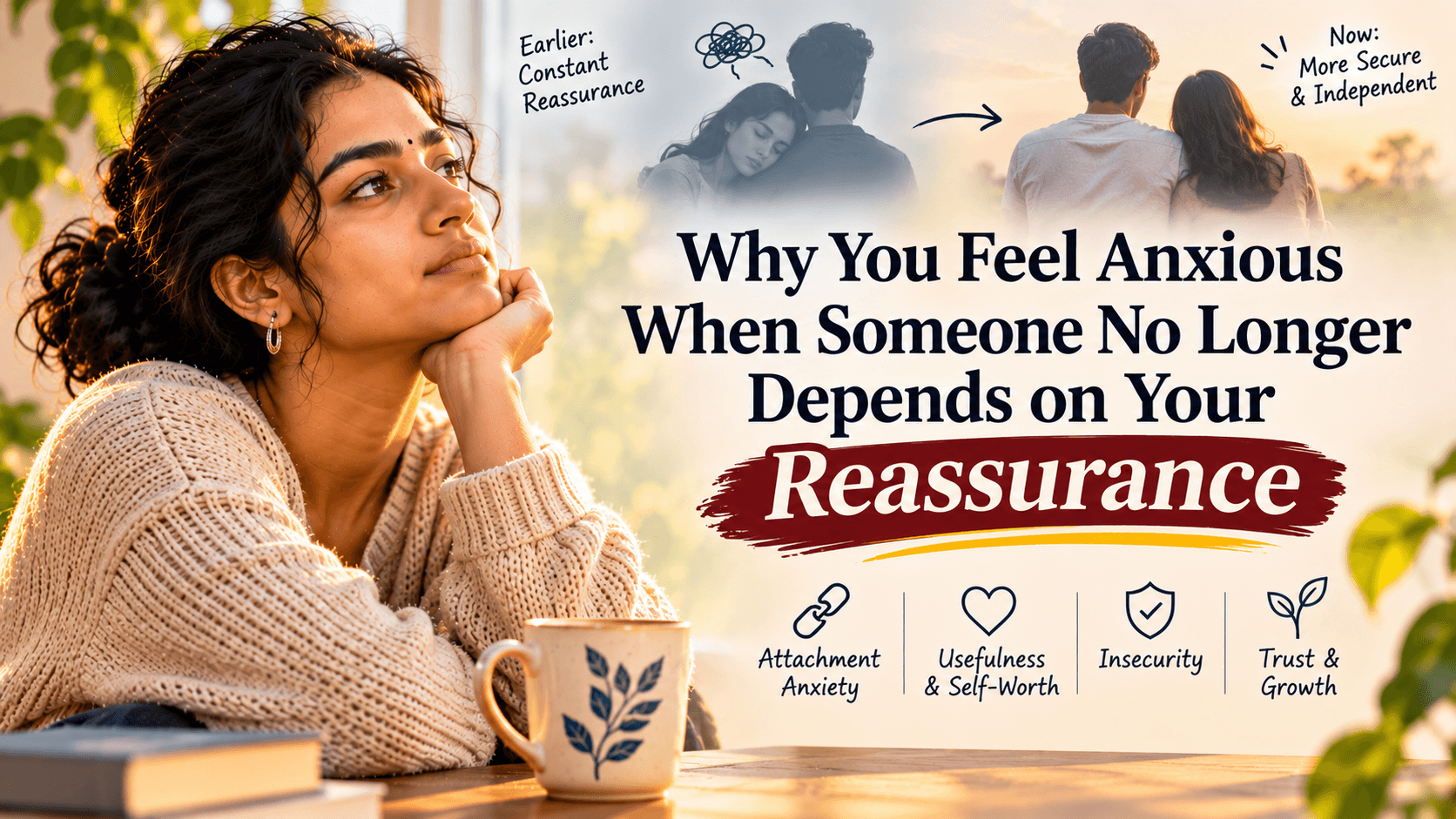
Why You Feel Anxious When Someone No Longer Depends on Your Reassurance
Why You Feel Anxious When Someone No Longer Depends on Your Reassurance
Focus: Attachment anxiety, usefulness, insecurity, trust
It can feel strange when someone who once relied heavily on your reassurance begins needing less of it. Maybe they used to ask whether everything was okay, check how you felt, seek comfort after conflict, or depend on your words to feel secure. When that changes, you may expect to feel relieved, but instead you feel anxious.
You may begin wondering whether they are becoming distant, whether they still need you in the same way, or whether your role in the relationship is changing. If reassurance once made you feel important, their growing independence can quietly trigger insecurity.
At India Therapist, many people come to therapy because they feel unsettled when someone becomes emotionally more independent. Therapy can help you understand how attachment anxiety, usefulness, insecurity, and trust are connected, while helping you build relationships where closeness does not depend on another person constantly needing reassurance from you.
Why Being Asked for Reassurance Can Make You Feel Important
When someone regularly asks for reassurance, it can create a strong sense of emotional closeness. They may ask whether you still care, whether the relationship is okay, or whether you are upset with them. Each time you reassure them, you may feel that your presence is meaningful and necessary.
Over time, this dynamic can become familiar. You know exactly how to respond, and you know what role you play in helping the other person feel safe. If they eventually stop asking, you may notice an unexpected emptiness.
A therapist in India can help you recognize that feeling important because someone needs reassurance is different from feeling secure because you trust the relationship. One depends on constant proof of your usefulness, while the other allows closeness to continue even when reassurance is not repeatedly required.
Attachment Anxiety Can Make Independence Feel Like Distance
Attachment anxiety often makes changes in closeness feel threatening. If someone becomes more confident, emotionally regulated, or less dependent on your reassurance, your mind may interpret that shift as a sign that they are moving away from you.
You may start noticing smaller changes in communication and wondering whether they still care as much. Even healthy emotional growth can begin to feel like rejection when your nervous system is sensitive to distance.
An Indian therapist online can help you separate independence from abandonment. Someone needing less reassurance may not mean they value you less. It may simply mean they are becoming more emotionally secure.
Healthy relationships allow both people to grow without treating that growth as a threat to connection.
Usefulness Can Become Tied to Your Role in the Relationship
Sometimes reassurance becomes one of the main ways you contribute emotionally. You may be the calm one, the person who explains everything, or the one who makes the other person feel safe after difficult moments.
Because this role feels meaningful, losing it can create uncertainty. You may wonder, “If they can reassure themselves now, what do they need from me?”
Therapy can help you understand that your value in a relationship is much larger than the emotional function you perform. You can be loved for your presence, personality, affection, companionship, and shared experiences—not only because you know how to calm someone down.
Their Growth Can Trigger Your Insecurity
You may genuinely want someone you love to become more secure, but their progress can still bring up uncomfortable feelings. They may stop asking for constant reassurance, become more confident in their own decisions, or learn to manage anxiety without always turning to you.
Part of you may feel proud of them while another part feels less important. This can create guilt because you may think you should only be happy about their growth.
Therapy helps you make room for both reactions. You can celebrate their progress while also exploring why their independence affects your sense of security. Understanding that tension can help you respond with honesty rather than trying to pull them back into dependence.
Reassurance Can Create a Cycle of Emotional Dependency
Reassurance is not unhealthy by itself. Everyone occasionally needs comfort, clarity, or confirmation from someone they trust. The problem begins when reassurance becomes the main way one person regulates anxiety and the main way the other person feels needed.
One person repeatedly asks, “Are we okay?” and the other repeatedly provides relief. For a while, both people may feel closer. But the cycle can slowly make both people dependent on the same pattern.
Therapy helps you recognize when reassurance is supportive and when it has become a substitute for deeper emotional security. Healthy relationships can include reassurance without requiring it constantly.
Trust Feels Quieter Than Reassurance
Repeated reassurance creates immediate emotional feedback. Someone asks whether you still care, you answer, and the connection feels visible.
Trust is often much quieter. A person may no longer need to ask because they already believe your actions, consistency, and commitment. They feel secure enough to assume the relationship is okay without checking constantly.
This quietness can feel unfamiliar if you are used to relationships where security is repeatedly confirmed through words.
Therapy in India can help you recognize that less reassurance may sometimes be a sign of more trust, not less love. Emotional security often looks calmer than anxiety-driven closeness.
You May Start Looking for New Ways to Feel Needed
When someone stops depending on reassurance, you may unconsciously look for another role that makes you feel important. You might offer more advice, check on them more frequently, or become more involved in solving their problems.
You may not realize that you are doing this because the old reassurance dynamic has changed. You simply feel unsettled and want to restore the familiar sense of closeness.
Therapy can help you notice when helping becomes a strategy for protecting your place in the relationship. You can still be supportive while allowing connection to exist without constant emotional dependence.
Emotional Independence Does Not Mean Emotional Distance
Healthy independence means someone can regulate some emotions, make decisions, and feel secure without depending completely on another person. It does not mean they no longer want closeness.
They may still want affection, intimacy, companionship, shared experiences, and emotional support. They simply may not need you to repeatedly prove the relationship is safe.
Therapy helps you build a more flexible understanding of intimacy. Two people can remain deeply connected while becoming more emotionally independent.
In many cases, that independence allows love to feel more sustainable.
Your Self-Worth Should Not Depend on Someone Needing Reassurance
If you feel valuable mostly when someone needs you, their emotional growth can become threatening. You may begin comparing how much they relied on you before with how little they rely on you now.
This can create insecurity even when the relationship itself has not become weaker.
Therapy helps you build self-worth that exists outside usefulness. Your value does not decrease because another person becomes more secure.
You do not have to remain emotionally indispensable in order to matter.
You May Fear That Being Less Needed Means Being More Replaceable
One of the deeper fears underneath this pattern can be replaceability. You may think that if someone no longer needs your reassurance, they could more easily live without you.
This fear can make you want to preserve dependence because dependence feels like security.
But being needed and being chosen are different. Someone who is emotionally capable of being alone and still chooses the relationship may actually be offering a more secure kind of love.
Therapy can help you become more comfortable with being chosen rather than needed. That kind of connection requires trust because neither person is staying solely because they depend on the other.
Healthy Love Makes Room for Both Reassurance and Self-Regulation
Secure relationships are not completely free of reassurance. There will still be moments when either person needs comfort, affection, or confirmation.
The difference is that reassurance becomes occasional support rather than the foundation of the relationship.
Both people gradually develop the ability to regulate themselves while also knowing they can turn toward each other when needed.
This balance creates healthier intimacy because neither person becomes entirely responsible for the other person’s emotional security.
How Therapy Helps You Adjust to Someone’s Growing Independence
Therapy gives you space to understand why another person needing less reassurance feels emotionally significant. You may discover that being needed helped you feel secure, useful, or protected from abandonment.
As you understand the pattern, you can begin building a different kind of security.
Therapy can help you strengthen self-worth, recognize attachment triggers, reduce over-functioning, tolerate another person’s independence, and build trust without depending on constant emotional confirmation.
At India Therapist, culturally sensitive therapists in India and Indian therapists online can support people dealing with attachment anxiety, relationship insecurity, dependency patterns, low self-worth, and fear of becoming less important.
You Can Let the Relationship Become Calmer
Sometimes relationships become quieter as they become healthier. There may be fewer anxious conversations, fewer repeated questions about whether everything is okay, and less emotional urgency.
At first, this can feel like something is missing.
But calmness does not automatically mean loss of connection. It may mean the relationship no longer needs constant repair or reassurance to feel secure.
Therapy helps you become comfortable with this quieter form of closeness instead of searching for anxiety to prove that the relationship still matters.
Their Confidence Does Not Reduce Your Importance
Someone learning to trust themselves can actually improve the relationship. They may become more comfortable communicating directly, less dependent on reassurance, and more capable of handling difficult emotions without turning every uncertainty into a crisis.
This creates space for the relationship to become more balanced.
You no longer have to carry the responsibility of constantly making them feel safe. Instead, both people can contribute to emotional security.
Their confidence is not taking something away from you. It may be creating room for a healthier kind of connection.
You Are Allowed to Be Loved Without Being Needed for Reassurance
Healing involves learning that your place in someone’s life does not have to be protected through emotional dependency.
You can still matter when they are calm. You can still be loved when they trust themselves. You can still have deep intimacy when they no longer need constant proof that the relationship is secure.
Therapy helps you move from “If they do not need my reassurance anymore, maybe I am becoming less important” to “Their emotional security can grow, and our connection can still remain meaningful, loving, and strong.”
Ready to talk to someone who understands?
Connect with an Indian therapist who speaks your language and understands your cultural context.