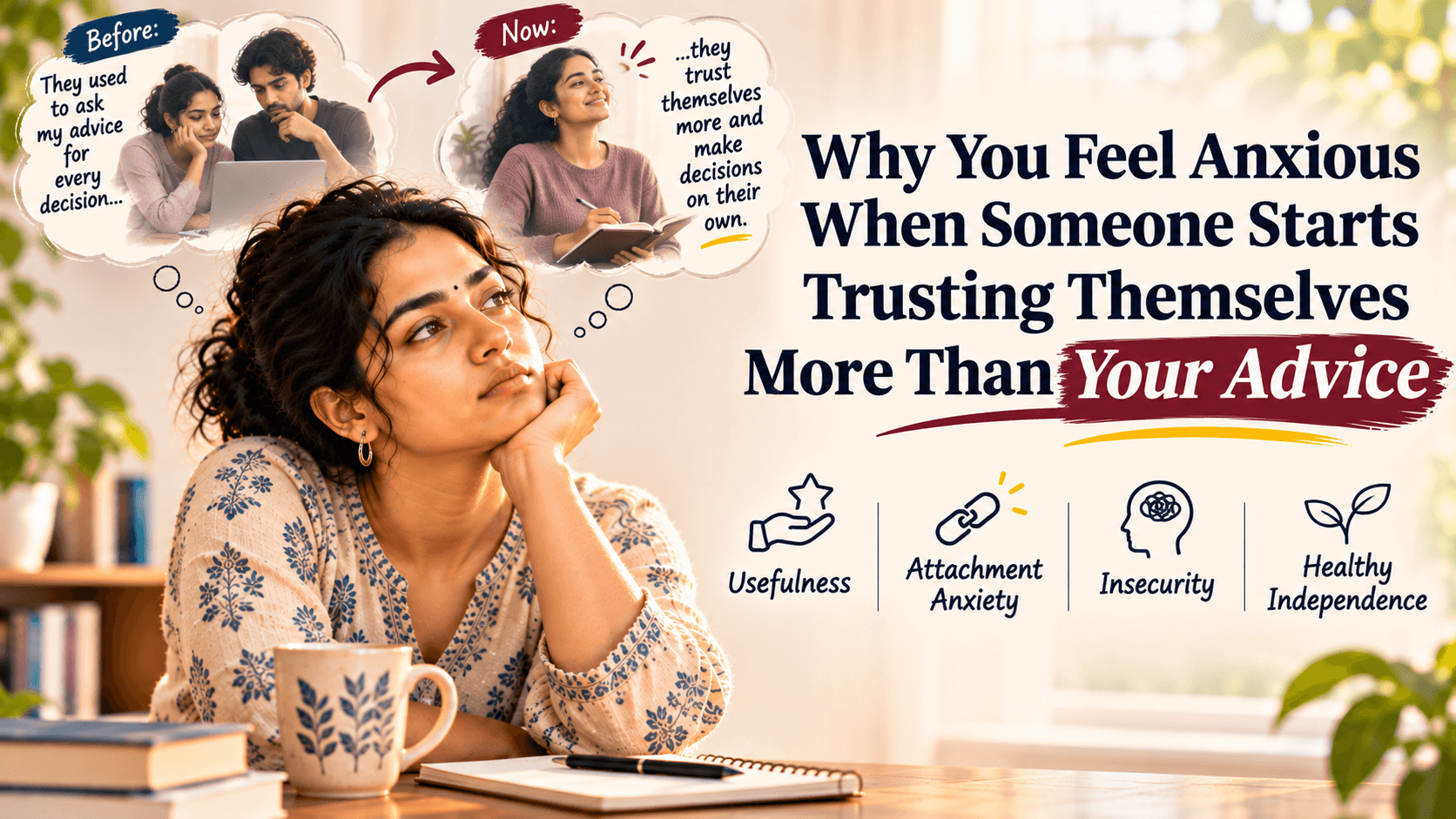
Why You Feel Anxious When Someone Starts Trusting Themselves More Than Your Advice
Why You Feel Anxious When Someone Starts Trusting Themselves More Than Your Advice
Focus: Usefulness, attachment anxiety, insecurity, healthy independence
It can feel surprisingly uncomfortable when someone who once depended on your advice begins trusting their own judgment more. Maybe they used to ask what you thought before making decisions, turn to you whenever they felt uncertain, or rely on your perspective to feel confident about what to do next. When that changes, you may expect to feel proud of their growth, yet instead you notice anxiety.
You may start wondering whether your opinion matters less, whether they are becoming emotionally distant, or whether your place in their life is changing. If being helpful has been an important part of how you experience closeness, their growing confidence can quietly trigger insecurity.
At India Therapist, many people come to therapy because someone else’s independence makes them question their own importance. Therapy can help you understand why being useful became connected to emotional security, reduce attachment anxiety, strengthen self-worth, and build relationships where another person’s confidence does not feel like a threat.
Why Being Asked for Advice Can Feel Like Proof That You Matter
When someone regularly asks for your opinion, it can create a strong sense of connection. They may trust your judgment, value your experience, and feel safer after talking things through with you.
Over time, being consulted can become part of how you measure your importance in the relationship. If they ask what you think, you know your perspective matters. When they begin making decisions without checking with you first, that absence can feel more significant than it actually is.
A therapist in India can help you separate being valued from being consulted constantly. Someone can respect you deeply while still becoming more confident in their own ability to make decisions.
Usefulness Can Become Part of Your Identity
If you are usually the person who gives good advice, solves problems, or helps people make sense of difficult situations, usefulness may become central to how you see yourself. You may feel confident when others need your perspective because you know exactly what role you play.
When someone stops asking as often, you may feel strangely uncertain. You might wonder, “If they do not need my advice anymore, what do I bring to this relationship?”
An Indian therapist online can help you recognize that your value is much larger than the advice you provide. You can be loved for your presence, personality, affection, humor, companionship, and emotional connection—not only because you help someone decide what to do.
Attachment Anxiety Can Make Independence Feel Like Distance
Attachment anxiety often makes changes in dependence feel threatening. When someone begins trusting themselves more, you may interpret their confidence as emotional distance rather than personal growth.
You may think, “They used to tell me everything,” or “They used to ask what I thought before making a decision.” Those observations may quickly become fears that the relationship is weakening.
Therapy can help you slow down this interpretation. Someone becoming more independent does not automatically mean they are becoming less connected to you.
Healthy relationships allow people to become stronger individually while remaining emotionally close.
Their Confidence Can Trigger Your Insecurity
You may genuinely want someone you love to become more confident. At the same time, their confidence may remove a role that once helped you feel important.
This can create mixed emotions. You may feel proud of them while also feeling less needed. That combination can be uncomfortable because you may believe you should only feel happy about their growth.
Therapy gives you space to acknowledge both reactions without judging yourself. Their growth can be positive while still revealing something important about how much your own security depended on being useful.
Advice Can Become a Form of Emotional Closeness
For some relationships, giving advice becomes one of the main ways intimacy happens. Someone brings you a problem, you help them understand it, and the conversation creates closeness.
When they stop needing this process as often, the relationship may suddenly feel quieter. You may miss the emotional intensity that came from being involved in every important decision.
Therapy in India can help you discover other forms of closeness. Intimacy can also come from curiosity, affection, shared experiences, vulnerability, laughter, and simply enjoying each other without needing a problem to solve.
You May Start Offering Advice That Was Never Requested
When you feel your role changing, you may unconsciously try to restore it. You might offer suggestions before someone asks, explain what you would do, or become more involved in decisions that belong to them.
This may come from genuine care, but underneath it there can also be anxiety. Being involved feels safer than watching them make decisions independently.
Therapy can help you pause before stepping in and ask, “Do they actually want advice, or am I trying to feel useful?”
That question can create healthier communication and reduce the pressure to remain involved in every decision.
Healthy Independence Does Not Mean They Stop Valuing You
Someone trusting themselves more does not mean your perspective has become meaningless. They may still respect your opinion while no longer needing it to validate every choice.
This can actually be a sign of growth. They may have internalized some of what they learned through past conversations and developed more confidence in their own judgment.
Healthy relationships do not require one person to remain uncertain so the other person can remain important.
Therapy helps you recognize that another person’s confidence can coexist with deep respect for you.
Control Can Hide Inside Helpfulness
Advice can sometimes provide a sense of control. When someone follows your recommendation, you may feel reassured because you understand the direction they are taking.
When they decide independently, uncertainty increases. They may choose something you would not choose, and you cannot guarantee the outcome.
This can feel uncomfortable, especially if you are used to protecting people from mistakes.
Therapy helps you understand that supporting someone does not mean controlling the outcome. Other adults are allowed to make decisions, experience consequences, and learn through their own choices.
Fear of Being Wrong Can Become Fear of Being Unnecessary
Sometimes someone begins trusting themselves because they realize that no outside advice can guarantee the perfect decision. They may listen to different perspectives and still choose what feels right to them.
If your identity is connected to having the answers, this can feel threatening. You may worry that your advice was not useful enough or that they no longer respect your judgment.
Therapy helps you release the pressure to always know what someone else should do. Your role in a relationship does not have to depend on being the person with the best answer.
You can support someone without being responsible for directing their life.
You May Fear That Someone Else Will Replace Your Role
If they stop asking you for advice and begin talking to other people, insecurity may become stronger. You may wonder whether a friend, partner, therapist, colleague, or family member has become more important.
This fear can make relationships feel like competitions for emotional influence.
Therapy helps you understand that people benefit from multiple perspectives and support systems. Someone turning to another person sometimes does not erase the connection they have with you.
You do not have to be the only trusted voice in someone’s life in order to matter deeply.
Self-Worth Should Not Depend on Being the Most Useful Person
When self-worth depends heavily on usefulness, another person’s growth can feel like your loss. The more capable they become, the less certain you may feel about what makes you valuable.
This can lead to over-functioning. You may keep finding ways to solve problems or provide guidance because being helpful temporarily restores your sense of importance.
Therapy helps you build self-worth that does not disappear when nobody needs your advice. You remain valuable when you are listening, resting, receiving support, or simply being yourself.
You do not have to earn your place through constant usefulness.
Healthy Relationships Allow People to Trust Themselves
One of the goals of healthy connection is not to make someone increasingly dependent on you. It is to create enough emotional safety that both people can become more confident in themselves.
Someone may listen to your opinion and still decide differently. They may make a mistake and learn from it. They may discover that their instincts are stronger than they once believed.
This independence does not weaken the relationship. It can create a more balanced one where both people take responsibility for their own lives.
At India Therapist, culturally sensitive therapists in India and Indian therapists online can support people working through attachment anxiety, insecurity, over-functioning, and difficulty adjusting to another person’s independence.
Trust Means Allowing Someone to Make Their Own Decisions
Trust is not only believing that someone will stay. It also means believing that they are capable of managing their own life.
You may disagree with some of their decisions and still respect their right to make them. You can share your perspective without needing them to follow it.
Therapy helps you move from directing toward supporting. Instead of thinking, “I need them to make the right choice,” you begin thinking, “I can share what I see and trust them to decide what is right for them.”
That shift can reduce anxiety for both people.
You Are Allowed to Be Important Without Being Their Guide
Someone can value you deeply without asking for instructions. They may want your company, affection, honesty, or perspective without needing you to guide every decision.
This can feel unfamiliar if advice has always been one of the main ways you connect. But it can also create a more mature form of intimacy.
You become someone they choose to share life with rather than someone they need in order to know what to do.
Therapy helps you become more comfortable with that difference.
How Therapy Helps You Adjust to Their Growing Confidence
Therapy can help you explore why another person’s independence activates anxiety. You may discover that being useful helped you feel secure, that advice gave you a sense of control, or that earlier relationships taught you that being needed was the safest way to remain important.
Understanding these patterns makes it easier to respond differently. Therapy can help you strengthen self-worth, reduce attachment anxiety, respect healthy independence, tolerate uncertainty, and learn to offer advice without needing it to be followed.
The goal is not to stop sharing your perspective. It is to make sure your sense of security does not depend on someone needing your guidance.
Their Growth Does Not Mean You Are Losing Your Place
When someone starts trusting themselves, something valuable is happening. They are becoming more confident in their ability to make decisions, tolerate uncertainty, and learn through experience.
That growth does not automatically take anything away from you.
They can become more capable and still value your wisdom. They can stop seeking permission and still care deeply about what you think. They can become more independent without becoming emotionally distant.
Therapy helps you hold both truths at the same time.
Closeness Becomes Healthier When Advice Is Optional
Relationships often become more secure when advice becomes something offered rather than something required.
You can say, “Would you like my thoughts?” and allow the other person to decide. You can listen without immediately solving. You can share your perspective while accepting that they may choose differently.
This creates more respect and less emotional pressure.
The relationship becomes less about dependence and more about connection between two people who trust themselves.
You Do Not Have to Be Needed to Remain Meaningful
One of the deepest parts of healing is learning that another person’s confidence does not erase your importance.
You can still matter when they know what they want. You can still be loved when they trust their instincts. You can still be emotionally close when they make decisions without asking you first.
Therapy helps you move from “If they trust themselves more than my advice, maybe they do not need me anymore” to “Their confidence can grow, and I can still remain an important, trusted, and meaningful part of their life.”
Ready to talk to someone who understands?
Connect with an Indian therapist who speaks your language and understands your cultural context.