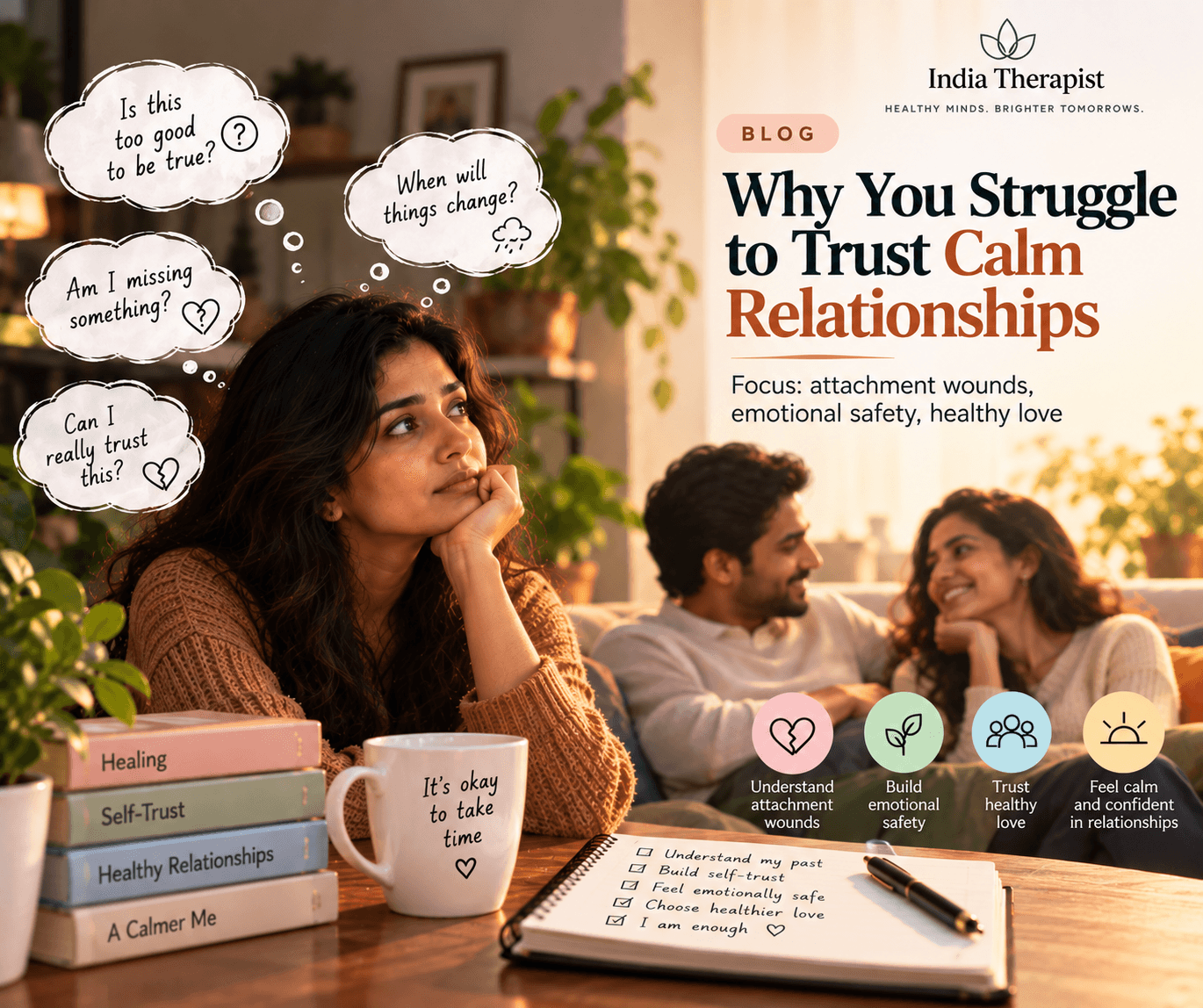
Why You Struggle to Trust Calm Relationships
Why You Struggle to Trust Calm Relationships
Focus: Attachment wounds, emotional safety, healthy love
Calm relationships can feel confusing when your past has taught you that love usually comes with anxiety. If you are used to mixed signals, emotional distance, inconsistency, conflict, or unpredictability, a healthy relationship may not immediately feel comforting. Instead, it may feel unfamiliar, boring, suspicious, or even emotionally unsafe in a different way.
At India Therapist, many people come to therapy saying they want peace in love, but when peace finally appears, they do not know how to relax into it. They may start overthinking, waiting for something to go wrong, or wondering if the connection is “too good to be true.” Therapy helps people understand why calm can feel uncomfortable, how attachment wounds shape trust, and how emotional safety can slowly begin to feel natural instead of strange.
When Chaos Starts Feeling Familiar
Many people do not realize how deeply the nervous system gets shaped by past relationships. If love once meant chasing attention, walking on eggshells, waiting for replies, dealing with hot-and-cold behavior, or managing another person’s moods, your mind may begin to associate intensity with connection.
In that kind of pattern, anxiety can start feeling like chemistry. The emotional highs and lows may create a false sense of depth, even though the relationship is exhausting. Later, when you meet someone steady, respectful, and emotionally available, the relationship may feel less dramatic. Instead of experiencing that as peace, you may interpret it as lack of passion or fear that something is missing.
A therapist in India can help you understand that this reaction is not a sign that you want unhealthy love. It is often a sign that your emotional system became more familiar with chaos than with calm.
Attachment Wounds Can Follow You Into Healthy Love
Attachment wounds often develop when closeness has felt inconsistent, unsafe, rejecting, or emotionally confusing. These wounds can come from childhood, family dynamics, earlier romantic relationships, or repeated emotional disappointment. Over time, they influence how you respond to affection, distance, reassurance, conflict, and commitment.
If you have anxious attachment patterns, you may struggle to trust calm relationships because part of you is always looking for signs of withdrawal. If you have avoidant patterns, calm closeness may feel uncomfortable because emotional safety can make you feel exposed. In both cases, the difficulty is not the relationship itself. The difficulty is the old emotional pattern that gets activated inside it.
An Indian therapist online can help you identify these attachment responses and understand why a healthy relationship may still trigger fear.
Why Emotional Safety Can Feel Unfamiliar
Emotional safety sounds simple, but if you have not experienced it consistently, it may take time to recognize it. Emotional safety means being with someone whose words and actions match, who respects your feelings, who does not use silence as punishment, and who is willing to communicate honestly instead of creating confusion.
But when you are not used to this, emotional safety can feel unsettling. You may question why the other person is being so patient. You may wait for the sudden change, the rejection, or the disappointment that has happened before. Your mind may say, “This cannot be real,” or “I need to stay prepared.”
Therapy helps you learn that unfamiliar does not always mean unsafe. Sometimes it simply means you are finally experiencing something healthier than what you knew before.
Trust Issues Are Not Always About the Present Person
When trust feels difficult, people often assume the problem is the current relationship. Sometimes that is true. But many times, trust struggles are shaped by pain that has not been fully processed from earlier experiences. A calm partner may not be causing your fear, but their consistency may bring your old wounds to the surface.
For example, a kind partner may offer reassurance, but part of you still expects abandonment. A respectful partner may give you space, but your mind may interpret that space as emotional distance. A peaceful disagreement may still trigger panic if past conflict taught you that every argument could lead to rejection.
At India Therapist, therapy helps people separate what belongs to the past from what is actually happening now. This creates more clarity and prevents old wounds from controlling present relationships.
Why You May Mistake Peace for Boredom
One of the most common experiences in healthier relationships is the fear that calm means dullness. If your past relationships were emotionally intense, your nervous system may have become used to that constant stimulation. The drama itself may have created a strong emotional charge.
Then, when you enter a relationship where communication is clear and affection is consistent, your body may not know how to respond. Instead of relief, you may feel restlessness. You may wonder, “Why does this feel different?” or “Why am I not obsessing the way I used to?”
The answer is often simple but surprising: calm love does not activate panic in the same way. It is quieter. It gives you more space to breathe. And for someone who is used to emotional turbulence, that quietness can take time to appreciate.
How Therapy Helps You Build Trust Slowly
Therapy does not force you to suddenly trust more. Instead, it helps you understand your reactions and build safety step by step. A healthy relationship does not require blind trust. It requires observing consistency over time and allowing your nervous system to adjust to something new.
Therapy can help you:
recognize attachment patterns
understand what emotional safety feels like
identify fear-based thoughts
communicate your needs more clearly
build self-trust
separate intuition from anxiety
stay present instead of expecting the past to repeat
Therapy in India often becomes a place where people first practice emotional safety. In therapy, you are not judged for your fears. You are helped to understand them. That understanding makes it easier to bring more awareness into your relationships.
Self-Trust Matters as Much as Trusting Others
Sometimes the real fear is not only about trusting another person. It is about trusting yourself. If you have been hurt before, ignored red flags, stayed too long, or repeated painful patterns, you may worry that you cannot trust your own judgment. That fear can make you suspicious even of good relationships because you are afraid of being wrong again.
Therapy helps rebuild self-trust. You begin to notice your emotional patterns, understand your triggers, and recognize what healthy love actually looks like. Instead of asking, “Can I trust this person completely right now?” you may begin asking, “Can I trust myself to observe, respond, and protect myself if needed?” That shift is powerful.
A therapist online India can help you strengthen this kind of inner trust, which often becomes the foundation for healthier connection.
Calm Relationships Still Need Emotional Work
Healthy love does not mean the absence of vulnerability. A calm relationship may be safer, but it can still bring up fear, grief, and insecurity. In fact, emotional safety may make deeper healing possible because you are no longer spending all your energy surviving chaos.
This is where therapy can be especially helpful. It supports people in learning how to stay emotionally open without becoming overwhelmed. It helps them understand that a healthy relationship is not one where fear never appears. It is one where fear can be faced with honesty, communication, and care.
Relationship counselling India can also help couples understand how past attachment wounds show up in present dynamics, so that one partner’s fear is not automatically misunderstood as lack of love.
Why This Can Feel Harder for Indians and NRIs
For many Indians and NRIs, trust in relationships can also be shaped by family expectations, emotional conditioning, and social pressure. Some people grow up in environments where emotional expression is limited or where conflict is handled indirectly. Others may have experienced pressure to stay in relationships or prioritize stability over emotional wellbeing.
NRIs may also carry added stress around loneliness, identity, and past long-distance or emotionally disconnected relationships. These experiences can make calm love feel even more unfamiliar. NRI counselling mental health support can help people explore how culture, family, and relationship history all shape the way they experience emotional safety.
Healthy Love Often Feels Different Before It Feels Better
One of the most important things to understand is that healthy love may not feel instantly comfortable if your past taught you something different. Calm relationships can feel slow, quiet, and unfamiliar before they start feeling safe and meaningful.
That does not mean the relationship is wrong. It may simply mean your nervous system is learning a new language of connection.
At India Therapist, culturally sensitive therapists in India and Indian therapists online support people with attachment wounds, trust issues, emotional healing, relationship anxiety, and the journey of learning how to receive healthier love.
You do not have to force yourself to trust immediately. You also do not have to run from peace just because it feels unfamiliar.
Therapy helps you understand that healthy love is not supposed to keep you anxious. It is supposed to help you feel safe enough to be yourself. And sometimes, learning to trust that safety is one of the deepest parts of healing.
Ready to talk to someone who understands?
Connect with an Indian therapist who speaks your language and understands your cultural context.